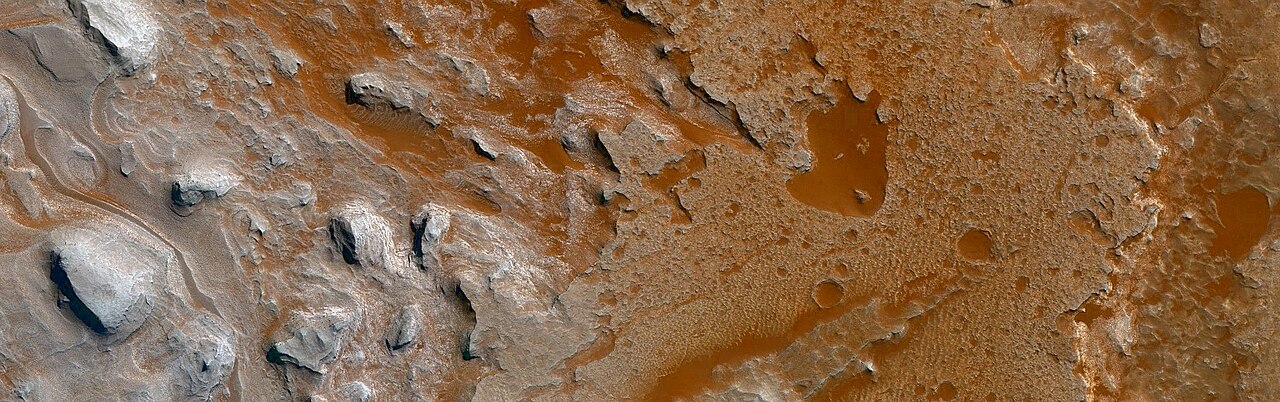
Scientists have spent years asking whether Mars once supported life, and whether any trace of that life might still be preserved in the planet’s ancient rocks. A new NASA-led study is adding fresh urgency to that search. Building on Curiosity rover measurements from Gale crater, researchers report that non-biological processes they tested still cannot fully explain the abundance of certain organic molecules detected in Martian rock. The result does not prove life ever existed on Mars. But it does narrow the menu of plausible explanations, strengthening the scientific case for returning samples to Earth for a closer look. ([science.nasa.gov](https://science.nasa.gov/blogs/science-news/2026/02/06/nasa-study-non-biologic-processes-dont-fully-explain-mars-organics/?utm_source=openai))
The study centers on a set of organic compounds that Curiosity identified in rocks formed billions of years ago in an ancient lakebed. Those molecules, including decane, undecane and dodecane, are among the largest organic compounds yet detected on Mars. On Earth, molecules in this chemical family can be associated with fatty acids, which living organisms make routinely. Mars complicates that picture: organics can also arise through geology, meteorite delivery or radiation-driven chemistry. The new work asked whether those non-living sources could account for what Curiosity found. ([science.nasa.gov](https://science.nasa.gov/blogs/science-news/2026/02/06/nasa-study-non-biologic-processes-dont-fully-explain-mars-organics/?utm_source=openai))
Why this Mars result matters now
The key scientific issue is not whether Curiosity has found “life,” but whether the measurements point to a chemistry that demands a more ambitious explanation. According to NASA’s summary of the follow-on study, the team used laboratory radiation experiments, mathematical modeling and Curiosity observations to estimate how much organic material would have been present before millions of years of cosmic radiation gradually broke it down. That back-calculation suggested the original abundance may have been too high for the non-biological pathways tested to explain on their own. ([science.nasa.gov](https://science.nasa.gov/blogs/science-news/2026/02/06/nasa-study-non-biologic-processes-dont-fully-explain-mars-organics/?utm_source=openai))
This is exactly the kind of result astrobiologists hope for and fear: intriguing enough to justify deeper scrutiny, but not definitive enough to settle the question. In other words, the discovery is a clue, not a conclusion. The researchers themselves emphasized that more work is needed to understand how quickly organic molecules break down in Mars-like rocks under Mars-like conditions, and to determine whether the organics reflect biology, geology or some combination of the two. ([science.nasa.gov](https://science.nasa.gov/blogs/science-news/2026/02/06/nasa-study-non-biologic-processes-dont-fully-explain-mars-organics/?utm_source=openai))
That caution matters because Mars is a chemical puzzle box. The planet has been bombarded by radiation for eons, and its surface rocks have been altered by water, wind and repeated temperature swings. Any potential biosignatures must survive all of that, often in tiny concentrations. So even a compelling molecule is only part of a larger story about mineral context, isotopic patterns, spatial distribution and whether the chemistry fits known non-living mechanisms. ([science.nasa.gov](https://science.nasa.gov/blogs/science-news/2026/02/06/nasa-study-non-biologic-processes-dont-fully-explain-mars-organics/?utm_source=openai))
How Curiosity keeps changing the picture
Curiosity has been roaming Gale crater since 2012, and it has repeatedly shown that ancient Mars was far more habitable than the dry, frigid world we see today. The rover has sampled sedimentary rocks laid down when liquid water was present, giving scientists a chance to study a past environment that could have supported microbial life if life ever got started there. The latest analysis extends that work by focusing not on habitability alone, but on preservation: what chemical traces can still survive after billions of years of exposure? ([science.nasa.gov](https://science.nasa.gov/blogs/science-news/2026/02/06/nasa-study-non-biologic-processes-dont-fully-explain-mars-organics/?utm_source=openai))
That question is central to the broader Mars strategy. NASA and its partners have long argued that some of the most promising evidence for ancient life may be locked inside rock cores, protected from the full fury of the Martian surface. Curiosity cannot return those samples to Earth, but it can identify where the most interesting chemistry is concentrated and how it behaves in the context of ancient mudstones and lake deposits. This latest paper helps sharpen the target list. ([science.nasa.gov](https://science.nasa.gov/blogs/science-news/2026/02/06/nasa-study-non-biologic-processes-dont-fully-explain-mars-organics/?utm_source=openai))
The finding also lands in a moment of heightened interest in Mars organics. Earlier reports, including the 2025 detection of unusually long organic chains, had already pushed the field toward more serious consideration of preserved prebiotic or biological chemistry. The new study does not claim that Mars harbors fossils or living organisms. What it does suggest is that the organics seen by Curiosity may be harder to dismiss as ordinary background chemistry than some models predicted. ([eurekalert.org](https://www.eurekalert.org/news-releases/1077554?utm_source=openai))
What happens next
The next step is not a press conference announcement of life on Mars. It is better laboratory work, better models and, ultimately, sample return. The Curiosity result underscores why planetary scientists have pushed for bringing Martian material to Earth, where sophisticated instruments can test for patterns that rover-sized payloads cannot fully resolve. Earth labs can probe molecular structures, chirality, isotopes and microtextures at a level of detail impossible from billions of miles away. ([science.nasa.gov](https://science.nasa.gov/blogs/science-news/2026/02/06/nasa-study-non-biologic-processes-dont-fully-explain-mars-organics/?utm_source=openai))
For now, the new paper leaves scientists with a sharpened mystery. If the molecules are not easily explained by meteorites or other non-biological inputs, where did they come from? If they are remnants of more complex ancient chemistry, what conditions preserved them? And if they are associated with life, how widespread was that life, and how much of it could still be hiding beneath the Martian surface? ([science.nasa.gov](https://science.nasa.gov/blogs/science-news/2026/02/06/nasa-study-non-biologic-processes-dont-fully-explain-mars-organics/?utm_source=openai))
One thing is clear: Mars is no longer a blank slate. It is a planet that continues to offer chemically specific, scientifically uncomfortable hints that the story of life in the solar system may be more complicated than once imagined. Curiosity’s latest clue does not answer the question. It makes the question harder to ignore. ([science.nasa.gov](https://science.nasa.gov/blogs/science-news/2026/02/06/nasa-study-non-biologic-processes-dont-fully-explain-mars-organics/?utm_source=openai))