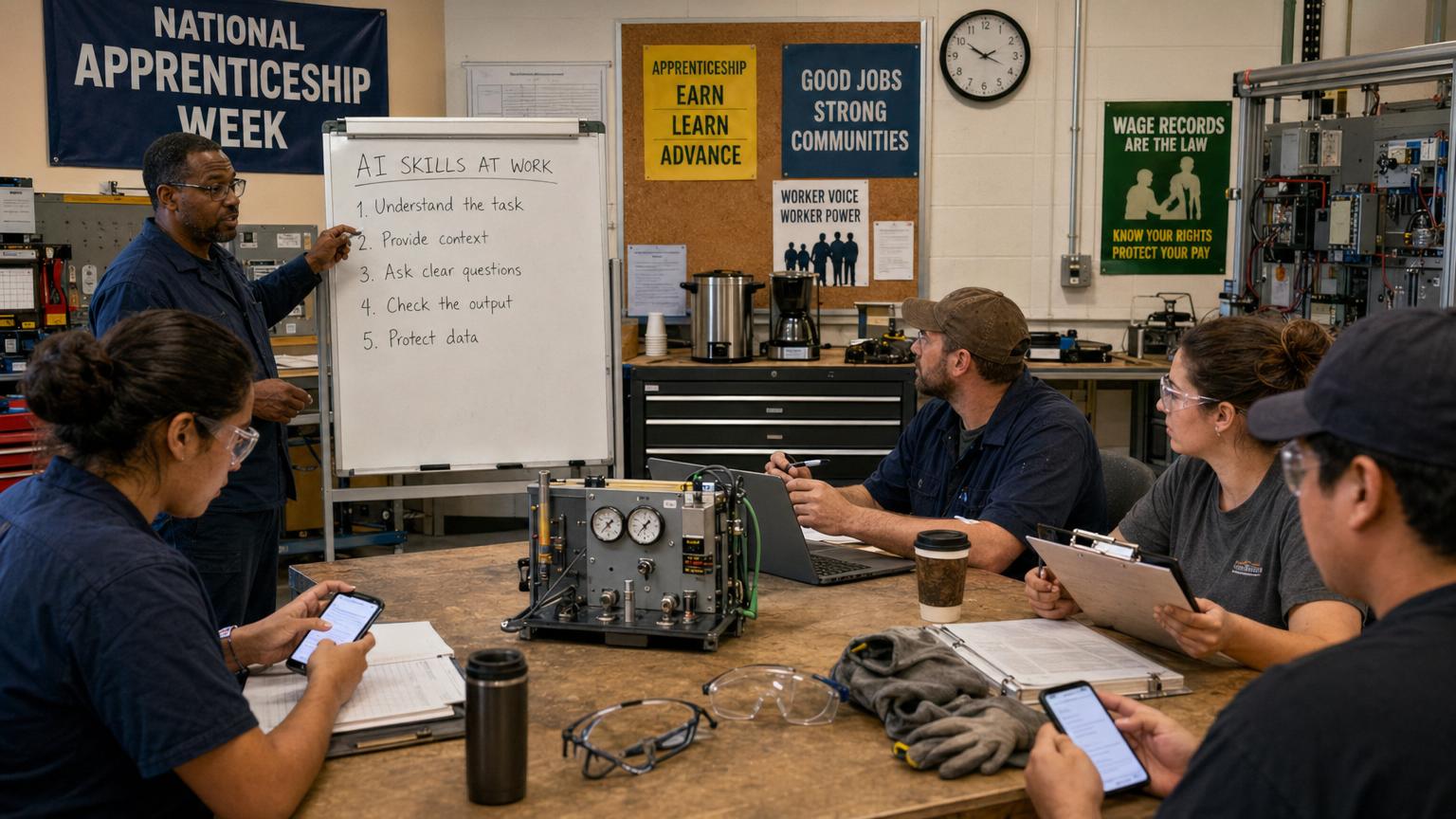
On a normal job-training desk, the props are not glamorous. A sign-in sheet. A stack of safety glasses. A half-empty coffee urn. A poster about wage records. A laptop with a cracked corner. Someone’s phone beside a clipboard because the instructor asked everyone to keep it handy for the first exercise.
This week, the phone is part of the lesson.
National Apprenticeship Week begins today, April 26, 2026, and the Labor Department has given the celebration an AI twist. The department has announced a spring push that links three things that do not usually appear in the same sentence: a voluntary AI literacy framework, a free seven-day course delivered by text message and a national contracting opportunity to put artificial-intelligence skills into Registered Apprenticeships.
The text course is the hook. A worker can enroll by texting READY to 20202. The promise is modest and revealing: one week, about 10 minutes a day, no laptop or home internet required. The curriculum is built around five basic habits: understand AI principles, explore uses, direct AI effectively, evaluate outputs and use AI responsibly. It is not a data-science degree. It is not a guarantee of a job. It is a first knock on a door that, for many workers, has been opened so far mainly by employers, software vendors and people who already have easy access to digital tools.
That is why the apprenticeship piece matters more than the novelty of a federal SMS course. A text lesson can reduce intimidation. It can introduce a warehouse worker, billing clerk, apprentice electrician, small-business employee or community-college student to the idea that AI output must be checked, that prompts need context and that private information should not be casually pasted into a tool. But a text message cannot by itself create supervised practice, paid time to learn, a wage progression, a safe data policy, a bargaining right or an employer commitment. Those are institutional questions.
The Labor Department’s new AI workforce effort should therefore be judged less by whether it can get people to reply to a phone prompt than by whether it can survive the training floor. If AI literacy becomes another badge workers are told to earn on their own time, it will be a cheap label. If it is built into paid work, community-college instruction, apprenticeship standards, union-management agreements and public measurement, it could become something more durable: a public workforce skill for people who are not already inside the first circle of the AI economy.
The course starts where the digital divide still lives
The phone-first design is not a gimmick. It is a concession to the actual shape of digital access in the United States. Most adults have smartphones, but home broadband, laptops, tablets and quiet time to use them remain unevenly distributed by income, education, age, race, geography and disability. The divide is no longer simply online versus offline. It is also about whether someone can do workplace-style digital learning on a full keyboard, with stable connectivity and enough support to move from tapping through an app to using software in a job setting.
That difference is central to AI training. Many consumer AI tools are easy to sample on a phone. A worker can ask for a summary, draft a message or test a prompt during a bus ride. But the uses that matter in a job are often more structured. They may involve an approved enterprise tool, a work order, a customer record, a scheduling system, a quality-control log, a translation review, a claims file or a spreadsheet. The worker has to know not only what the tool can do, but what the workplace allows, what the law requires and who is responsible when the output is wrong.
Workforce organizations have been warning about this practical gap. San Francisco Fed researchers, drawing on 2025 listening sessions with workforce, education and community groups serving lower-income populations, reported that many providers had not yet seen a large increase in local employer demand for specific AI skills. Yet those same groups worried that clients without early exposure would fall behind. They also described a familiar access problem: many lower-income young people use the internet mainly through phones and may not have regular access to desktop or laptop computers, making it harder to learn how AI tools operate in a workplace context.
The Labor Department’s text course is useful because it chooses the most common door. It lowers the first barrier. It does not require a worker to know which platform to try, which tutorial to trust or which course to pay for. That matters. Fear and unfamiliarity can become their own form of exclusion.
But the phone is only an entry point. The harder work begins when a learner needs to move from awareness to practice. A person can learn a prompt formula by text. She cannot learn the judgment required for a hospital billing office, a manufacturing floor, a city permitting desk or a logistics dispatch center without examples, feedback and rules. She needs to see when an
That is where apprenticeships, community colleges and employers become the real classroom.
Why apprenticeships are not webinars
Registered Apprenticeship is not just a training brand. At its best, it is a structured bargain: paid work, on-the-job learning, related instruction, supervision, standards and a credential that is supposed to be portable beyond one employer. The model is better known for construction trades, manufacturing, transportation, public safety and health-care support than for prompt-writing. That is precisely why the AI apprenticeship announcement is worth attention.
The Labor Department’s April 1 initiative asks for a national intermediary to help develop AI-related curricula, training modules and apprenticeship standards; support employers; provide technical assistance; convene stakeholders; and accelerate the use of AI-enabled training models. The department said the work is meant to embed AI tools and curricula into existing apprenticeship programs, include AI in roles that build or apply AI technologies and strengthen pipelines in areas such as telecommunications, advanced manufacturing and data-center-related infrastructure.
The best version of that idea is not to pretend every apprentice should become a machine-learning engineer. It is to put AI where the work already is.
For an advanced-manufacturing apprentice, that might mean using an AI-assisted maintenance log while learning how to verify a diagnosis against equipment history and a supervisor’s inspection. For a telecommunications apprentice, it might mean understanding how software helps plan network work without confusing a model’s recommendation with field conditions. For a medical assistant or health-information worker, it might mean learning when an For a public-sector clerk, it might mean using AI to draft a plain-language notice while knowing when legal review is required. For a small-business employee, it might mean using AI to draft customer responses or inventory notes without uploading trade secrets or customer data to an unapproved system.
That is a different frame from the usual AI boot-camp pitch. It treats AI not as a separate island but as a layer of ordinary work. The question is whether that layer will be taught as part of craft, safety, documentation, privacy and accountability, or whether workers will be left to pick it up alone after hours.
Apprenticeship has its own weaknesses. It can be hard to enter. Some programs are still concentrated in occupations and networks that do not reach women, people of color, people with disabilities or rural workers equally. Completion can vary. Some employers may want the prestige of the apprentice label without the full burden of mentoring and standards. But compared with a generic online certificate, apprenticeship has one major advantage: it ties learning to a job and a wage. That is exactly the discipline AI literacy needs.
The labor market is not telling one story
Policymakers are reaching for training because the evidence on AI and jobs remains unsettled. The most confident forecasts are often the least useful. Some executives and analysts warn of sweeping displacement. Some AI companies promise enormous productivity gains. Workers hear both and wonder whether they are being prepared for a raise, a layoff, a speedup or a new kind of surveillance.
The best current evidence is more complicated. A Federal Reserve note published in April 2026 emphasized that AI adoption looks different depending on what is being measured: the share of firms using AI, the share of workers using generative AI at work, or the share of workers employed by firms that have adopted AI. Large firms matter because they employ so many people and because they are often heavier adopters. That means a worker may be inside an organization where AI is present even if the worker is not yet using it directly.
A separate analysis based on corporate executives found little evidence that AI had already reduced overall headcount across surveyed firms, and little expectation of broad near-term employment shrinkage. But the same work pointed to changes in the composition of work. Firms expected the share of routine clerical workers to decline and skilled technical roles to increase. That is the kind of shift workers feel even when the unemployment rate does not jump: fewer openings in one lane, more pressure to move into another, and more ambiguity about which skills will remain valuable.
The New York Fed’s Survey of Consumer Expectations added a more human number. Among employed respondents, about 38 percent said training in how to use AI tools was important to them, but only 15.9 percent said their employer currently offered any AI training. The gap was especially important because some workers who valued AI training most, including those without a college degree, also had lower rates of AI use and less access to employer-provided training.
This is the public-policy opening. If employers provide AI training mainly to workers who already have college degrees, confidence and high-quality digital access, the technology could widen existing divides. If public workforce systems can reach people before those gaps harden, they may make the tools less exclusive.
There is no guarantee. Workforce training has a long American history of being asked to solve problems larger than training: plant closures, weak bargaining power, regional decline, discrimination, child-care shortages, transportation problems, disability access, credential inflation and the pressure to take any available job quickly. AI does not erase those constraints. It adds a new one.
A badge is not a bargaining position
The strongest critique of the AI-literacy boom is that training can be used to shift responsibility from institutions to individuals. If you lose work, why did you not reskill? If your job changes, why did you not take the course? If the tool makes a mistake, why did you not catch it? If your productivity target rises, why are you not using AI better?
That logic is dangerous because it treats workers as the only adjustable part of the system. Employers choose tools. Vendors design them. Managers decide whether training happens on the clock. Procurement officers decide whether privacy and security rules are real. Government sets labor standards and funds public training. Schools and community colleges decide what can be taught at scale. A worker who has completed a seven-day text course is better informed than before, but not suddenly powerful.
Labor groups have been explicit about this point. The AFL-CIO’s worker-first AI principles call for worker input, collective bargaining, notice, protection from harmful surveillance and real support if AI changes or eliminates jobs. In that view, training is necessary but nowhere near sufficient. A cashier, dispatcher, claims processor, warehouse worker, paralegal, teacher or nurse can understand an AI tool and still have no say over whether management uses it to intensify work, reduce staffing, monitor speech, manipulate schedules or evaluate performance with a flawed metric.
That does not make AI literacy useless. It means literacy should be tied to power. Workers need enough understanding to use tools well, question bad outputs, identify risks and participate in decisions. They also need rules that make participation meaningful. A worker who knows a scheduling algorithm is unfair but has no channel to challenge it has been educated into frustration.
This is where apprenticeship can help if it is done carefully. In a strong apprenticeship, skills are not aspirational slogans. They are written into standards, taught over time, observed, measured and connected to wages. If AI skills enter that structure, they can be less flimsy than the average badge. If they are pasted onto job descriptions without paid practice or worker voice, they will become another line of credential clutter.
The old training system has old scars
Public workforce programs have produced real successes, but the record is uneven. Evaluations of earlier federal adult and dislocated-worker programs found that services can help, but training impacts are not automatic and depend on program quality, local labor demand, participant circumstances and whether credentials match real jobs. Researchers have repeatedly noted barriers that do not fit neatly on a course syllabus: child care, transportation, housing instability, disability accommodations, digital access and the need to earn money while training.
AI training will inherit all of that. A laid-off administrative worker may not be deciding between an AI course and leisure. She may be deciding among rent, child care, a part-time job, a bus schedule and a certificate that may or may not lead to an interview. A rural worker may have a phone but no reliable broadband or nearby lab. An older worker may have deep industry judgment but less comfort with new software. A younger worker may know apps well but lack the workplace context to know when an AI answer is confidently wrong.
That is why serious AI workforce policy must pay attention to boring supports. Time to learn. Devices. Broadband. Instructors. Employer commitments. Clear standards. Labor-market information. Transportation. Child care. Translation and disability access. A way to test whether a credential produced a raise, a promotion, a safer workplace or a better job rather than only a completion certificate.
Without those supports, AI literacy risks becoming the new computer literacy: universally demanded, unevenly taught and often assumed rather than paid for.
States and colleges are already improvising
Washington is not starting from an empty page. State workforce agencies, community colleges, industry groups and philanthropies are already assembling their own AI-readiness experiments.
California’s Employment Development Department has circulated the Labor Department’s free text-based AI course to workforce partners, emphasizing that it can be completed in seven days and that the phone numbers used for enrollment are for course delivery rather than marketing. Ohio’s JobsOhio and the Enterprise Technology Association have launched an AI Ready Ohio pilot tied to foundational AI training, mentorship and certification pathways. New Jersey’s community-college system has announced a U.S. Department of Labor-recognized Machine Learning Data Scientist and AI Registered Apprenticeship model. Austin Community College has announced a human-centered AI initiative that includes workforce and business training as well as student-support uses.
The National Science Foundation’s TechAccess: AI-Ready America program points in the same direction at a larger scale. It is designed around state and territory coordination hubs, with 2026 and 2027 deadlines, and it explicitly links AI readiness to partnerships among workforce systems, education, employers, small businesses and local priorities.
These examples show the range of the field. Some programs are basic literacy. Some are advanced technical pathways. Some are regional economic-development efforts. Some are community-college attempts to reorganize training around AI while still serving students who need credentials, transfer pathways and jobs. The range is healthy, but it creates a measurement problem.
What counts as success? A text-course completion? A digital badge? A better resume? A raise? A promotion? Fewer layoffs? Safer use of customer data? More small businesses adopting tools well? More workers able to challenge bad AI output? More apprentices completing programs in industries that actually hire?
If everything counts, nothing counts. The next stage of AI workforce policy needs harder evidence. Ribbon cuttings and dashboards will not be enough.
The jobs are not all in tech
It is tempting to hear AI training and picture only data scientists. Those jobs do matter. The Bureau of Labor Statistics projects data-scientist employment to grow much faster than average from 2024 to 2034. Its broader 2024-34 projections also link AI adoption to demand for software developers, information-security analysts, computer and information research scientists, computing infrastructure providers and data-processing services.
But the larger workforce story is not simply the creation of AI jobs. It is the spread of AI tasks into non-AI jobs.
A restaurant owner may use AI to draft menu descriptions or analyze reviews. A paralegal may use it to summarize documents, then verify every citation. A maintenance technician may use it to interpret sensor output. A teacher may use it to generate practice questions while deciding what helps a particular student. A county worker may use it to translate a public notice but must know when a translation has legal consequences. A union steward may need to understand a scheduling algorithm well enough to bargain over it. A home-health administrator may use AI to draft care-plan reminders while protecting patient information.
That is why the phrase AI literacy can be both useful and slippery. It should not mean that every worker becomes a technologist. It should mean that more workers can understand the tool’s limits, ask better questions, protect sensitive information, verify outputs and know when human judgment or a formal rule controls the decision.
In many occupations, domain knowledge may become more important, not less. The worker who knows the building, the patient, the machine, the statute, the customer, the route or the classroom can catch errors that a general-purpose tool cannot see. A good AI lesson for a 52-year-old supervisor should not imply that her experience is obsolete. It should show how that experience helps her catch the machine being wrong.
The small print should be part of the lesson
Any public AI course should teach one sentence early: do not put secrets into a tool you do not understand.
Responsible use sounds abstract until it becomes a customer list, patient note, student record, personnel file, bid document, union grievance, proprietary recipe, safety report or trade secret. A worker told to experiment with AI needs to know which tools are approved, what data can be entered, who can see the output, where the output is stored, what must be verified and who signs off.
This is especially important in small businesses and small public agencies. Large organizations may have legal departments, procurement reviews, security teams and compliance officers, although even they often move messily. Smaller employers may adopt consumer tools faster because they are cheap and easy. That can help them compete. It can also create privacy, accuracy, recordkeeping and labor risks they do not fully see.
An apprenticeship approach can make the small print concrete. Instead of teaching prompt-writing in isolation, an instructor can ask: What information in this work order is private? What part of this output must be checked against the manual? What would you do if the AI recommends a shortcut that violates safety practice? What should be documented? Who is accountable?
That is not anti-technology. It is shop-floor realism.
Congress likes training because training sounds agreeable
AI has produced bitter fights over copyright, safety rules, state regulation, energy, national security, market power and liability. Workforce training is one of the few AI topics on which many politicians can nod in the same room.
House lawmakers have been holding hearings under the Building an AI-Ready America banner, including an April 15, 2026, hearing on AI’s economic impact on workers and employers. A bipartisan AI workforce training tax-credit proposal has also been floated, aimed at encouraging businesses to pay for qualified AI training expenses. The broad theme is politically attractive: help workers adapt, help employers compete, keep the United States technologically strong.
The details are harder. Who pays for training? Does it happen on the clock? Can the worker take the credential to another employer? Are vendors evaluated? Do programs reach low-wage workers or mainly the already advantaged? Does training come with protections against displacement and surveillance? Is public money going to skills that are genuinely useful, or to fashionable products with weak evidence?
The Labor Department’s apprenticeship funding and contracting announcements add useful structure, but they do not answer all of those questions. A national intermediary can develop standards and curricula. A grant can encourage states and employers to expand programs. A text course can introduce vocabulary. But the quality of implementation will depend on the institutions closest to the work: apprenticeship sponsors, unions, employers, community colleges, workforce boards, state agencies and instructors.
AI literacy may be the easy phrase everyone can agree on. The fight will be over whether it is funded, measured and attached to worker power.
The useful lesson is humility
The best AI training should not sell certainty. It should teach judgment.
Large language models can draft, summarize, brainstorm, translate and code. They can also make things up, reproduce bias, misunderstand context, omit key facts and sound more certain than the evidence allows. Other AI systems, including image recognition, predictive models and optimization tools, have their own strengths and failure modes. A workforce lesson that treats AI as magic will make workers less safe. A lesson that treats AI as irrelevant will leave them unprepared.
The worker needs more than a prompt formula. The worker needs a habit: ask what the tool is good at, what evidence supports the answer, what data it used, what could go wrong, who might be harmed and when a human rule, law, safety standard, contract or professional duty controls the decision.
This is why the apprenticeship door is more interesting than the press release. Apprenticeship is built around supervised practice. You do not learn wiring by reading one tip sheet. You do not learn welding by watching one video. You do not learn patient care by passing a vocabulary quiz. You learn under standards, with feedback, around people who can say: not like that.
AI work needs some of that same humility. Not because using a chatbot is as physically dangerous as a live wire, but because AI errors can travel quickly through paperwork, decisions and trust.
The phone buzzes, then the real work begins
Imagine the first morning of a workforce class. The instructor asks everyone to take out a phone. A warehouse worker, a displaced billing clerk, a 19-year-old apprentice, a veteran, a small-business owner and a community-college student all see the same opening question: What is your level of experience with AI?
That is a modest beginning. It is also a revealing one. The country is trying to build an AI workforce strategy in real time, while the technology, the job market and the politics keep moving. Nobody knows exactly which tasks will be automated fastest, which occupations will grow, which credentials will still matter in five years or how much displacement will show up as layoffs rather than slower hiring, lower wages or degraded job quality.
But some things are already clear. Workers without access to training can fall behind even when their jobs are not immediately eliminated. Employers cannot get the full benefit of tools their staff do not understand. Public workforce systems cannot treat AI as a coastal specialty. And training that does not come with job quality, worker voice and real measurement will not carry the weight being placed on it.
A text message can knock on the apprenticeship door. It cannot build the room. That job belongs to the institutions on the other side: employers, unions, community colleges, workforce boards, state agencies and Congress. If they do it well, AI literacy could become a practical public skill. If they do it poorly, it will become one more password workers are told to remember while the workplace changes around them.