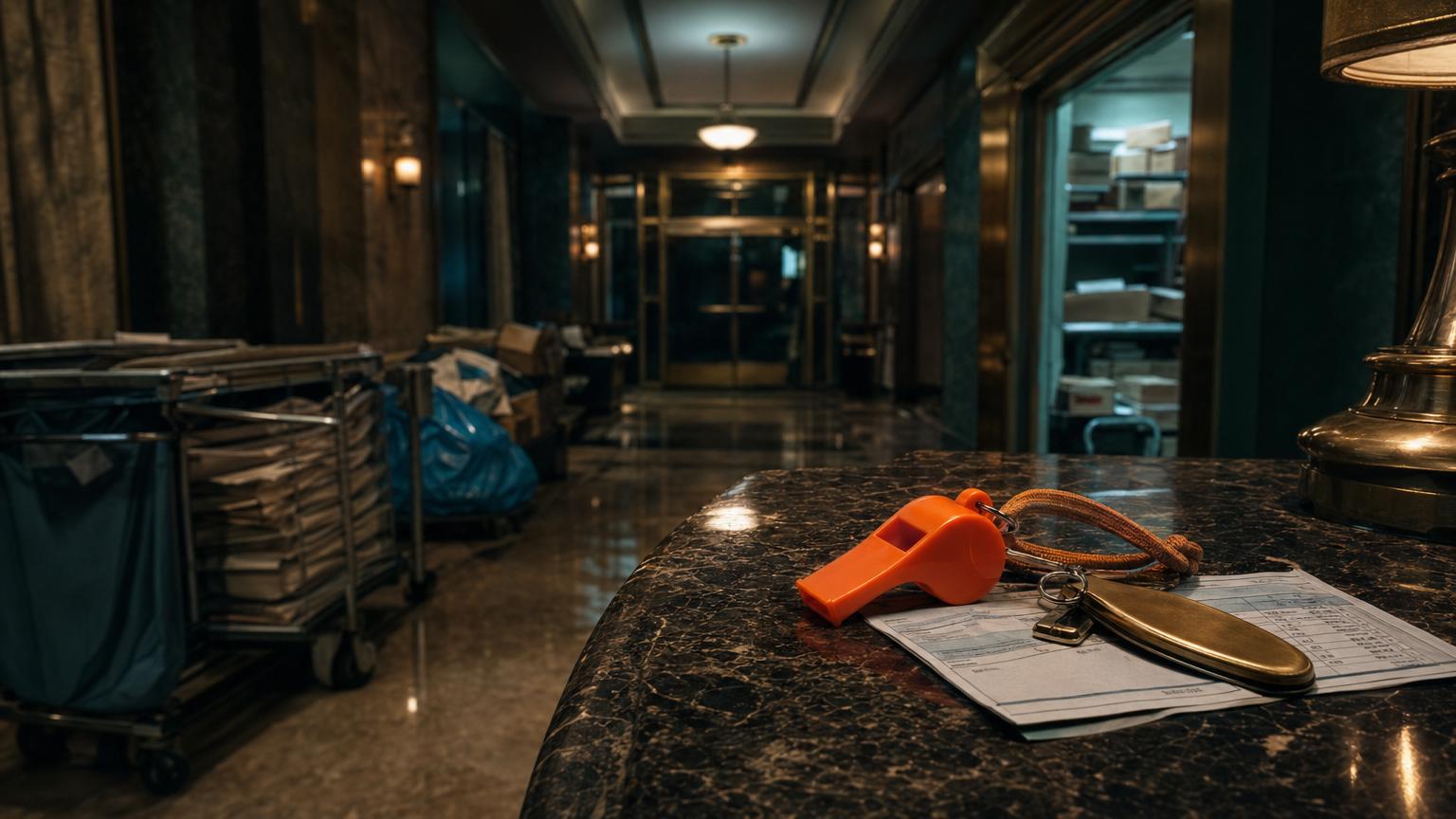
The most important economic machinery in New York last week may not have been on a trading floor, in a bank tower or inside a mayoral budget office. It may have been behind a lobby desk, beside a package cart, under a boiler-room light, or at the curb where a porter knows exactly which recycling bags will leak.
On April 17, 2026, 32BJ SEIU, the union representing New York City residential building service workers, announced a tentative four-year agreement with the Realty Advisory Board on Labor Relations, known as RAB. The union says the master agreement covers nearly 34,000 doorpersons, porters, handypersons, superintendents and resident managers who maintain about 600,000 households in roughly 3,500 co-ops, condos and apartment buildings. RAB confirmed that a tentative renewal agreement had been reached, while saying details would follow ratification by the union membership and RAB board.
That word, tentative, is the first guardrail around the story. This is not yet a finished contract. Workers are expected to vote by May 28. But the near-strike already revealed a piece of New York’s household economy that usually tries to be invisible. If the old contract had expired at midnight on April 20 without a deal, the Associated Press reported, a strike would have affected the homes of an estimated 1.5 million people and would have been the first walkout by these workers in 35 years.
The disruption would not have looked like one single shutdown. It would have looked like a thousand small improvisations: residents staffing doors, boards circulating emergency memos, packages piling up, trash rooms turning experimental, renovations pausing, contractors losing access, elderly residents wondering whom to call, and building managers trying to keep elevators, water, heat and hallway life moving with fewer hands.
The tentative agreement’s brightest number is easy to remember: $4.50 an hour in wage increases over four years. The union also says the deal includes a 15% increase to guaranteed pension benefits, maintenance of health coverage with no employee premium sharing, and protection against a two-tier workforce for future hires. AP reported that average annual wages for a doorperson or porter would rise from about $62,000 now to about $71,000 in four years. Habitat, a co-op and condo trade publication, reported that the weighted average annual wage increase under the agreement is 3.48% and that RAB expects the typical employee’s total wage to exceed $71,000 by the contract’s end.
That is the money story: New York appears to have chosen, at least for this group of workers, to preserve a familiar middle-income union job with family health care, a pension and a raise. The next question is who can absorb the bill.
Lobby work is not just a smile
The word doorman can make the job sound ornamental, like a brass button on a coat. The real work is less decorative. Residential building service workers receive deliveries, handle move-ins, respond to leaks, shovel snow, call emergency help, clean hallways, manage trash rooms, monitor contractors, keep watch over building systems and often serve as the human memory of a building.
That memory has economic value. A building without reliable staff is not merely less elegant. It can become less safe, less efficient and more expensive to run. A delayed leak can become a ceiling claim. A mishandled trash room can become a pest problem. A poorly supervised contractor can become a repair bill. A resident who needs help during a medical emergency may not care whether the person at the desk is in a job category called concierge, doorperson, porter or resident manager. Dense vertical life depends on people who know the building.
That point matters because the buildings covered by the agreement are easy to caricature. Yes, some are luxury co-ops and rentals in very expensive neighborhoods. The strike authorization rally took place on Park Avenue, which is not exactly subtle symbolism. But 32BJ says the agreement covers co-ops, condos and apartment buildings across Manhattan, Brooklyn, Queens and Staten Island, and the households behind those doors are not all the same. Some residents are renters. Some are older co-op shareholders on fixed incomes. Some stretched to buy an apartment and now read maintenance notices with the dread other people reserve for medical bills.
That mix is why the contract argument was so sharp. Workers said they needed wages and benefits that could keep up with New York. Owners and boards said they were also facing rising costs: insurance, fuel, repairs, taxes, regulation, building-safety work and climate-compliance requirements. Both claims can be true. A city can be too expensive for the worker at the desk and too expensive for the resident upstairs.
What $4.50 means when everything else moved too
The raise is simple in arithmetic and complicated in life. A $4.50 hourly increase, multiplied by 2,080 hours for a full-time year, equals $9,360 more per year by the end of the contract before taxes, assuming the full raise applies and hours stay steady. That is meaningful money. It is not a fortune in a region where housing, groceries, insurance, transportation, child care and medical costs can rearrange a paycheck before it reaches the kitchen table.
The inflation backdrop explains why the union made wages central. The Bureau of Labor Statistics reported that prices in the New York-Newark-Jersey City area rose 4.0% over the year ending in March 2026. Energy prices rose 17.1% over that same period. Food was up 3.3%. Shelter was up 3.9%, including a 3.7% increase in rent of primary residence. BLS also warns that local price indexes are more volatile than national measures because they use smaller samples and are not seasonally adjusted, so the numbers should be read as a useful signal rather than a private budget for any one worker.
Those figures still capture the union’s basic argument: a paycheck can look stable on paper while its buying power keeps taking small hits. A worker with a stabilized apartment, two children and a long commute does not experience inflation the same way as a worker sharing a room near the job. A superintendent with employer health coverage faces a different monthly budget than a porter paying off medical debt. But for many households, the direction is familiar. The same dollars have been asked to cover more.
New York’s legal wage floor also shows how unusual this job standard is. As of Jan. 1, 2026, the minimum wage is $17 an hour in New York City, Long Island and Westchester, according to the state Labor Department. A residential building-service job averaging roughly $62,000 and moving toward about $71,000 is far above that floor. That does not make it lavish. It makes it a union job whose compensation is shaped by bargaining power, not merely by the market price of cleaning, checking, carrying and responding.
The MIT Living Wage Calculator is useful here as a reminder, not a verdict. It estimates the income required for basic needs in a specific place and household type. It is not a law, and it is not a contract demand. But its blunt lesson fits this story: a salary that sounds middle class in a national conversation can still feel thin in Manhattan, Brooklyn, Queens or the suburbs where many service workers live.
Health care was the quiet giant
In a wage fight, the raise is the number that travels fastest. The health plan may be the larger economic prize.
The tentative agreement preserves health care with no employee premium sharing, according to 32BJ and multiple news accounts. Premium sharing means workers pay part of the regular insurance premium out of their paychecks. For many families, that can act like a pay cut even when the hourly wage goes up. A worker who gets a raise but starts paying hundreds of dollars a month for family coverage may discover that the raise has already been eaten before groceries enter the picture.
RAB had been seeking relief on health-fund costs, according to AP. The tentative deal appears to give owners some break on payments into a health fund that had built a reserve, according to RAB President Howard Rothschild’s comments reported by AP. That detail complicates any easy victory lap. The workers protected a central benefit. The owners appear to have won some cost relief. The result is not simply labor defeats management, or management caves to labor. It is a negotiated adjustment inside a very expensive American health-care system.
That matters beyond New York. Employer-sponsored health insurance is one of the hidden foundations of the American middle class. It is also one of its traps. Workers prize it because losing it is frightening. Employers resent its cost because it is volatile and hard to control. Unions fight to protect it because a strong health plan can be as important as a wage increase, especially for families, older workers and people managing chronic conditions.
In this contract, the lobby economy is also the insurance economy. A building worker’s take-home pay depends not only on the hourly rate but on whether the paycheck has to carry a family premium.
The owners’ ledger is not imaginary
It would be easy, and popular in some neighborhoods, to cast every building owner as a marble-column villain. That would be lazy economics.
RAB represents co-op and condo boards as well as other residential building owners. A co-op board may be a group of residents rather than a distant corporation. Some buildings have wealthy shareholders. Others have retirees who bought decades ago, limited-equity owners, or middle-income households allergic to every new assessment because it lands like a second rent.
The city’s Rent Guidelines Board offers one window into building costs, though its data focuses on buildings containing rent-stabilized apartments rather than the entire 32BJ universe. Its 2026 Price Index of Operating Costs found that operating costs for buildings with rent-stabilized apartments rose 5.3% from April 2025 to March 2026. Fuel rose 11.0%. Insurance costs rose 10.5%. Maintenance rose 6.0%. Utilities rose 5.6%. Labor costs rose 3.0%.
Those numbers do not prove that every landlord is squeezed. The board’s 2026 Income and Expense Study also found that average net operating income, a measure of income left after operating costs but before debt service and some other expenses, grew 6.2% from 2023 to 2024 in the studied stock. Looking over a much longer period, the study said inflation-adjusted net operating income was up 56.6% citywide from 1990 to 2024.
Those facts sit in tension. Costs are rising. Owner income has also risen over many periods. Averages can hide both a strong balance sheet and a fragile one. A large, high-rent building in a prime neighborhood and a smaller building with heavy debt, aging systems and regulated rents can live in different financial weather while appearing in the same public argument.
The tension is especially visible in co-ops and condos. Those owners cannot always pass along higher costs in the same way a landlord raises market rent. Boards may increase monthly maintenance or common charges, levy assessments, borrow, defer repairs or cut services. Every choice has consequences. Higher charges can strain residents. Deferred repairs can become larger bills later. Service cuts can reduce quality of life and property value. Borrowing can keep the lobby calm today and make the future more expensive.
Renters are watching another scoreboard
For renters, the 32BJ agreement sits inside a housing market that already feels like musical chairs with too few chairs.
New York City’s 2023 Housing and Vacancy Survey found a citywide net rental vacancy rate of 1.41%, down from 4.54% in 2021. The vacancy rate in rent-stabilized housing was 0.98%. The official summary from the city’s housing agency said units renting for under $2,400 had a vacancy rate below 1%. In plain English, the lower-price part of the rental market had almost no slack.
More recent private-market indicators show the pressure continuing. StreetEasy reported that Manhattan’s median asking rent reached $4,750 in March 2026, up 7.5% from a year earlier and the highest in its records. Its citywide median asking rent was $3,995. NYCEDC’s April economic snapshot said a rental price index was up 6.8% year over year and 30% since February 2020.
Those are asking-rent measures, not what every tenant pays. They are heavily shaped by available listings and market-rate units, not by the whole universe of occupied apartments. But they describe the environment in which workers and residents bargain with life. When rents are high and vacancies are scarce, a raise can disappear into housing. When building costs rise, landlords argue that rent restrictions and other regulations limit their ability to cover payroll and repairs. When rent increases are allowed, tenants argue that they are already paying for everything twice: once in rent and again in the anxiety of not being able to find another place.
The 32BJ agreement does not solve that. It adds one more claim to the city’s crowded ledger: the person who keeps the building working should be able to live somewhere in or near the city that needs the work.
A strike averted is not a problem solved
The deal avoided a rare event. AP reported that the union’s last strike, in 1991, lasted 12 days. That memory hovered over the talks not because history repeats neatly, but because a building strike in New York is unusually visible. It puts class, convenience and dependency in the same elevator.
In the days before the tentative agreement, thousands of workers rallied on Park Avenue and authorized a strike if talks failed. AP reported that Mayor Zohran Mamdani and other local Democratic officials appeared with workers. The optics were powerful: workers who serve some of the city’s most expensive buildings gathered in one of its most expensive corridors to say the city could not take their labor for granted.
The most interesting part of the agreement may be what did not happen. The union says it defeated a two-tier workforce proposal. A two-tier system generally means newer hires receive lower pay, weaker benefits or a slower path than current workers. Employers often seek tiers to control future costs without cutting current workers directly. Unions resist them because they can split a workforce by age and start date, making solidarity harder and turning today’s new-hire discount into tomorrow’s standard job.
New York’s building-service contract is therefore a small but vivid piece of a national labor question: can unions preserve a single standard for future workers, not just protect current members?
That question travels. Across the economy, employers are trying to contain benefit costs, automate tasks, use contractors or create new job classifications. Workers are trying to defend predictability: a wage scale, a health plan, a pension, a grievance process, a schedule that does not change by text at midnight. BLS reported that the national union-membership rate was 10.0% in 2025 and that the private-sector rate was 5.9%. New York remains one of the country’s most unionized states, though BLS cautioned that 2025 state estimates should be interpreted carefully because of data disruptions tied to the federal government shutdown.
In that sense, this local deal is also a glimpse of what remains possible where unions still have density. It is not a model that can simply be photocopied onto every service job. The residential building industry has its own geography, labor history and resident-facing pressure points. But it does show how a union can make an otherwise quiet job standard hard to cut quietly.
The climate bill under the lobby rug
Another reason building owners and boards are nervous has little to do with the front desk and much to do with basements, boilers and carbon.
Local Law 97, New York City’s building-emissions law, requires most buildings larger than 25,000 square feet to meet greenhouse-gas limits, with stricter limits coming in 2030 and a city goal of net-zero emissions by 2050 for the largest buildings. The Department of Buildings says buildings are responsible for more than two-thirds of New York City’s greenhouse-gas emissions. The law is meant to push energy efficiency and cleaner systems.
For co-op and condo boards, that can mean planning for expensive work: insulation, controls, heat pumps, boiler changes, engineering reports and financing. On April 22, the city said roughly 93% of covered privately owned properties had filed required Local Law 97 compliance reports. DOB staff were auditing filings from approximately 28,000 buildings, and the city said additional property-specific compliance data would be made public later. The Real Deal, citing the city’s release, reported that roughly 1,400 properties required to submit paperwork had failed to do so and were facing enforcement steps if they did not file within 60 days.
The early compliance figures are encouraging, but they do not erase the harder 2030 question. Sustainability experts and real estate groups have long warned that the first compliance period would be easier for many buildings than the next one. The Urban Land Institute New York and the Mayor’s Office of Climate and Environmental Justice have also warned that co-ops face special challenges because retrofit costs may fall directly on residents, especially in limited-equity buildings that provide affordable housing for low- and middle-income New Yorkers.
None of that cancels the case for worker raises. It does explain why boards may feel as if every line of the budget is turning red at once. A building can face higher insurance, higher fuel, wage increases, facade work, elevator repairs and climate compliance in the same planning cycle. The resident’s maintenance bill then becomes a crowded envelope containing labor policy, climate policy, insurance markets, aging infrastructure and New York’s housing shortage.
Why the deal matters beyond buildings with awnings
The 32BJ agreement is easy to caricature because doorman buildings are easy to caricature. But the deal should not be dismissed as a luxury-sector curiosity.
First, it covers a large group of workers in an expensive city. Nearly 34,000 jobs is not small. These are not app engineers with stock options or Wall Street bonus recipients. They are workers whose compensation comes from collective bargaining in a service economy that often pays far less. BLS data for the New York metropolitan area show that the broader building and grounds cleaning and maintenance occupational group had a mean hourly wage of $22.74 in May 2024. A unionized residential building job paying much more than that is a reminder that job quality is not fixed by the task alone. It is shaped by who has bargaining power.
Second, the contract protects a benefit structure that is increasingly rare: employer-covered health care without premium sharing and a pension improvement. A pension is retirement income promised according to a formula, rather than an individual savings account whose value depends on contributions and markets. Pensions are not magic; they must be funded. But for workers, they shift some retirement risk away from the individual.
Third, the contract shows how local wages ripple through local households. A raise paid to a porter in Queens may become grocery spending, rent, remittances, school supplies, debt payments or a little less overtime. It may also become a higher maintenance fee for a co-op shareholder or a cost line in a landlord’s rent argument. Money does not stop at the lobby desk. It circulates.
Fourth, the contract is a political signal. In a city where many service jobs are precarious, 32BJ is saying the standard job should not be allowed to erode quietly through premiums, tiers and temporary labor. RAB is saying the residential real estate sector cannot be treated as an endless wallet. The tentative deal is the point where those claims met, not the place where either side’s worries vanished.
What to watch before May 28
The next practical question is ratification. Workers still have to vote. Members may celebrate the health-care and pension protections while debating whether $4.50 over four years is enough. Some labor-left critics have argued that the wage gains do not fully match New York’s cost pressure. That critique deserves to be taken seriously, even if it does not represent every worker. A tentative agreement can be both a win against employer givebacks and a compromise that leaves some members wishing for more.
Employers and boards will also study the fine print. The timing of wage steps, health-fund contribution relief, training provisions, pension details and work-rule language will matter. So will the way different buildings budget the increases. A large luxury rental tower, a small co-op, a mixed-income building and a rent-stabilized property may feel the same master agreement differently.
Residents should watch their own notices. If maintenance fees, common charges or rents rise, the contract may be named as one reason. It probably will not be the only reason. Insurance, debt service, repairs, taxes, energy, facade requirements and climate compliance all belong in the pile. The honest building budget is rarely a single-cause story.
City officials should watch the larger pattern. New York’s economy depends on workers whose jobs cannot be done remotely: cleaners, porters, aides, guards, cooks, delivery workers, transit workers, child-care workers and home-care workers. If the city wants them present, it has to care about their pay. If it wants housing to remain livable for residents, it has to care about building costs. If it wants emissions cuts, it has to care about retrofit finance. These are not separate policy boxes. They meet in the same lobby.
The near-strike ended with relief, not triumph. Packages kept moving. Trash kept leaving. Boilers kept being checked. Residents did not have to learn, in one chaotic week, how much work lives behind a clean hallway.
That may be the real value of the deal: it made visible an economy that usually succeeds by disappearing. The person at the door is part of the city’s price system, health-care system, retirement system, housing system and climate-transition system. The $4.50 raise is not enough to explain all of that. It is just the small, bright number that opened the door.