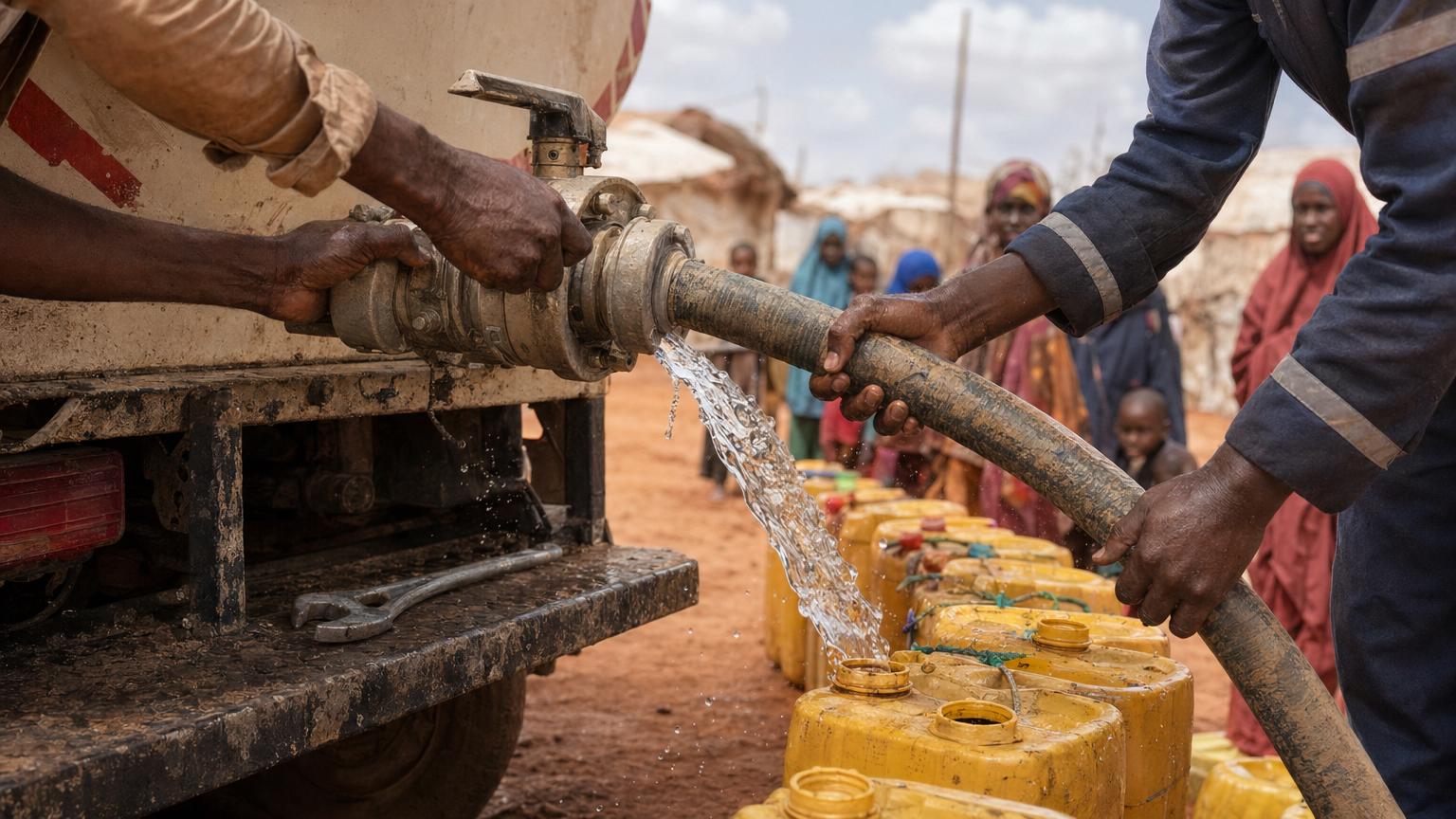
The most important machine in a drought camp is not always a generator, a phone tower or a satellite terminal. Sometimes it is a truck valve turned by hand.
If the valve opens, water slaps into yellow jerrycans. If the truck has fuel, it can come back tomorrow. If the road is passable, the next neighborhood may get a delivery too. If the money keeps arriving, the hose keeps moving.
That chain is now under strain in Somalia. On April 24, the International Organization for Migration, the United Nations agency that tracks and assists people on the move, said nearly 62,000 people had been displaced by drought in five Somali districts since the start of 2026. The districts named in IOM reporting — Baidoa, Dayniile, Kahda, Diinsoor and Doolow — are not an abstract map of climate stress. They are places where families decide whether to stay with failing wells, sell a weak animal, walk to a clinic, board a truck, or join the edge of a city that is already short of shelter and water.
The number is alarming, but it is also partial. At a UN Geneva briefing, Brian Kelly, IOM’s senior programme coordinator in Somalia, said the five-district count did not capture the whole country and that the national figure could be more than 300,000. Other reporting using broader humanitarian displacement counts has put this year’s total above 500,000, with drought driving most of the movement. Those figures should not be mashed together as if they came from one ledger. They are a warning about the same problem: the measurable part of this crisis is already large, and the unmeasured part may be larger.
IOM’s Displacement Tracking Matrix, a system that monitors movements of people during crises, projects that roughly 125,000 more people could be displaced by drought between April and the end of June even if the Gu rains perform normally. Gu is Somalia’s main April-to-June rainy season. That last point sounds strange until you stand in the timeline of a drought. Rain can fall and still arrive too late for a household that has already lost livestock, seed, debt capacity, transport money and safe water. A green patch on the landscape does not automatically refill a family’s balance sheet. A herd does not rebuild in a week. A failed harvest does not jump back into the granary because the sky finally changed its mind.
The crisis has a local address
Baidoa, in Somalia’s Southwest State, has become one of the central addresses of this emergency. It has seen this role before: a city asked to absorb people pushed from farms and grazing areas by drought, insecurity and hunger. This time, the new arrivals are part of a broader national deterioration after poor 2025 Deyr rains — the October-to-December season — and a harsh Jilaal dry season, which usually runs from January to March.
In a neat disaster chart, drought sits in one box, conflict in another, prices in another and disease in another. Somalia does not have the luxury of neat boxes. Water scarcity weakens crops and animals. Weak crops and animals cut income. Less income means people buy less food at the very moment food prices rise. The walk to water grows longer. The walk to a clinic grows more expensive. A child who is hungry becomes more vulnerable to diarrhea, measles or cholera. A family that moves to a city may find safety from one danger but new exposure to another: crowded shelters, insecure tenure, sanitation gaps and fewer ways to earn money.
The official food-security numbers show how quickly the slide has sharpened. The Integrated Food Security Phase Classification, or IPC, estimated that 6.5 million people in Somalia faced Crisis-level hunger or worse in February and March 2026. IPC is a global system that classifies acute food insecurity from Phase 1, Minimal, to Phase 5, Famine. Crisis, Phase 3, means families are already making painful choices to cover food gaps. Emergency, Phase 4, means large food gaps and high acute malnutrition. Famine, Phase 5, is the extreme threshold, and it requires specific evidence of starvation, deaths and very high malnutrition.
Somalia has not been declared in famine in the current IPC assessment. That matters. Famine is a technical classification, not a synonym for severe hunger. But the absence of a famine declaration is not a comfort blanket. IPC analysts said the number of people in high acute food insecurity had nearly doubled from August 2025 to early 2026, and more than 2 million people were in Emergency conditions. More than 1.8 million children under five were projected to suffer acute malnutrition in 2026.
For a parent, those phases do not arrive as acronyms. They arrive as smaller meals, watered-down porridge, an animal sold too early, a child too tired to play, a school day missed, a debt rolled forward, then one more debt after that.
Why rain may not be enough
One of the cruel tricks of drought reporting is that rain can make a headline feel outdated before the crisis is over. Forecasts for the Gu season have suggested some areas could receive near-normal or above-normal rain, and in parts of the Horn of Africa rains can quickly bring pasture back to life. But agencies working in Somalia warn that the starting point is very low. Wells and boreholes have dried. Grazing has deteriorated. Cropland in key producing areas has suffered severe moisture stress. Livestock conception and birth rates have been lower than normal. Seed stocks have been depleted.
FAO, the UN food and agriculture agency, warned in February that the 2025-26 drought was intensifying quickly and could be as severe and widespread as Somalia’s major droughts of 2011, 2017 and 2022. The agency’s Somalia Water and Land Information Management system, known as SWALIM, uses rainfall, temperature and other environmental data to monitor drought. Its Combined Drought Index is not a crystal ball; it is a way to combine signals that matter for crops, pasture and water. Those signals were pointing in a dangerous direction before the latest displacement update.
This is why emergency workers talk about livelihoods, not just weather. A livelihood is the practical package that lets a household survive: animals, land, seeds, tools, market access, credit, skills, relatives, roads, water points and social ties. Drought breaks that package in pieces. When enough pieces break, movement becomes less a choice than the last remaining tool.
A recent Nature Food study adds useful caution to the debate. Researchers examined more than 40,000 cases of environmental migration in Somalia between 2015 and 2021 and found that 76 to 91 percent of environmental migrants departed from statistically significant hot spots where drought, food insecurity and agricultural water scarcity overlapped. That does not mean water scarcity explains every movement. It means water stress is often the pressure that connects the farm, the herd, the meal and the road.
That distinction matters because Somalia’s displacement is not simply climate migration, if that phrase suggests a single-cause story. Conflict, insecurity, land disputes, weak services, food prices, disease and limited government capacity all shape who moves and who cannot. Some people are trapped because they are too poor, too old, too ill or too exposed to leave. Some move only after they have lost the very assets that would have made moving safer.
Fuel has joined the drought
The newest complication is that water now travels through a more expensive world. Somalia imports most essential goods, including food, fuel, medicine and humanitarian supplies. The Middle East conflict and disruption around regional shipping and fuel markets have pushed up costs far from the front lines. UN officials said in March that fuel prices in Somalia had more than doubled in recent days, from about 60 cents to $1.50 per liter. At the April 24 Geneva briefing, Kelly again pointed to fuel inflation and supply restrictions as factors reducing families’ ability to cope.
That matters because drought response is heavy work. It runs on trucks, pumps, warehouses, planes, clinics, mobile teams and people who can get from one place to another. A water truck with no fuel is a parked promise. A clinic with no affordable transport nearby is a building patients cannot reach. A nutrition shipment delayed by port congestion or higher shipping costs is not just a spreadsheet problem; it is a child waiting longer for therapeutic food.
MSF, also known as Doctors Without Borders, reported that in Baidoa the local price of fuel rose from $1.20 to $1.50 per liter and water trucking costs rose from $50 to $70 per trip. Its teams said they delivered more than 32 million liters of safe drinking water in January and February 2026, rehabilitated two boreholes and distributed hygiene kits and jerrycans. That is the kind of practical work that keeps a crisis from turning into a larger health emergency. It is also exactly the kind of work that becomes more expensive when fuel prices jump.
Water, in this story, is both a human right and a logistics problem. A 20-liter jerrycan is not much if a family must cook, drink, wash, care for animals and manage illness. But moving even that amount requires roads, pumps, tanks, maintenance, guards in insecure areas, fuel, money and time. Every added dollar somewhere in the chain means fewer deliveries or a harder choice somewhere else.
Funding is a second drought
The humanitarian system has its own dry season. Somalia’s 2026 Humanitarian Needs and Response Plan sought $852 million to assist 2.4 million people. It was already a tightly prioritized plan, shaped by lower expected funding rather than by a sudden improvement in conditions. UN officials said at the April 24 Geneva briefing that agencies and NGO partners had received only 14 percent of the required 2026 humanitarian funding. Earlier in March, UN briefings put the figure near 11 percent.
The arithmetic is brutal. If the appeal is underfunded, agencies do not merely do the same work with fewer branded tents. They reduce food rations. They close health and nutrition sites. They narrow targeting. They delay water trucking. They skip less accessible communities. They focus on people at the very edge of survival and hope that those one step behind the edge can wait.
WFP said in February that it had cut emergency food assistance from 2.2 million people in early 2025 to just over 600,000, and warned it needed $95 million to continue supporting the most food-insecure people between March and August 2026. UNICEF said in late March that more than 400 health and nutrition facilities, including more than 125 sites offering nutrition assistance, had closed over the previous year because of insufficient financing. MSF separately reported more than 200 health and malnutrition treatment facility closures since early 2025. Different agencies count different service categories, so these figures should not be mashed into one total. But they point in the same direction: the service map is shrinking while the need map is spreading.
This is where the story becomes global without losing its local address. A family arriving in Baidoa may have been pushed by a failed rain season, but whether it finds water may depend on donor budgets in Europe, North America, the Gulf and elsewhere; fuel markets linked to war in the Middle East; the ability of Somali authorities to coordinate relief; and whether aid agencies can safely move through areas affected by al-Shabab, clan violence or political tension.
Humanitarian funding is not morally simple. Donor governments face competing emergencies, domestic politics and legitimate questions about accountability. Somalia’s own institutions have responsibilities too: to coordinate transparently, reduce barriers, invest in water systems, protect displaced people from evictions and improve public services. Aid groups also have to show that their programs work and that they are not simply maintaining permanent camps as the default answer to repeated shocks.
But a funding shortfall during a fast-moving drought is not an abstract efficiency test. It changes who gets a water delivery this week.
The city is the safety net — and the stress point
When rural households move, they often move toward towns and cities because cities concentrate clinics, markets, relatives, aid agencies, schools, phone networks and government offices. That is rational. It is also hard on the receiving city.
Baidoa and Mogadishu have absorbed waves of displaced people over many years. Dayniile and Kahda, districts in the Banadir region around Mogadishu, also carry the weight of displacement. Informal settlements can grow faster than water pipes, drainage, schools and health services. Families who arrive after losing animals or harvests often lack money for rent or transport. They may settle on land where they can be evicted later. Women and girls may face greater risk when they walk farther for water or firewood. Children may miss school, then miss more school, then never return.
In an April 27 photo essay provided by the Norwegian Refugee Council and published by Al Jazeera, families in Baidoa’s displacement sites described journeys from Bakool and other drought-hit areas after animals died and food ran out. Those accounts are not a statistical sample, and photographs can never stand in for a full national picture. But they are a useful correction to the way crisis numbers flatten people. The movement is not a dot sliding across a map. It is a donkey cart, a bundle of cooking pots, a sick grandfather carried by children, a mother calculating whether the camp will have water when the family arrives.
The international response often divides work into sectors: food security, health, nutrition, WASH, shelter, protection. WASH means water, sanitation and hygiene. Families do not live in sectors. They live in the overlap. A child’s malnutrition treatment depends on clean water. A clean water point depends on fuel and maintenance. A mother’s ability to reach a clinic depends on transport costs. A household’s decision to remain near a farm depends on whether animals can find pasture and whether armed groups make the road dangerous.
Emergency aid still matters, but it cannot be the whole plan
There is a strong counterargument to any story focused on aid shortfalls: Somalia cannot water-truck its way out of a climate future. That argument is right. Emergency trucking saves lives, but it is expensive and temporary. If each drought ends with more displaced families in informal urban sites, then the system is not adapting; it is moving the emergency from the countryside to the city edge.
The World Bank’s 2026 Country Climate and Development Report for Somalia argues that investments in climate-smart agriculture, resilient cities, disaster risk management, water management and stronger institutions could cut projected economic losses from climate change and support jobs. The report also warns that without urgent action, climate change could reduce Somalia’s GDP by up to 13.5 percent by 2060 compared with a no-climate-impact scenario. Long-term resilience can sound like conference language, but in practice it means less glamorous things: boreholes that are maintained, water data that reaches local officials, cash systems that work before the worst month, veterinary support that protects herds, roads and storage that keep markets functioning, and land arrangements that do not leave displaced people one eviction notice from another emergency.
Somalia’s government has emphasized coordination through the Somalia Disaster Management Agency, known as SoDMA. President Hassan Sheikh Mohamud visited SoDMA’s emergency operations center on February 4 and directed government attention toward drought relief, including tax exemptions for aid imports, according to the Somali National News Agency. The Federal Government activated its National Preparedness Plan for Food and Nutrition Security Crises on February 5, the World Bank said, calling it the first use of that plan since it was established. Those steps matter because this is not only a UN story. Somali institutions, local organizations, religious networks, business people and diaspora families often move faster than international systems and are trusted in places where outside agencies have limited access.
Still, the scale of the need is far beyond what family remittances or local charity can cover. Remittances may help a household pay for water, transport or food, but they cannot replace national water infrastructure or fund a full nutrition response. Local generosity can keep neighbors alive; it cannot stabilize a broken rainy season across multiple regions.
What to watch next
The next few weeks will be a test of three clocks.
The first is the rain clock. If the Gu rains are late, uneven or below expectations in key areas, displacement could accelerate. If they are strong, they may improve pasture and water availability, but they may also bring flood risks in some locations and will not immediately reverse livestock losses, debt or malnutrition. In late April, SWALIM’s weekly forecast still listed drought hot spots even as parts of the country expected rainfall.
The second is the funding clock. Somalia’s appeal does not need perfect financing to save lives, but it needs enough predictable money for agencies to plan beyond the next truckload. Late funding is still useful, but early funding can prevent more expensive crisis response later. If health, nutrition and water programs keep closing, the emergency becomes harder and costlier to reverse.
The third is the access clock. Insecurity, poor roads, airspace restrictions, border delays and high transport costs can block assistance even when supplies exist. The Somalia Logistics Cluster reported in March that it had supported air delivery of critical supplies to hard-to-reach areas and pre-positioned cargo in hubs including Mogadishu, Baidoa, Dhobley and Garowe. That is a reminder that humanitarian work is often less like a grand rescue and more like a stubborn delivery schedule under bad conditions.
There is no single villain in a drought this complicated, and no single fix. Climate stress is real. Conflict is real. Global fuel prices are real. Weak infrastructure is real. Funding fatigue is real. So is the daily labor of the people trying to keep water moving.
That is why the water truck is a useful place to end. It does not explain the whole crisis. It cannot solve the whole crisis. But it shows the stakes clearly. Somewhere near Baidoa, a worker tightens a coupling, opens a valve and watches the first jerrycan fill. The scene is ordinary enough to miss. It is also the edge between a family that can stay another day and a family that has to move again.