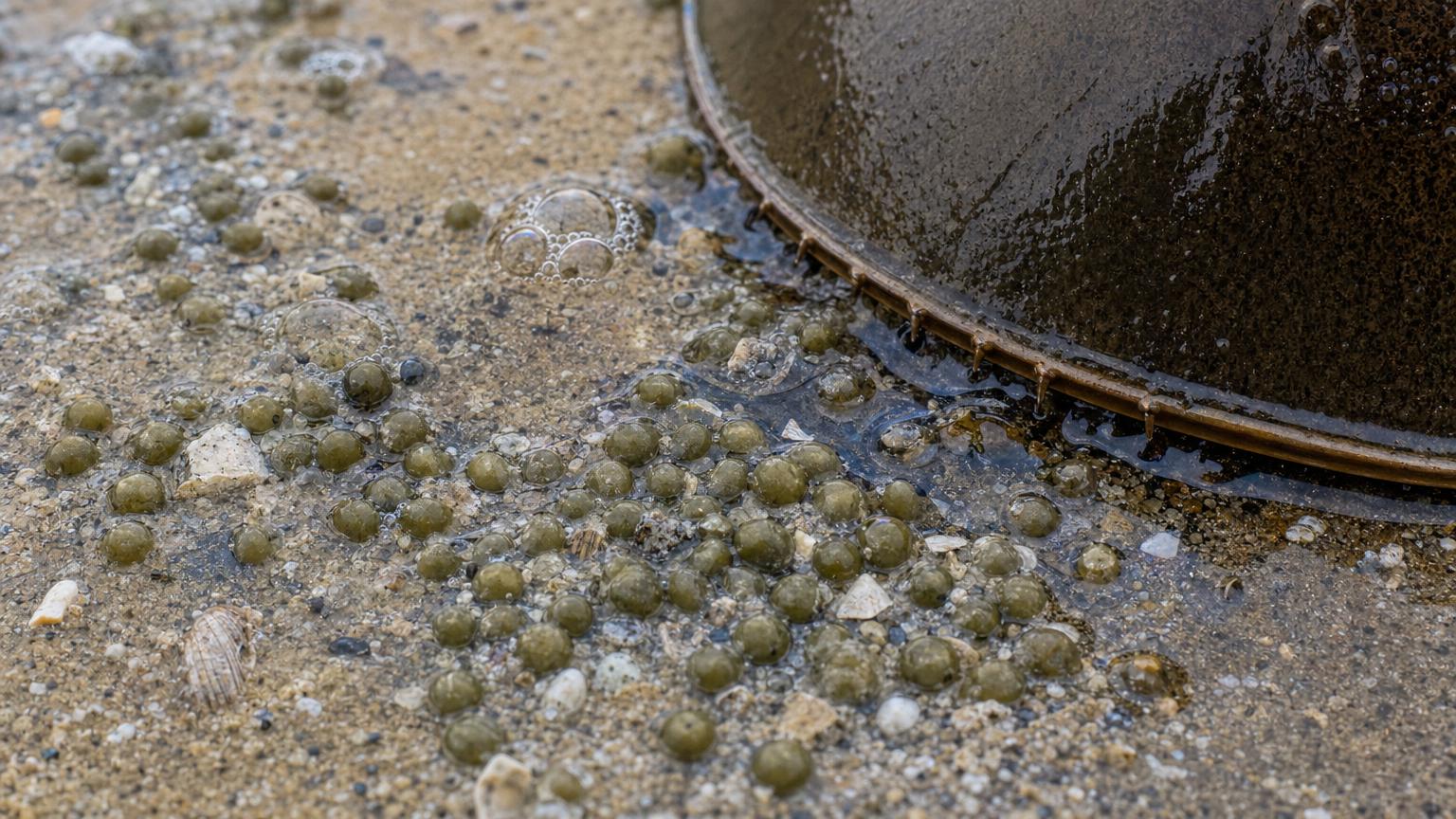
On a good spring night, a horseshoe crab looks less like an animal arriving than like a helmet that learned to crawl.
It comes out of the dark water with a domed brown shell, hinged legs tucked underneath, and a long tail that is not a stinger but a lever. The tail helps the animal flip itself over when waves, gulls or bad luck leave it upside down. Along the Atlantic coast, especially around Cape Cod and Delaware Bay, horseshoe crabs shuffle ashore to spawn on moonlit beaches. Their eggs feed migratory shorebirds. Their adults are used as bait for eel and whelk. Their blue blood became one of modern medicine’s strangest safety tools.
That last fact is the weird hinge of the story. Horseshoe crabs are not true crabs. They are marine arthropods more closely related to spiders and scorpions than to blue crabs or lobsters. Their blood is blue because it uses copper-based hemocyanin rather than iron-based hemoglobin to help move oxygen. Inside that blood are amebocytes, immune cells that react sharply to a dangerous kind of bacterial contamination called endotoxin. Endotoxins are fragments from certain bacteria that can cause fever, shock and worse if they enter the bloodstream through an injection, implant or medical device.
For decades, the pharmaceutical and medical-device world has used a product made from horseshoe-crab blood, Limulus amebocyte lysate, usually shortened to LAL, to help test sterile drugs, vaccines and devices. It is one of those hidden public-health systems that most people never hear about until they learn the recipe.
This spring, the recipe and the rulebook are both moving. On March 18, 2026, the Food and Drug Administration updated its guidance on pyrogen and endotoxin testing. The agency said the revision removed some LAL-specific language, aligned with U.S. Pharmacopeia Chapter <86> and gave manufacturers more flexibility to use recombinant, non-animal-derived reagents. Recombinant, in this case, means made by cells using copied genetic instructions rather than taken from a wild animal. The newer tests mimic parts of the horseshoe crab’s endotoxin-detection machinery without requiring a fresh draw of crab blood.
That might sound like the ending: a strange old practice yields to a cleaner modern substitute. But the beach is not done with the lab, and the lab is not done with the beach.
Massachusetts showed why. Early in 2026, the Division of Marine Fisheries proposed reducing the state’s annual bait quota for horseshoe crabs from 140,000 to 100,000 and reallocating those 40,000 crabs to the biomedical quota at a 1-to-2 ratio, which would have raised the biomedical quota from 200,000 to 280,000. The agency framed the idea as a response to lower local bait demand and higher biomedical demand. Because bait harvest is lethal and biomedical bleeding is designed as capture, bleed and release, the proposal looked to regulators like a possible way to correct a market mismatch without simply increasing the total paper supply.
Then the state stepped back. In March 2026 meeting materials, Massachusetts described a “Decision to Withdraw” the horseshoe-crab quota reallocation. In the March Marine Fisheries Advisory Commission summary, the agency said it withdrew the proposal in response to public comment. Its presentation said the current management program was achieving conservation goals, that the 2023 quotas had been set to cap mortality near 2022 levels, and that the proposal may have corrected market misalignment only at disproportionate cost and amid strong stakeholder frustration. One telling line said the state had interest in seeing its “rent-a-crab” program return to the historic practice of bleeding crabs already destined for bait, rather than letting biomedical demand drive bait-crab demand.
So the most current Massachusetts story is not “the state is about to approve more bleeding.” It is more precise and more interesting: Massachusetts considered giving the biomedical sector more crabs, backed away, and left intact a deeper conflict that will not be settled by one withdrawn proposal. The live question is how quickly a public-health system built around a wild animal can change now that the official path away from that animal is clearer.
One animal, three ledgers
The horseshoe crab has become a creature of ledgers.
There is the beach ledger: how many adults come ashore, how many females dig nests, how many eggs reach the upper layer of sand where shorebirds can eat them. There is the fishing ledger: how many crabs are harvested as bait for eel and whelk, the sea snails often sold as conch. There is the biomedical ledger: how many crabs are captured, bled, released and later estimated to die from the process.
The Atlantic States Marine Fisheries Commission, an interstate body that helps manage coastal fisheries from Maine to Florida, says 1,073,329 horseshoe crabs were collected coastwide solely for biomedical purposes in 2024. Its 2024 fishery-management-plan review estimated biomedical mortality that year at 184,693 horseshoe crabs. That estimate includes observed deaths and an assumed 15% post-bleeding mortality rate for bled crabs that are released. The same review says biomedical mortality represented about a quarter of 2024 directed-use mortality, which also includes bait removals.
Those numbers are not tiny. They also are not the whole picture. Crabs harvested for bait die. Crabs collected solely for biomedical bleeding are supposed to be returned to the water. Some crabs may move through both systems: in Massachusetts, a “rent-a-crab” arrangement can allow biomedical processors to bleed crabs that are later sold as bait, so those animals are counted against the bait quota rather than the biomedical quota. Supporters describe that kind of dual use as a way to reduce total harvest and make use of animals that were already going to die. Critics describe it as a blurred accounting system that can hide how many animals are actually being handled by biomedical firms.
This is why the Massachusetts withdrawal matters even without a new quota. The state’s own documents show that regulators were not simply choosing between “science” and “sentiment.” They were trying to balance bait, blood, mortality, public comment, commercial expectation, conservation optics and a changing test market. That is not a clean morality play. It is a governance test with a shell on it.
Massachusetts has tightened some rules in recent years. Starting in 2024, the state adopted a mid-April to June 7 closure on horseshoe-crab harvest to protect spawning animals and prohibited harvest within Cape Cod National Seashore and Monomoy National Wildlife Refuge. The state also monitors horseshoe crabs through fishery-independent surveys and reports that the Nantucket Sound region, where much of the commercial harvest occurs, has shown increasing 10- and 15-year trends. Those points are central to the state-management argument: Massachusetts is not a free-for-all.
But state trend lines do not silence the larger question. Biomedical demand coastwide remains large. U.S. standards now give clearer recognition to animal-free reagents. Other states are moving in different directions. New York’s Horseshoe Crab Protection Act, signed in December 2025, prohibits taking horseshoe crabs from New York waters for commercial or biomedical purposes, with exceptions for bona fide scientific or educational purposes. Conservation groups celebrated it as a phaseout with a full ban taking effect in 2029. Massachusetts’ choice not to expand the biomedical quota this spring sits inside that regional shift.
Why blood from a beach animal entered the medicine cabinet
The biomedical use of horseshoe crabs is bizarre only until the risk becomes clear.
Endotoxin contamination is not ordinary dirt. It can survive some processes that kill bacteria. If enough endotoxin gets into an injectable drug, an IV fluid, a vaccine or a device that contacts blood or spinal fluid, it can trigger a dangerous immune reaction. Before LAL, manufacturers often relied on rabbit pyrogen tests, in which rabbits were injected and monitored for fever. LAL became a powerful replacement because it could detect endotoxin more directly and sensitively.
The horseshoe crab came with its own alarm system. In the animal, amebocytes clot around invading bacteria. In the lab, that clotting reaction can be adapted into a test. If the sample triggers the reaction, the manufacturer has a warning.
That test helped make modern sterile manufacturing safer. It also created dependence on wild animals that do not belong to any one company. A horseshoe crab is born on a beach, grows slowly and can take about a decade to reach adulthood. It might crawl into a spawning survey, a bait boat, a biomedical collection pen or a child’s touch-tank memory. It is a public animal pulled into a private quality-control chain.
The newer recombinant tests try to separate the safety function from wild harvest. Recombinant Factor C, often called rFC, uses the first endotoxin-sensitive component of the horseshoe crab clotting cascade. Recombinant cascade reagents, or rCR, use more of that cascade. In plain language: scientists copied the biological instructions for the crab’s warning system and built tests that do not require bleeding a crab.
Europe moved earlier to recognize recombinant Factor C in its pharmacopoeia, the official book of medicine standards. The U.S. Pharmacopeia approved Chapter <86> in 2024 for bacterial endotoxin testing using recombinant reagents; it was available for early adoption in November 2024 and became official on May 1, 2025. The FDA’s March 2026 update then clarified its own thinking, saying firms using recombinant reagents should verify that an assay method is suitable for its intended purpose.
That phrase — suitable for its intended purpose — sounds like regulatory wallpaper. It is not. It means a company cannot simply swap one test for another as if changing paper towels. It must show that the new method works for its material, drug substance or finished product under its own conditions. A biologic medicine, an orthopedic implant rinse, water used in manufacturing and a simple injectable may pose different testing problems. Regulators are saying the door is open, but companies still have to walk through it carefully.
The door is open. The hallway is long.
There are signs of movement.
In February 2026, shareholder advocacy group As You Sow announced that Amgen and Abbott Laboratories had agreed to publicly commit to transition away from horseshoe-crab blood in biomedical testing. Amgen’s own statement says the company has been working to replace compendial LAL endotoxin testing with a recombinant, non-animal-derived option for water testing and new product approvals, and to publish progress until that transition is complete. The Boston Globe reported in February that Eli Lilly has already moved a large share of its safety testing to synthetic alternatives and began using synthetic reagent for new products in 2016.
Those examples matter because they complicate the common excuse that alternatives are only theoretical. They are not. Several companies have used or adopted them. Suppliers sell them. The U.S. Pharmacopeia has recognized them. FDA says its updated guidance is consistent with a long-term goal to reduce, refine and replace animal testing. In an April 20, 2026 update on animal-testing reduction, the FDA described the endotoxin guidance as part of work to support a transition away from horseshoe-crab-derived testing.
Yet availability has not automatically produced conversion. The lag is partly technical, partly regulatory, partly cultural and partly commercial. Large drug and device manufacturers may have thousands of internal test methods, product filings, supplier agreements, release specifications and quality-control procedures. Each change can require documentation, validation, regulatory communication and staff training. If a product was approved with one endotoxin method, changing the method for that product may feel less like buying a new tool than reopening a file cabinet full of promises.
Critics say that is exactly why regulators should push harder. On April 9, 2026, the Physicians Committee for Responsible Medicine argued that the FDA’s endotoxin-testing update fell short because it did not explicitly incorporate USP <86> into FDA-recognized standards or clearly direct companies toward nonanimal methods for existing products. From that view, flexibility can become a comfortable word for delay.
Industry voices and quality specialists answer with another word: safety. Endotoxin testing is a release gate. If a test gives a false negative, contaminated product may reach patients. If a test gives a false positive or does not perform well with a specific material, safe product may be blocked and shortages may follow. The argument for caution is not automatically an argument for endless LAL use. It is a reminder that drug safety is a system, not a slogan.
The transition therefore has several clocks. The regulatory clock has moved quickly in the past two years: USP approval, official status, FDA alignment. The corporate clock moves through budgets, quality systems, validation packages and product dossiers. The ecological clock is moon-driven and seasonal. Crabs spawn whether a standard operating procedure is ready or not.
Birds read the beach differently
If the horseshoe crab were only a lab ingredient, the debate would be easier. It is also bird food.
Rufa red knots are shorebirds that fly from southern South America toward Arctic breeding grounds. Delaware Bay is their great spring cafeteria. The U.S. Fish and Wildlife Service says Delaware Bay is a principal spring staging area for the rufa red knot because the birds rely heavily on horseshoe-crab eggs there. The birds arrive tired and must gain weight fast. In a strong stopover, they can nearly double their weight by eating crab eggs before continuing north.
The annual numbers are not a simple scoreboard. In 2025, the Fish and Wildlife Service reported a Delaware Bay rufa red knot ground count of 25,667 on May 23. Counts were up from record lows in 2021 and 2022, but the agency and its partners warn that timing, weather, water temperature, spawning conditions and where birds choose to stop can all affect what a count appears to say. A low count may reflect fewer birds, shorter stays, early departures, late crab spawning or some combination. A higher count does not mean the whole system is repaired.
Here, too, the evidence resists cartooning. A 2025 U.S. Geological Survey publication found that Delaware Bay horseshoe-crab abundance declined from the 1990s through about 2005, stayed relatively low and stable until 2010, and then increased through 2023 after harvest reductions, nearing early-1990s levels in the model. The Atlantic States Marine Fisheries Commission has built a special adaptive-management framework for Delaware Bay-origin crabs because the bay is not only a crab source; it is a shorebird fuel stop. For the 2026 and 2027 fishing seasons, the commission set Delaware Bay-origin bait harvest limits at 500,000 males and zero females.
That female number matters. Female crabs carry the eggs. Male-only harvest is meant to keep some bait supply moving while reducing direct pressure on egg production. It is a compromise, and not everyone likes it. Some conservation groups argue that even male harvest affects the system, while fishing interests warn that restrictions can be written without enough attention to local data, permit holders and bait needs.
Then the map complicates itself. A 2025 Scientific Reports study analyzed six datasets from Long Island Sound and found declines of 2% to 9% per year in horseshoe-crab count per sample, with significant declines in five of six datasets from bays and harbors. Long Island Sound is not the same place as Delaware Bay and is not simply a mirror of Massachusetts. That is the point. Local declines may arise from habitat loss, shoreline hardening, warming water, local harvest history, survey differences and changing spawning conditions. Biomedical bleeding may be one pressure in some places and not the main pressure in others. A single villain is satisfying. It may also be wrong.
The best version of the debate is not blood versus birds, or medicine versus nature. It is harder: when a wild animal supports public health, fisheries and endangered wildlife, how much uncertainty should managers accept, and who gets the benefit of the doubt?
Fishing towns are in the story, too
Horseshoe-crab protection can sound simple if the only humans in the picture are pharmaceutical executives and birdwatchers. But bait matters in fishing towns.
Crabs are used as bait for eel and whelk fisheries. The Massachusetts proposal rested partly on a change in that market: state officials said local bait demand had dropped with reduced effort in the conch pot fishery. The Cape Cod Commercial Fishermen’s Alliance opposed the proposed reallocation, arguing that small-boat fishermen rely on responsibly managed local fisheries and bait sources, and pointing to existing Massachusetts protections such as spawning-season closures, refuge harvest prohibitions, permitting, reporting and trip limits.
That does not make fishing groups right about every ecological question. It does mean the story is not solved by telling fishermen to disappear. A crab not used as bait may be available for biomedical collection. A rule that looks like conservation to one person may look like a lost working option to another. A rule that looks like a sensible reallocation to regulators may look like locking in blood harvest to activists.
New York chose a different path by prohibiting commercial and biomedical taking from state waters, subject to the scientific and educational exceptions written into law. Connecticut had already banned horseshoe-crab harvesting in state waters in 2023. New Jersey has long had strict limits around Delaware Bay. Massachusetts, with a large life-sciences economy and an active coastal fishing culture, remains a place where the competing ledgers sit close together.
This is one reason the horseshoe crab belongs in The Weird File and not only on a science page. It is a beach animal whose blood helped replace rabbit fever tests, whose eggs feed a bird that flies nearly pole to pole, whose body baits sea snails, whose shell appears on T-shirts and touch tanks, and whose future may depend on the wording of pharmaceutical quality chapters.
It is also a story about how markets behave after an alternative exists. Animal-free endotoxin tests are not a brand-new rumor. Recombinant products have been available for years. Several large drugmakers have used or adopted them. Yet availability did not automatically produce full conversion. Standards, regulation, habit, cost, paperwork, risk aversion, supply contracts and corporate inertia all slowed the turn.
That lag has consequences. If a company says it supports sustainability but keeps using LAL for legacy products because the old path is familiar, the burden stays partly on beaches. If regulators allow alternatives but do not clearly reward switching, companies may wait for competitors to move first. If states expand biomedical quotas because demand remains high, the market receives one signal. If states ban harvest, tighten spawning closures or reject reallocation, it receives another.
A strange creature becomes a deadline test
Massachusetts’ withdrawn proposal is not the whole future of the horseshoe crab. But it is a sharp example of the future arriving unevenly.
On one side: LAL remains an important safety tool. Biomedical collection is regulated. Some managers argue that crabs shifted from lethal bait harvest to catch-and-release biomedical use can reduce total mortality if handled well. Massachusetts has seasonal closures, protected areas, reporting rules and monitoring. Coastwide management is not the same as neglect.
On another side: more than 1 million crabs were still collected coastwide solely for biomedical purposes in 2024. The best animal-free replacements now have clearer U.S. recognition than they had two years ago. Major companies are beginning to make public transition commitments. FDA has updated its language. If this is the moment when dependence can fall, conservationists ask why any state should make room for more bleeding.
Both sides can point to a responsible word: safety. For drugmakers, safety means a reliable test that keeps contaminated products away from patients. For wildlife managers, safety means enough spawning adults and enough eggs for an ecosystem already squeezed by harvest, habitat loss and climate stress. For fishing families, safety may mean rules that do not erase a permit or bait source overnight. For patients, safety means sterile medicine without a fragile supply chain. For the crab, if one may put it that way, safety means not being reduced to a reagent with legs.
The most honest answer is likely transitional and unsatisfying. LAL will not vanish tomorrow. Recombinant tests will likely keep gaining ground. The speed will depend on whether regulators, companies, investors, states and buyers treat conversion as a side project or a deadline. Meanwhile, beaches will keep asking their older question: how many adults came back this year?
In late April 2026, that question is no abstraction. Spawning season is beginning or near at hand along much of the coast. Red knots are moving north. Massachusetts has withdrawn one quota change but not the underlying dilemma. FDA has updated its guidance. USP Chapter <86> is no longer a future promise. New York’s phaseout clock is ticking toward 2029. Delaware Bay’s 2026 and 2027 harvest limits are set at half a million males and no females.
And somewhere in the wet sand, under a moon that cares nothing for policy, a horseshoe crab is pressing its shell into the beach. If the animal had a lobbyist, it might choose a simple argument: I have been useful for 450 million years. Please be specific about what you still need from me.