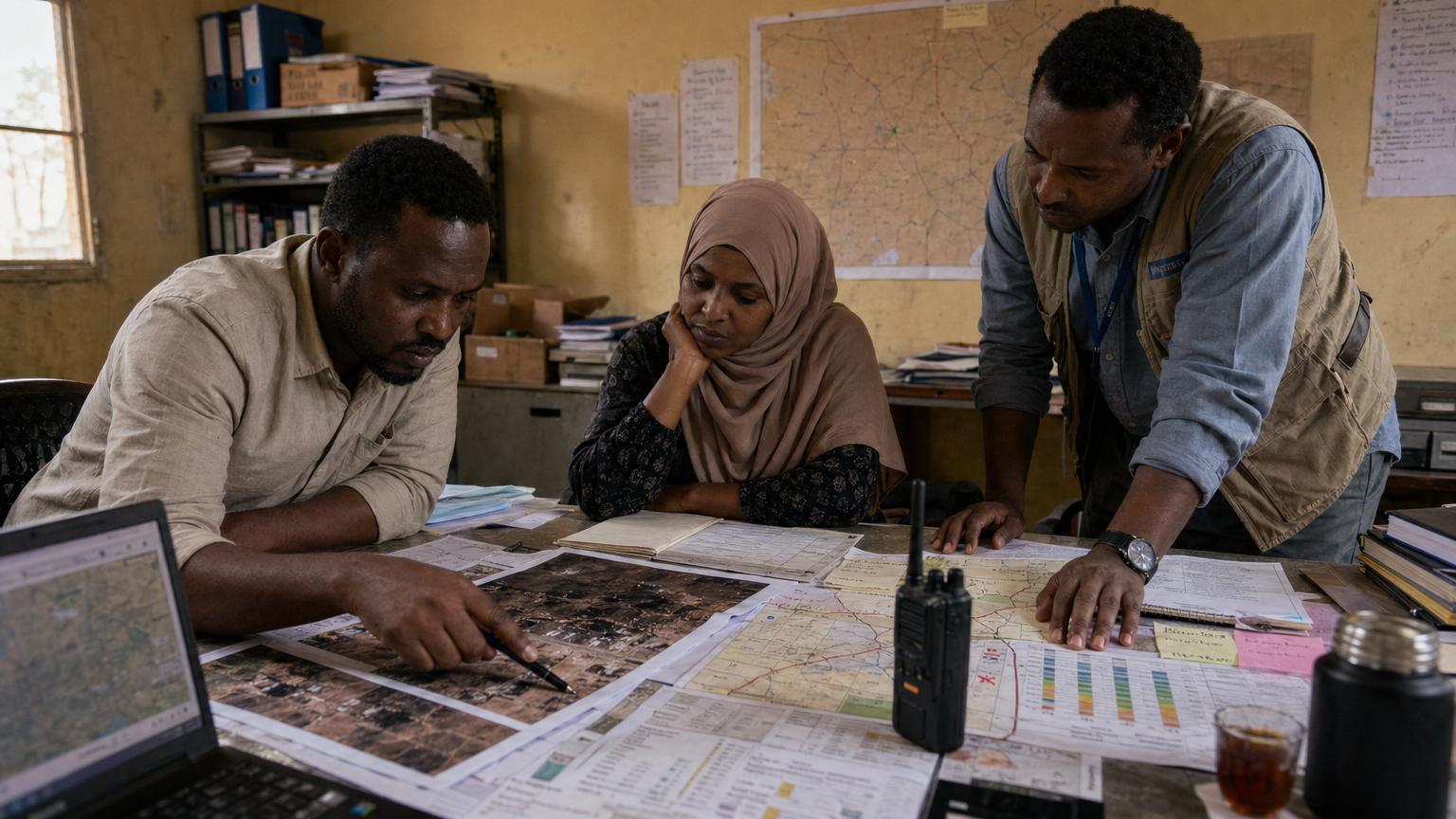
On a screen in a research office far from Darfur, a village can disappear in stages.
First comes the hot point: a thermal mark from a satellite sensor, the kind that can show a fire burning where there should be homes, animal pens or stored grain. Then comes the blackened shape where roofs and huts used to be. Weeks later, if the imagery is sharp enough and the clouds are kind, there is a quieter clue. Fields that should show the scratchwork of planting remain still. Footpaths blur. Grass thickens over spaces where people once walked every morning. A livestock corral looks damaged or empty. A settlement begins to look less like a living place than a scar.
That is not only a map of destruction. In Darfur now, it is increasingly a map of food.
A March 2026 report by the Yale School of Public Health Humanitarian Research Lab, working with NASA Harvest, gives one of the clearest recent examples. The researchers said the Rapid Support Forces, or RSF, intentionally razed 41 agricultural communities north and northwest of El Fasher between March 31 and June 12, 2024, as the paramilitary force opened what became an 18-month siege of the North Darfur capital. The conclusion drew on very high-resolution satellite imagery, thermal detections, open-source reporting and remote-sensing data that can help estimate whether fields were cultivated even when investigators cannot safely enter.
The report’s most important number is not a body count. It is a farming number. Yale’s team found that the average size of farming fields near the attacked communities became 82 percent smaller than in previous years. The fields that remained were, on average, far farther from the settlements. Most communities appeared damaged and depopulated months after the fires. In the lab’s reading, the burn scars were evidence not only of village destruction, but of a local food system being cut at the root.
That matters because Sudan’s war, which began on April 15, 2023, between the Sudanese Armed Forces, or SAF, and the RSF, has entered its fourth year. UN agencies describe Sudan as the world’s largest humanitarian and displacement crisis. Famine has been confirmed in Al Fasher and Kadugli, and monitors have warned of famine risk in additional areas of Greater Darfur and Greater Kordofan. The current alarm is not simply that Sudan has too little food. It is that in parts of the country the entire route from seed to plate has become a battlefield.
The field is the first checkpoint
Famine can sound like a weather word, as if it arrives the way drought does. Sudan’s crisis does include climate stress, disease outbreaks, inflation, damaged infrastructure and a collapsing economy. But in Darfur and Kordofan, recent evidence points to something more deliberate and more mechanical: people are being separated from the land, markets are being shelled or squeezed, roads are being made dangerous or expensive, and aid is being delayed, denied or priced beyond reach.
The Yale findings are useful because they begin at the farm rather than the food-distribution line. The agricultural villages around El Fasher were part of the city’s local food web. They produced cereals, supported livestock, held seed stocks and connected rural households to urban markets. If a city is a cooking pot, those villages were part of the woodpile, the water jar and the hand that keeps stirring.
According to Yale’s key findings, 10 of the 41 communities were razed more than once, and one was burned at least seven times. The lab counted 176 thermal detections within two kilometers of the communities in 2024, compared with only two detections in the same areas from 2019 through 2023. That evidence cannot, by itself, identify the person who lit every fire. Satellite imagery cannot cross-examine a fighter. But repeated burning, timing, location, damage patterns and corroborating reports can help distinguish a battlefield accident from a campaign.
The Center for Information Resilience’s Sudan Witness project has been doing a broader version of this work since 2023, verifying fire damage by combining satellite imagery, NASA fire data, media reports and user-generated content. Reporting shared with El País this month said Sudan Witness had recorded more than 750 fires across Darfur by January 10, 2026, affecting 357 settlements, villages or towns. The same reporting made an important caution: not every fire can be attributed to the same actor, and not every fire can be proved to be deliberate arson. Fires may follow shelling, local clashes, criminal attacks or other violence. But the scale and pattern in RSF-controlled or RSF-attacked areas have been large enough for rights groups, open-source investigators and UN bodies to treat burning as part of a wider campaign in Darfur.
This is where the hunger story and the atrocity story overlap, but they are not the same story. A massacre kills immediately. A burned farming belt keeps killing later if seed stocks are lost, tractors are stolen, herds are scattered, wells are unsafe and the people who know when to plant have fled.
A joint April 2026 report by Action Against Hunger, CARE, the International Rescue Committee, Mercy Corps and the Norwegian Refugee Council describes that food chain in plain terms. In parts of Sudan, a meal may depend on ingredients that have crossed one or more battlefields. The report follows food through three stages: the farm, the road and the table. At every stage, war adds a toll.
Farmers interviewed for that report described planting under fire, losing tools and harvests to armed men, facing seed shortages and paying sharply higher prices for fuel, fertilizer and pesticides. Women, who often keep households fed while also farming, trading and caring for children, face particular danger when they go to fields, markets, water points or food lines. In a normal year, Sudan’s agricultural calendar is already unforgiving. Miss the planting window and the next meal is not the only thing at risk; next season is, too.
A siege is a market policy with guns
El Fasher became the central Darfur case because it was both a city and a symbol. It was the last major SAF foothold in Darfur before the RSF captured it on October 26, 2025. It also sheltered large numbers of displaced people from non-Arab communities, including Zaghawa, Fur and others, whose memories of the Darfur atrocities of the early 2000s are not historical abstractions but family history.
By 2024, aid groups and rights monitors were describing El Fasher as effectively encircled. Yale and other monitors later documented an earthen wall, or berm, around the city. The military purpose of such a barrier is easy to understand. It slows people. It channels movement. It makes food, medicine and escape routes easier to control. In a siege, hunger does not require every house to be attacked. It requires the entrances to be made narrow, costly and frightening.
The April NGO report says markets in El Fasher were shelled and roads into the city were cut off, opened only intermittently or made lethal by checkpoints and attacks. Staple grains reportedly entered at night under dangerous conditions. Small traders improvised, sometimes selling from homes or makeshift stalls and staying open only briefly because of strikes. Communal kitchens closed when food stocks ran out.
This is why the phrase market disruption sounds too tidy. A market is not just a place where sacks of sorghum sit in a row. It is a set of risks people have agreed to take because they believe tomorrow will be survivable. A trader borrows money. A driver buys fuel. A farmer saves seed. A mother walks to a stall. A baker trusts that flour will arrive. Once roadblocks, shelling, looting and predatory taxes enter the chain, the market may still exist, but it starts behaving like a wounded animal: smaller, jumpier, open for fewer hours, serving fewer people at higher prices.
The World Food Programme’s April 2026 market monitor shows how uneven that pressure can be. In March, the national average retail price of wheat flour was 3,388 Sudanese pounds per kilogram, 33 percent higher than a year earlier. The highest wheat-flour prices were in East Darfur, South Darfur and West Kordofan, around 5,000 pounds per kilogram. Sorghum, a staple grain, was cheaper than the previous year nationally, but the highest prices were still recorded in conflict-affected and access-stressed areas. Groundnut prices were 100 percent higher than a year earlier, driven in part by reduced harvests and limited supplies from key production zones.
Prices do not explain everything. A family can live near a sack of grain and still go hungry if the road to it is controlled by armed men, if the wage for casual labor is too low, if cash is scarce, or if going to market exposes women to assault. In parts of North Darfur, Central Darfur, North Kordofan and Sinnar, WFP recorded casual wages below 10,000 Sudanese pounds a day, far lower than in some eastern and northern states. Hunger is often a math problem. In Sudan, it is also a security problem.
The road has moved west
Before the war, many commodities for Darfur and Kordofan came from eastern and central Sudan through Khartoum or Al Jazirah. The war broke those habits. The joint NGO report says supplies now move through costlier and more precarious routes from Chad, South Sudan or Libya. That shift matters because geography is not neutral. A longer route means more fuel, more checkpoints, more spoiled goods, more opportunities for extortion and more time for front lines to change.
Humanitarian routes are under the same strain. Port Sudan on the Red Sea has become the main hub for many international operations. But moving supplies from a coastal hub to western Sudan requires permissions, trucks, fuel, security guarantees and roads that remain passable. Cross-border routes from Chad, including Adré and Tiné, have been vital for Darfur. ACAPS, an independent humanitarian analysis group, warned in March 2026 that border policy, insecurity and bureaucracy around crossings could disrupt both humanitarian and commercial supply chains into Darfur and Kordofan.
Then there is the weather. The rainy season in Darfur and Kordofan can turn poor roads into mud puzzles. A truck that would be slow in February may be impossible in July. That creates a cruel deadline: food and medicine need to be pre-positioned before the roads fail, but conflict and permissions often delay precisely the convoys that must move early.
Regional shocks add another layer. UN and WFP officials warned in mid-April that conflict in the wider Middle East and disruption affecting Red Sea shipping were raising the cost of imported food, fuel and fertilizer. Fuel is not just something that moves trucks. It runs water systems, mills, cold chains for medicines and the generators that make an aid warehouse more than a room full of boxes.
When analysts talk about engineered hunger, this is the machinery they mean. It is not one lever. It is the field burned here, the truck taxed there, the border crossing delayed, the market shelled, the fuel price raised, the humanitarian plan underfunded, the rainy season arriving on schedule because weather does not negotiate.
What famine means, and what it does not
The Integrated Food Security Phase Classification, usually called IPC, is a technical system used by governments, UN agencies and aid groups to classify the severity of acute food insecurity. It has five phases. Phase 3 is Crisis. Phase 4 is Emergency. Phase 5 is Catastrophe at the household level, and Famine at the area level when enough evidence shows a collapse in food consumption, very high acute malnutrition and elevated death rates.
That definition is intentionally strict. It is also hard to apply in a war zone. The IPC’s November 2025 special snapshot said famine was occurring, with reasonable evidence, in El Fasher in North Darfur and Kadugli in South Kordofan for the September 2025 period and was expected to persist through January 2026. It warned of famine risk in 20 additional areas across Greater Darfur and Greater Kordofan. In February 2026, an IPC alert said famine thresholds for acute malnutrition had been surpassed in Um Baru and Kernoi in North Darfur, while making clear that an alert is not the same as a full new area-level famine classification.
This distinction matters. Famine declarations often arrive late because the evidence needed to confirm them is difficult to collect where people are trapped, displaced or dead. If investigators cannot reach a place, the absence of a classification may mean absence of data, not absence of hunger. The IPC snapshot said several high-concern areas could not be classified for the February-to-May 2026 projection because conditions were too volatile and uncertain.
There is also a complication that should not be ignored: some parts of Sudan have improved where conflict has subsided and access has expanded. The IPC snapshot showed lower national numbers after harvest and relative stabilization in places such as Khartoum, Al Jazirah and Sennar. FEWS NET, the famine early-warning network, assessed in early 2026 that famine thresholds were no longer being met in parts of South Kordofan after some siege conditions eased, while warning that a credible risk of renewed famine would remain if areas were isolated again from markets and assistance.
That is not a contradiction of the Darfur alarm. It is the point. Hunger in Sudan is now intensely geographic. A child in one town may benefit from a harvest or an aid delivery while a child across a checkpoint faces an empty bowl. The food map changes with front lines, rainfall, permissions, currency, trade routes and fear.
The accused are not the only story
Much of the satellite and rights evidence around burned agricultural villages in North Darfur points toward the RSF and allied Arab militias. Yale researchers, Human Rights Watch, Sudan Witness, El País and UN human rights reporting all describe patterns of RSF-linked violence in Darfur, especially against non-Arab communities. The RSF grew out of the Janjaweed militia networks used by Sudan’s government during the earlier Darfur war, a history that hangs over today’s violence.
But an honest account also has to say that Sudan’s hunger crisis is not caused by one tactic or one side alone. The SAF has been accused of unlawful attacks, including airstrikes and shelling that have harmed civilians and damaged infrastructure. Both the SAF and RSF, along with allied armed groups and rival administrative authorities, have imposed restrictions, paperwork, security demands and interference that slow aid. Local clashes, criminal predation, currency collapse and regional supply shocks all compound the damage.
That complexity should not blur responsibility where the evidence is strong. International humanitarian law prohibits using starvation of civilians as a method of warfare. It also protects objects indispensable to civilian survival, including food supplies, crops, livestock, drinking-water installations and irrigation works. When agricultural communities are repeatedly burned, roads to a besieged city are blocked, markets are attacked and aid is prevented from entering, those are not background conditions. They are possible violations demanding investigation and accountability.
UN human rights investigators have gone further in El Fasher. A February 2026 UN Human Rights Office report, based on interviews with people who fled the final offensive, described killings, sexual violence, attacks on civilians along escape routes and other alleged abuses during the RSF capture of the city. The UN Independent International Fact-Finding Mission has described RSF actions in and around El Fasher as bearing the hallmarks of genocide against Zaghawa and Fur communities. Those findings sit beside the food evidence. Together they suggest that hunger around El Fasher was not merely collateral damage. It was part of the pressure placed on a civilian population already targeted by identity, location and perceived allegiance.
The market keeps trying to breathe
One reason Sudan’s hunger crisis can be hard to see clearly is that people keep adapting. A market that looks dead one week may reappear in a different street. A trader may switch from truck to donkey cart. A family may dilute porridge so everyone gets a spoonful. A communal kitchen may feed a neighborhood for one more day by borrowing grain from someone who has almost none.
The April NGO report notes that markets outside full siege conditions have shown remarkable resilience. In some places, traders and market unions have negotiated with local authorities, arranged credit, organized bulk purchases and found new routes. Remote analysis cited in the report found that some rural markets shrank during violent episodes and then recovered within one to eight months after fighting subsided.
This resilience is hopeful, but it is not a rescue plan. It depends on people accepting risks that no civilian should have to accept. It also depends on brief lulls in violence. When siege conditions tighten, when fuel disappears, when a border closes or when a market is shelled, improvisation reaches its limit.
Local responders, including Emergency Response Rooms and communal kitchens, have become some of the most important food actors in Sudan. They know who is newly displaced, which road is passable, which family has not eaten and which volunteer can still move safely. Yet many receive little formal funding, and some operate under threat from armed actors who distrust independent civic networks.
International aid is also underfunded. UN officials said in April that the 2026 humanitarian plan aims to support about 20 million people and requires nearly $3 billion. WFP says it urgently needs $610 million for operations from March to August 2026. Those numbers are large. They are still smaller than the cost of letting the food system collapse and then trying to rebuild people, herds, fields, markets and trust from ashes.
Reading the burn map
The most useful way to read Darfur’s burned villages is not as a gallery of destruction. It is as a working diagram.
Here is the field where sorghum might have grown. Here is the pen where goats might have survived. Here is the family that might have planted, now displaced toward Chad, Tawila or another crowded place with too little water. Here is the market that used to buy from that village. Here is the road where a trader now pays in cash, fuel or food at successive checkpoints. Here is the city where a mother finds flour only at a price she cannot meet. Here is the clinic where malnutrition arrives as a child too weak to fight infection.
That diagram does not prove every claim made in Sudan’s information war. It cannot identify every arsonist. It cannot count every death. It cannot fully capture how people survive by sharing, hiding, bargaining and moving. But it does make one thing harder to deny: in parts of Darfur and Kordofan, hunger is following the lines of violence with terrible precision.
The war’s food map is being drawn by fire, displacement and the economics of fear. If the fields around El Fasher look empty from space, the emptiness is not abstract. It is tomorrow’s missing market sack, next month’s unaffordable grain, a communal kitchen with nothing left to stretch, and a famine warning that may arrive after the village that could have fed the city has already burned.