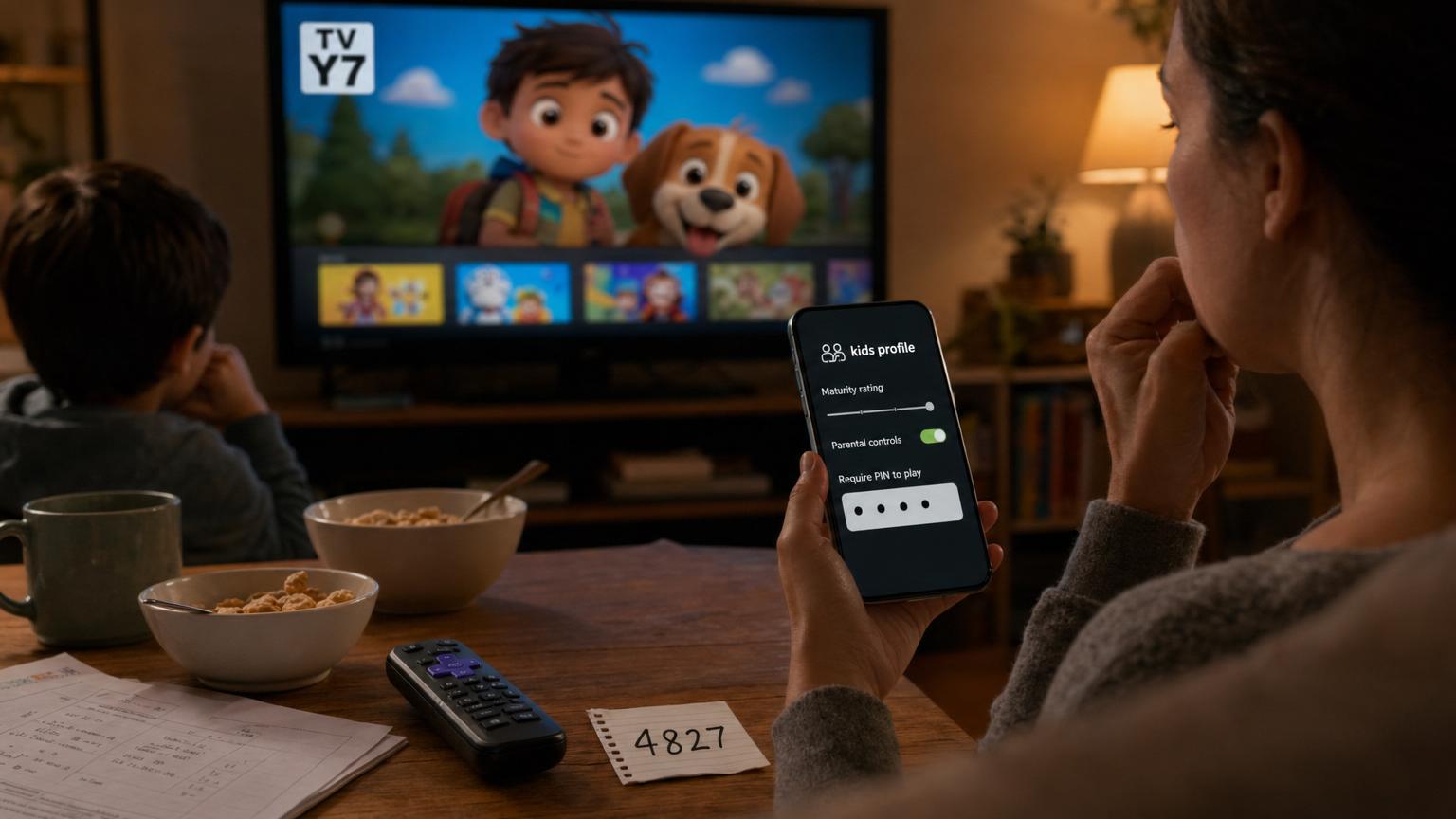
The most consequential object in the newest culture fight from Washington may not be the six-page public notice, the docket number or the familiar seal of the Federal Communications Commission. It may be the small plastic rectangle that disappears under couch cushions: the family remote.
On April 22, 2026, the FCC’s Media Bureau released a public notice in MB Docket No. 19-41 asking whether the television rating system still gives parents the information they need. Comments are due May 22, 2026. Reply comments are due June 22. The notice does not change the ratings. It does not order a streaming service to add a new warning. It does not create a federal ban on any character, plot or subject. What it does is ask a pointed question: should children’s programs rated TV-Y, TV-Y7 or TV-G be rated differently, or carry additional descriptions, when they include discussion or depiction of gender identity themes, including transgender or nonbinary characters or topics?
That is a narrow regulatory question with a very wide cultural shadow. It is about the little icon in the upper-left corner of a screen. It is about who decides what counts as ordinary childhood subject matter and what counts as a topic requiring special notice. It is about a ratings system built for channel surfing trying to operate inside smart-TV menus, streaming profiles and recommendation engines. It is about parents who want tools, creators who fear invisible pressure, companies that dislike public controversy, and children who experience culture less as a policy debate than as a show they like after school.
The cleanest way to understand the fight is to start at home. A parent opens a streaming app while dinner is half-made. One child wants a cartoon. Another wants the tablet. The phone asks for a PIN. The app offers a kids profile, a maturity rating, a row of tiles, a pause button and a promise of control. Somewhere behind that simple menu is a complicated chain: writers, network standards departments, studio lawyers, metadata teams, parental-control engineers, industry boards, advocacy groups, federal agencies and courts. The FCC notice has not rewritten that chain. It has reminded everyone in it that the chain can be pulled.
A 1990s tool in a 2026 living room
The TV Parental Guidelines are the age ratings many viewers have seen for decades: TV-Y for all children, TV-Y7 for older children, TV-G for general audiences, TV-PG, TV-14 and TV-MA. Ratings can also carry content letters: D for suggestive dialogue, L for coarse or crude language, S for sexual situations, V for violence and FV for fantasy violence in children’s programming. The system was developed by the television industry after Congress passed the Telecommunications Act of 1996, which pressed toward V-chip technology, a built-in television feature that can block programs by rating.
The original bargain was meant to be less intrusive than direct government censorship. Congress wanted parents to receive information and to have a technical way to block content they considered harmful. The television industry, rather than the FCC, would rate programs. The FCC accepted the voluntary industry system in 1998, and the system has remained in place. It covers most television programming, though news and sports are exempt, and religious and home-shopping programs do not typically carry the ratings.
That bargain made sense for a world of broadcast schedules, cable lineups and televisions with channels. It is less tidy in a world of streaming catalogs. A child now may encounter the same franchise through a broadcast episode, a cable rerun, a subscription app, a free ad-supported streaming channel, a short clip, a trailer, a toy-unboxing video or a phone screen in the back seat of a car. Nielsen reported that streaming passed the combined share of broadcast and cable viewing for the first time in May 2025, and its February 2026 Gauge report showed how much major events, streaming simulcasts and platform-specific viewing now blur old categories. The ratings icon still matters. It just has to travel farther than it used to.
The TV Parental Guidelines Monitoring Board, often shortened to TVOMB, sits at the center of that system. It is not the FCC. It is an industry-created oversight body tied to a federal policy design. Its board has included media companies, trade groups and public-interest organizations. Its current public materials describe its role as promoting consistency, reviewing complaints and helping families understand ratings and parental controls. In 2025, the board said it conducted four spot-check audits across broadcast, cable and streaming platforms and held its annual meeting on Oct. 28.
The April 22 FCC notice asks whether that board has become transparent enough, whether it is balanced enough, whether additional family-oriented or faith-based perspectives should be represented, whether the complaint process provides meaningful public participation, and whether programs are rated consistently across broadcast, cable, satellite and streaming. Those are practical governance questions. They could exist even if the notice never mentioned gender identity. But the notice did mention it, in language that made the proceeding much more than housekeeping.
The phrase that changed the docket
The Media Bureau said parents have raised concerns that what it called controversial gender identity issues are being included or promoted in children’s programs without disclosure or transparency. It asked whether parents know that programs rated TV-Y, TV-Y7 and TV-G may include discussion or promotion of gender identity themes. It asked whether such programming should be rated differently or include relevant descriptions so parents can make informed decisions.
Those sentences turned an old ratings file into a current culture story. For supporters of the inquiry, the question is parental notice. They argue that families already receive alerts about violence, sexual situations or coarse language, and that parents should also know when a children’s show includes themes they consider morally, religiously or developmentally significant. In that view, a label is not a ban. It is a tool. Different households can set different rules without removing a program from the marketplace.
For critics, the danger is that the government is treating the presence of transgender or nonbinary people as if it were a risk category comparable to violence or sexual content. GLAAD president and chief executive Sarah Kate Ellis criticized the review as government overreach and part of an anti-transgender political agenda. The Guardian framed the inquiry as one more move by an FCC led by Chairman Brendan Carr into sensitive media content. That framing matters because ratings do not operate only as information. They can shape what gets made, what gets promoted, what schools use, what advertisers prefer and what cautious executives avoid.
The two sides are not merely disagreeing about one descriptor. They are disagreeing about what a descriptor does. Is it a neutral household-control tool, like a warning for graphic violence? Or is it a signal that a particular kind of person is unsuitable for children unless specially flagged? That question cannot be answered in the abstract. It depends on the wording of any future label, the process used to create it, whether it is mandatory or voluntary, how platforms display it, and how media companies react once a federal agency has identified a topic as a problem.
For now, the FCC has asked questions. It has not adopted answers. But questions from a regulator can alter behavior before rules do. A standards executive who once treated a character’s pronouns as a normal script detail may now ask whether that line creates ratings exposure. A producer may ask whether the episode will be harder to sell internationally. A streaming service may ask whether an extra label will reduce discoverability inside a kids profile. A writer may decide the scene is no longer worth the meeting it will trigger. The public may never see the choices that are quietly not made.
The parent’s case is real
One trap in this story is to turn parents into props. That would be unfair. Parents are not imagining the difficulty of managing children’s media in 2026. They face more screens, more apps, more passwords, more recommendations and more pressure than the V-chip era anticipated. Pew Research Center reported in October 2025 that nine in ten U.S. parents of children 12 and younger said their child ever watches TV, while 68% said their child uses a tablet and 61% said their child uses a smartphone. Pew also found that 85% said their child ever watches YouTube, including about half who said it happens daily. Common Sense Media’s 2025 census of children ages zero to eight found that young children’s screen time was steady at about two and a half hours a day, but that gaming time had surged and short-form video use was rising while traditional TV viewing declined.
Those numbers describe a household management problem, not an ideology. Parents may have children of different ages sharing one TV. They may work multiple jobs. They may have limited time to preview a show. They may belong to religious communities with strong views about when and how certain topics should be introduced. They may care less about one topic and much more about another: bullying, self-harm, body image, scary imagery, advertising, profanity, substance use, sexual jokes, guns or cruelty. A better information system can help them.
The best version of the parental-notice argument is not that one household’s moral framework should govern everyone else’s screen. It is that a plural society needs tools that let households make different choices. A parent who wants to avoid a subject is not automatically trying to ban it for everyone. A parent who wants more granular information is not automatically a censor. The daily work of parenting often consists of making imperfect decisions with incomplete information, usually while someone is asking for a snack.
The ratings system has always been imperfect because simplicity is its main virtue. TV-Y, TV-Y7, TV-G and the rest are easy to understand because they reduce a lot of judgment to a small symbol. That is also why they frustrate people. Violence is not one thing. A cartoon pratfall, a fantasy laser fight and a realistic shooting all work differently on a child’s imagination. Sexual content is not one thing. A kiss, a pregnancy discussion and explicit nudity do not carry the same weight. Language is not one thing. A rude insult and a slur are not equal. Ratings compress all of that into icons and letters because the system has to work quickly.
Gender identity would be even harder to compress. Would a descriptor apply to any transgender character? Only to a plot about transition? Only to a discussion of pronouns? What about a family with a transgender parent? A documentary? A historical program? A classroom scene? A joke about clothing? A story about bullying a child who does not follow gender expectations? What about a program that presents a religious objection to gender identity? A label that is too broad risks marking people as warnings. A label that is too narrow may be confusing and arbitrary. No label leaves some parents saying the system withheld information they wanted. None of the options is cost-free.
The law is not a couch cushion
The legal context is one reason the FCC notice is careful to ask rather than command. The Communications Act contains an anti-censorship provision: the FCC may not be understood to have censorship power over radio communications or interfere with free speech by radio communication. The 1996 video-ratings framework also contains an important limit: it did not authorize rating video programming based on political or religious content.
Gender identity is not identical to political or religious content. It concerns people’s lives, families, bodies, language and social recognition. But public fights over gender identity are often political and religious. That makes the line treacherous. A government-backed move that appears to single out identity, viewpoint or contested social belief would invite serious First Amendment scrutiny, especially if the pressure moves beyond neutral information and begins to shape what speakers feel safe including in children’s programming.
The FCC’s authority is also uneven across media. Broadcast television has historically been subject to more regulation than print, cable or internet speech because it uses public airwaves and has been treated by courts as uniquely pervasive and accessible to children. Cable, satellite and streaming do not sit in exactly the same legal box. Yet the TV ratings system is used more broadly than broadcast, and many companies operate across all categories. A broadcast network may share corporate ownership with cable channels and streaming platforms. A children’s franchise may travel across all of them. That means even a proceeding formally rooted in traditional television can influence streaming decisions by reputation, risk and business pressure.
This is the odd power of a voluntary system with official fingerprints. The ratings are industry-run, but they exist because Congress created a federal backstop and because the FCC accepted the industry’s answer. The TVOMB is not a government agency, but it performs a function that Congress and the FCC helped shape. The system is private enough to avoid being a straightforward content code and public enough to become a political target when cultural fights intensify.
That ambiguity has always been there. The April 22 notice simply makes it visible again.
The board behind the icon
One of the most useful parts of the FCC notice has little to do with gender identity. It asks whether people know how to complain about a rating and whether the TVOMB has followed earlier recommendations for transparency and accuracy. That is a real issue.
In 2019, the FCC’s Media Bureau sent Congress a report on the TV ratings system and the oversight board. The bureau said the board could better serve viewers if it were more accessible and transparent. It urged more public awareness of the board’s role, clearer complaint information, public reporting on the number and nature of complaints, at least one public meeting a year, and random audits or spot checks to test ratings accuracy and consistency.
The TVOMB has done some of that work. Its 2025 annual report says it received and responded to 170 public comments between Oct. 1, 2024, and Sept. 30, 2025. Only 11 involved TV Parental Guidelines ratings. It says seven of those involved participating broadcast, cable or streaming services and four involved nonparticipating streaming services. Its spot-check program found just two instances requiring rating changes. The board can read those numbers as evidence that the system is working. Skeptics can read them another way: perhaps few people know the board exists, know what it can do, or believe a complaint will matter.
That is the plumbing beneath the culture war. If parents cannot tell who assigns ratings, how to challenge them, whether complaints are public, and what happened after a complaint, the system depends on trust it has not fully earned. If companies are effectively rating their own work with limited public visibility, critics will suspect leniency. If the government steps in too aggressively, critics will suspect censorship. A credible system needs both independence and restraint.
The board’s membership matters for the same reason. Self-regulation means the industry has expertise, but it also means the industry has incentives. Media companies know their audiences, formats and production realities. They also sell the programming. Public-interest members can broaden the view, but their influence depends on selection, independence and transparency. The FCC notice asks whether additional faith-based organizations should be represented. That might add one set of family perspectives, but it could also increase concern that the system is moving toward religious or viewpoint-based judgments. The question is not simply who gets a chair. It is what criteria the chairs are allowed to use.
Streaming did not break parenting. It broke the old map.
A V-chip can block programs by rating on a television set. That is useful, but it does not describe the entire screen environment. Streaming services use their own maturity settings, kids profiles and advisory labels. Some display traditional TV ratings. Some add extra labels such as smoking, self-harm, sexual assault, domestic violence or substance use. The TVOMB’s 2024 streaming best-practices guidance says streaming services should at minimum strive to replicate the television ratings experience and may add additional content labels or resources.
That means the fight is not really about whether more detailed labels can exist. They already do. The fight is about who decides which labels matter and whether a federal agency should nudge the industry toward a label attached to gender identity.
Streaming also complicates consistency. A program may be rated episode by episode. It may be edited for one platform and not another. Theatrical films may carry Motion Picture Association ratings in one context and TV Parental Guidelines in another after being edited for television. A series originally made for streaming may later be licensed to a cable network. A platform may create a kids profile that screens out some content but still recommends trailers or related tiles. A family may assume the app is doing more than it is.
That confusion creates a strong case for clearer design. Parents should not need to become media-rights specialists to understand whether a show is meant for preschoolers, older children or general audiences. They should be able to see ratings before playback, understand content descriptors, change PINs easily and know when a kids profile does not cover the whole device. Better interface design may do more for families than adding one more politicized label.
Still, labels have symbolic force. If a streaming menu says violence, most viewers understand it as a content advisory. If it says gender identity, some viewers will understand it as a neutral heads-up, while others will hear a warning about the presence of transgender or nonbinary people. That is why the implementation details are not technical leftovers. They are the center of the story.
The creator’s quiet calculation
For viewers, ratings are icons. For creators, they can become boundaries. Standards departments, legal teams and executives may not wait for a formal rule. If the FCC’s questions make one kind of children’s story more controversial inside a company, that story may face extra review. Extra review can become delay. Delay can become a rewrite. A rewrite can become absence.
This is how soft pressure works in culture. It often leaves no memo saying, remove the character. Instead, it produces a thousand smaller questions. Do we need this scene? Could we say it another way? Will this affect a school-distribution deal? Will this complicate advertising? Will one distributor flag the episode? Will another country cut it? Will a parent group start a campaign? Will a federal filing quote us later? The safest answer may be to make the character less specific, the family less visible, the line less clear.
That possibility does not prove that any future label would be censorship. It does show why critics are nervous. Children’s media is especially sensitive to controversy because it is attached to trust. Brands built for families often avoid topics that can become campaigns. Animation, voice work, licensing, toys, books, international dubbing and school use can all be affected by a maturity label or a public dispute. A label is a small mark on screen. Behind it is a supply chain of decisions.
Workers far from the writers room would feel any change, too. Someone has to classify episodes. Someone has to update metadata. Someone has to build the menu field. Someone has to answer customer emails. Someone has to decide how a label appears on a phone screen, a television screen and a child’s profile. Someone has to train reviewers on examples. Someone has to handle disputes when parents, advocates or creators disagree. Regulation reaches daily life partly by becoming paperwork and software.
What would a less explosive reform look like?
If the goal is to help families rather than to fight over one identity category, several reforms are less inflammatory and more broadly useful. The TVOMB could publish clearer, more detailed complaint summaries while protecting personal information. It could explain which complaints led to rating changes and why. It could hold better-publicized public meetings. It could use independent researchers to test whether parents understand the ratings. It could expand spot checks and publish more about methodology. It could make streaming participation easier to see. It could create plain-language guides explaining where TV ratings end and platform-specific controls begin.
Platforms could also improve the household side. Ratings and advisory labels should appear before playback, not after a child has already started watching. Parent dashboards should explain what each setting blocks and what it does not. Profiles should make it easy to separate preschool, older-child and teen settings. PIN recovery should be secure but not maddening. Content labels should be searchable, consistent and readable on small screens. Families should be able to distinguish an age rating from a subject advisory. None of that requires treating a person’s identity as a hazard.
Industry self-regulation could also be more transparent about judgment calls. Parents may be more likely to trust a system that admits ratings are contextual. A show about bullying may be appropriate for some children and distressing for others. A story about a transgender classmate may be ordinary for one household, sensitive for another and affirming for a third. No icon can replace a parent’s judgment. A good system should give useful information without pretending it can settle the values of every family.
That is the hard civic balance. A plural society has to make room for parents who want more control and for children who should not be taught that some neighbors are warnings. It has to protect free expression while recognizing that parents do need help navigating an overwhelming media environment. It has to avoid both smug dismissal of parental concern and government-backed stigmatization of minority lives.
What happens next
The formal answer begins with comments. Advocacy groups will file. Industry groups will file. Parents will file. Civil-liberties groups may file. Some submissions will be careful and data-heavy. Some will be emotional. Some will be copied from campaigns. That is how public dockets often work: they are policy records, lobbying stages and public squares all at once.
After the comment period, the FCC could take several paths. It could issue another report. It could pressure the TVOMB to revise guidance. It could focus on transparency and complaint handling. It could encourage more consistent streaming practices. It could move toward a more formal rulemaking, though that would be harder legally and politically. The industry could also act before the FCC does, either to satisfy the agency or to avoid a more direct confrontation.
The safest prediction is uncertainty. The April 22 notice is not a final rule. It is a signal. Signals matter in culture because institutions respond to them before viewers see the result.
For now, the rating icon remains small. It appears for seconds. It sits in a corner. The remote remains where it always is, half tool and half illusion. A parent can block a rating. A child can find another screen. A platform can add a label. A studio can avoid a fight. A government bureau can ask whether the old system still works. None of that resolves the deeper question now sitting on the couch: how can families be given real information without turning some children, parents or characters into content warnings?
That question will not fit in the upper-left corner of the screen.