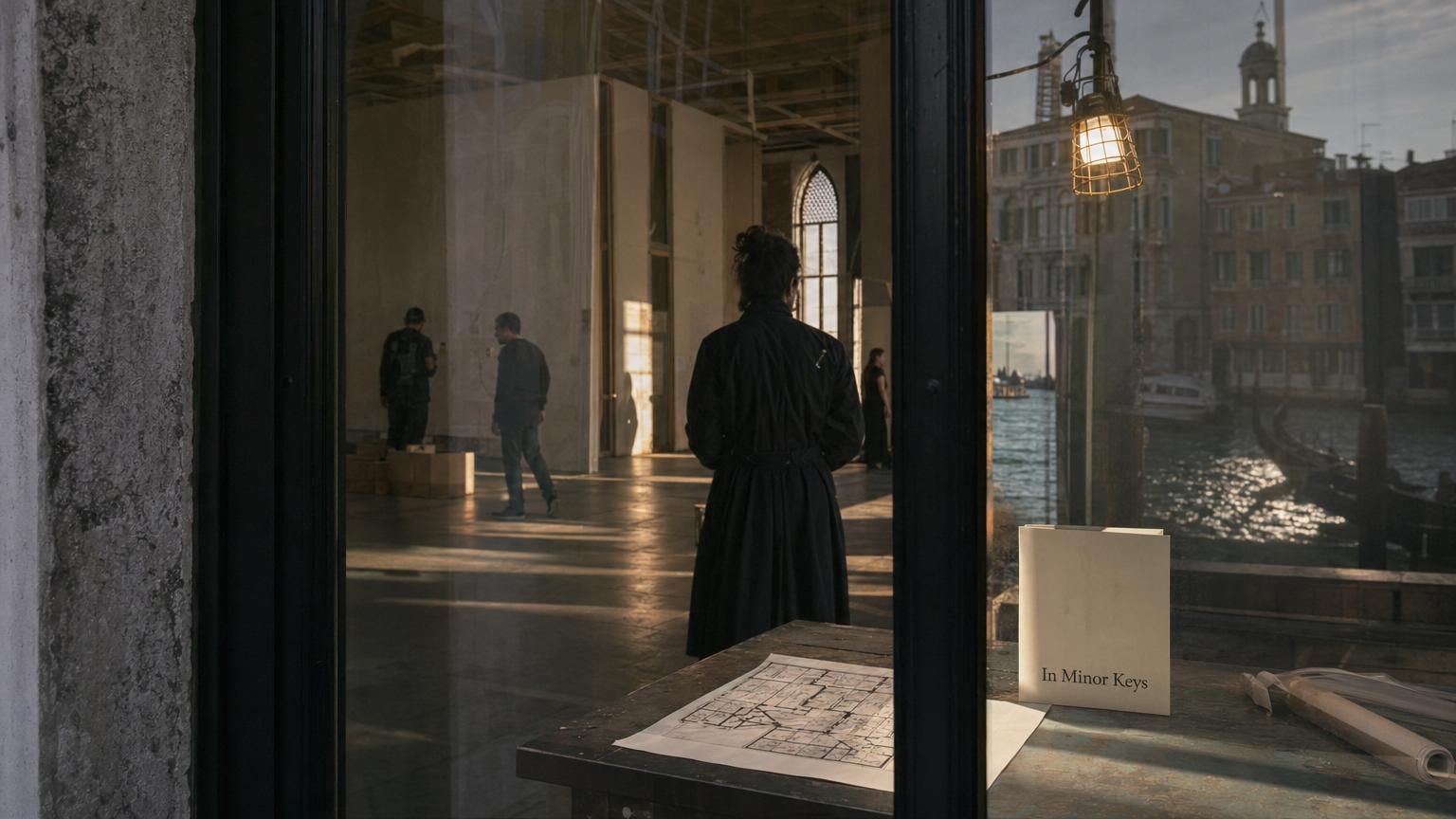
On a normal art-world calendar, the week before the Venice Biennale opens is a comedy of wet shoes, lost press passes, half-charged phones and people pretending not to panic beside crates. This year, the pressure has a different pitch. The 61st International Art Exhibition opens to the public on Saturday, May 9, 2026, after pre-opening days on May 6, 7 and 8. Its awards ceremony is also scheduled for May 9. And its central exhibition is being carried into the world by a curator who is no longer here to greet it.
Koyo Kouoh, the Cameroonian-Swiss curator chosen to direct Biennale Arte 2026, died on May 10, 2025. La Biennale di Venezia says she had already set the title, theoretical frame, artist selection, catalogue authors, graphic identity and architecture of the show before her death. Her team has spent the past year turning that work into an exhibition called In Minor Keys. The phrase now has to do several jobs at once. It is an artistic proposition. It is a promise not to shout. It is also, whether the organizers want it to be or not, a way of asking how a global culture machine handles grief, war, tourism, state branding and money without flattening them into spectacle.
The Biennale is often called the art world’s Olympics, which is useful and misleading in exactly the right proportions. Yes, countries send official presentations. Yes, prizes are awarded. Yes, power arrives wearing comfortable shoes. But there is no single race. A visitor can move from a sculpture in the Giardini to a national pavilion in the Arsenale, then across a bridge to a collateral exhibition in a church or palazzo, and end the day unsure whether the strongest work was official, national, private, improvised or accidentally found on the way to buy a sandwich.
That sprawl is why this edition matters beyond Venice. The official program lists 110 invited participants in the central exhibition, 100 national participations and 31 collateral events. Collateral events are independently organized exhibitions approved to run alongside the Biennale, which means the city becomes a second exhibition plan wrapped around the official one. Seven countries are first-time participants in the national section: Guinea, Equatorial Guinea, Nauru, Qatar, Sierra Leone, Somalia and Viet Nam. El Salvador is participating for the first time with its own pavilion. Those numbers make the 2026 Biennale a map of ambition. They also make it a map of argument.
A show built from an absence
Kouoh was appointed in late 2024 as director of the Visual Arts Department, with the task of curating the 2026 exhibition. The appointment was historic: she was widely identified as the first African woman chosen to lead the Venice Art Biennale. Her career moved through Cape Town, Dakar, Basel and major international exhibitions, but one of her most important institutions was RAW Material Company, the Dakar center for art, knowledge and society that she founded. That matters because In Minor Keys is not being presented as a package of finished instructions delivered from above. It is being described as a relational project, built through encounters, affinities and what the organizers call resonances across places.
The team named by La Biennale is Gabe Beckhurst Feijoo, Marie Hélène Pereira and Rasha Salti as advisers, Siddhartha Mitter as editor in chief and Rory Tsapayi as research assistant. Their work continued through remote meetings and in-person seminars after Kouoh’s death. The key meeting, according to the Biennale, came in Dakar in April 2025 at RAW Material Company, before Kouoh died, when the exhibition’s motifs and structure took shape. In the team’s own account, that week unfolded under a mango tree, a detail so vivid that it risks becoming too neat.
Art institutions love an origin story. A mango tree can turn into a logo before anyone has time to object. But here the detail is also practical. A curator’s death leaves behind documents, emails, checklists, budgets and relationships. It also leaves a harder question: when does fidelity to a vision become ventriloquism? The Biennale’s answer has been to keep Kouoh’s authorship in front while naming the people carrying the work forward. That makes In Minor Keys more than a posthumous exhibition. It is also an exhibition about how culture is never really made by one person, even when one person’s intelligence gives it form.
The official description says the show does not want to be either a catalogue of world crises or an escape from them. Its language turns toward the emotional, sensory, subjective and affective. In ordinary language, that means the show is betting that feeling is not a retreat from public life. It may be one of the ways people survive public life.
Minor does not mean small
In music, a minor key can sound mournful, tense, smoky, sweet or unresolved. It is not automatically sad. Kouoh’s title seems to work in that broad sense. The exhibition’s motifs include shrines, processions, schools, rest, gardens and performance. These are not sections in a tidy museum layout, according to the organizers, but undercurrents. A shrine can be a place of memory. A procession can be protest, ritual, parade, funeral or carnival. A school can be a building, but also a method of learning together. Rest can be political when the world rewards exhaustion. Performance can be a body doing something a wall label cannot.
The artist list makes that range visible. It includes Laurie Anderson, Kader Attia, Nick Cave, Wangechi Mutu, Otobong Nkanga, Walid Raad, Torkwase Dyson, Guadalupe Maravilla, Ebony G. Patterson, Tsai Ming-liang, Pauline Oliveros, Marcel Duchamp, Beverly Buchanan and Issa Samb, along with collectives and artist-led institutions such as RAW Material Company, G.A.S. Foundation, Nairobi Contemporary Art Institute, blaxTARLINES KUMASI and lugar a dudas. The official list also includes Gala Porras-Kim in the Applied Arts Pavilion, a special project with the Victoria and Albert Museum, out of competition.
Some early summaries of the show counted 111 participants, apparently treating Porras-Kim’s out-of-competition Applied Arts Pavilion project as part of the tally. La Biennale’s current invited-artists page gives the central exhibition count as 110 and then lists the Applied Arts Pavilion separately. That may sound like bookkeeping, but bookkeeping is part of culture. Counts tell artists, countries, funders and critics where they stand. A number can become a claim about scale, representation or exclusion. In Venice, even arithmetic has a press preview.
The geographical emphasis is striking. Kouoh’s framing looks toward Salvador, Dakar, San Juan, Beirut, Paris, Nashville and many other places as sites of simultaneous invention, rather than treating one art capital as the center and everyone else as a footnote. That is one of the stakes of this edition. The Biennale is still in Venice, still old, still prestigious, still connected to collectors and national prestige. But In Minor Keys asks visitors to listen for cultural knowledge that often arrives outside the loudest rooms.
The national pavilions have their own weather
The central exhibition is only half the Biennale’s public meaning. The national pavilions are where art and diplomacy become roommates. Each country chooses its own artist or artists, its own curator and its own version of what it wants to project. Some presentations are brave. Some are safe. Some are overproduced. Some are beautiful in ways their governments may not fully understand.
This year’s list is unusually crowded with cultural statecraft. Qatar is listed as a new national participation in the Giardini with untitled 2026 (a gathering of remarkable people), involving Rirkrit Tiravanija, Sophia Al-Maria, Tarek Atoui, Alia Farid and Fadi Kattan, with Sheikha Al Mayassa bint Hamad bin Khalifa Al Thani as commissioner and Tom Eccles and Ruba Katrib as curators. The official Biennale listing places Qatar in the Giardini, where permanent national presence is rare and symbolically heavy. A pavilion there is not just a room. It is a claim of belonging inside one of contemporary art’s oldest clubhouses.
Great Britain will be represented by Lubaina Himid, the Turner Prize-winning artist whose work has long explored Black histories, overlooked labor and the theatrical staging of power. The United States pavilion lists Alma Allen’s Call Me the Breeze, with Jenni Parido as commissioner and Jeffrey Uslip as curator. Australia’s pavilion lists Khaled Sabsabi and Michael Dagostino, whose path to Venice became a public argument after Creative Australia first dropped and later reinstated them following an independent review. Ukraine’s pavilion is called Security Guarantees, with Zhanna Kadyrova as exhibitor. The title alone shows how difficult it is for any national pavilion to pretend it floats above events.
Even absence has become a cultural fact. South Africa, after initially preparing participation, will not have its official pavilion as planned following a dispute over Gabrielle Goliath’s Gaza-related project Elegy. The work is expected to be shown outside the main event at Chiesa di Sant’Antonin, according to March reporting. That means a project blocked from national representation may still reach Venice, just without the flag structure that would have made it official. For visitors, the question becomes simple and uncomfortable: who gets to speak for a country when artists, ministers and publics disagree?
Russia, Israel and the prize problem
The sharpest political dispute around the 2026 Biennale is the presence of Russia and Israel in the national section. La Biennale’s March list included Russia with The tree is rooted in the sky in the Giardini, and Israel with Rose of Nothingness in the Arsenale. La Biennale also wrote that it rejects exclusion or censorship of culture and art, and that Venice remains a place of dialogue, openness and artistic freedom.
That position has not ended the dispute. It has made the dispute more concrete. The European Commission has moved to cut a 2 million euro grant connected to the Biennale over Russia’s return to the national pavilion list, according to AP reporting. The Biennale has time to defend its decision, but the message from Brussels is plain: cultural events that receive European public money are now being judged not only by artistic openness but by sanctions, democratic commitments and geopolitical responsibility.
The story is still moving. On April 27, Euronews reported that Italian Culture Minister Alessandro Giuli would not attend the opening in protest over the Russian pavilion, and that the Russian pavilion would be open only to media during the May 6-8 pre-opening days and remain closed to the public for the exhibition’s run. That leaves Russia in a peculiar position: officially listed, politically condemned, financially costly for the Biennale, and, if that reporting holds, not available to ordinary ticket-holders. It is hard to imagine a clearer example of the national pavilion system turning institutional procedure into political theater.
The international jury has also been drawn into the argument. La Biennale announced on April 22 that the jury is made up of Solange Oliveira Farkas as president, with Zoe Butt, Elvira Dyangani Ose, Marta Kuzma and Giovanna Zapperi. Subsequent reporting by The Guardian, El País and Euronews said the jury would not consider artists from countries whose leaders face International Criminal Court charges related to war crimes or crimes against humanity, a decision widely understood to refer to Russia and Israel. The International Criminal Court, often shortened to ICC, is the Hague-based court that prosecutes genocide, crimes against humanity, war crimes and the crime of aggression when its jurisdiction applies. The legal details differ by case, and the moral arguments are not identical. But the cultural effect is shared: an art prize has become a place where international law, public outrage and institutional discretion meet.
There is a serious counterargument. If art institutions exclude national pavilions whenever governments commit grave acts, the list of exclusions could expand quickly and unevenly. Some critics say bans can punish artists more than leaders. Others say allowing state pavilions during active wars or mass suffering can launder state power through culture. Both concerns are real. The Biennale’s national format makes the problem almost impossible to avoid, because the pavilions do not merely show artists from countries. They are official national participations.
That is why In Minor Keys faces a strange burden. Kouoh’s central exhibition may be built around listening, rest, schools and shared life, but the national system around it still speaks the language of states. A soft note can be swallowed by a brass band.
Venice is not just a backdrop
The city itself is another actor. Venice is not a neutral container where art conveniently appears every two years. It is a fragile, working, overvisited city whose residents live inside the global appetite for beauty. During the Biennale, the local and the global do not meet in an abstract way. They meet at vaporetto stops, narrow bridges, rental apartments, cafes, ticket counters, church floors and doorways where staff ask visitors not to block the entrance.
The city’s 2026 access-fee system is in force on selected days. The official Venezia Unica site says the fee applies in the ancient city on scheduled days and times, from 8:30 a.m. to 4 p.m., unless an exemption applies. The cost is 5 euros for those who pay by the fourth day before access and 10 euros for later payment. The fee does not apply to the minor lagoon islands. This is not a Biennale rule; it is a city rule. But the overlap matters. A person may arrive to see contemporary art and first encounter a QR code about crowd management.
UNESCO advisers have been blunt about the larger pattern. A recent mission report recognized tourism’s economic role but described mass tourism and overtourism as one of the most critical challenges for Venice and its lagoon. It recommended a dedicated sustainable tourism management plan, better data, reductions in daily visitors, limits on short-term rentals and more support for residents. The same report said the access-fee system should be assessed for whether it actually reduces visitor numbers and whether it adds burdens to residents’ daily lives.
So the Biennale’s local-to-global story is not simply that the world comes to Venice. It is that Venice has to absorb the world’s arrival. The art economy benefits from the city’s atmosphere, but the city pays in congestion, housing pressure and the slow conversion of everyday space into visitor space. A show about lower frequencies opens in a place where the volume knob has been broken for years.
Why this edition feels bigger than a preview
There are years when the Venice Biennale can be covered as a list: best pavilions, biggest names, strongest parties, sharpest shoes. This year resists that treatment. The central exhibition is posthumous. The national pavilions are unusually charged. The jury is under political scrutiny before the awards ceremony. The European Union funding fight has turned a cultural program into a public-money test. South Africa’s withdrawal, Australia’s reversal and the debates around Russia and Israel all point to the same basic question: who controls the frame when art becomes international representation?
For young artists and small countries, the Biennale can still be a rare amplifier. A first-time pavilion can change how a scene is seen by curators, collectors and museums elsewhere. For larger states, the stakes are different. The pavilion can be a soft-power instrument, a protest stage, a risk-management problem or a prestige machine. For visitors, the stakes are more intimate. Do you stand long enough to let a work change the pace of your thinking, or do you rush to the next famous room because someone on a group chat said it is essential?
Kouoh’s title offers one answer without pretending to solve everything. In Minor Keys suggests that not all significant culture arrives as a declaration. Some of it arrives as a murmur, a procession, a resting place, a school, a shrine, a shared meal, a video in a church outside the official route, a sculpture in a pavilion whose commissioner is trying very hard to explain the national mood. Minor does not mean marginal. It can mean tuned differently.
That may be the most humane way to approach this Biennale. Not as a puzzle with one correct political solution. Not as a luxury carnival immune from politics. Not as proof that art heals war, grief or institutional distrust. Art does not do that on command. But it can make people practice attention in public, which is not nothing.
When the doors open in May, most visitors will not read every policy fight behind every pavilion. They will look, wander, sit, argue, miss things, misunderstand things and occasionally find a room that makes the rest of the city go quiet for a minute. Kouoh’s team has built an exhibition around that possibility. Venice, crowded and reflective as ever, will decide how much quiet it can hold.