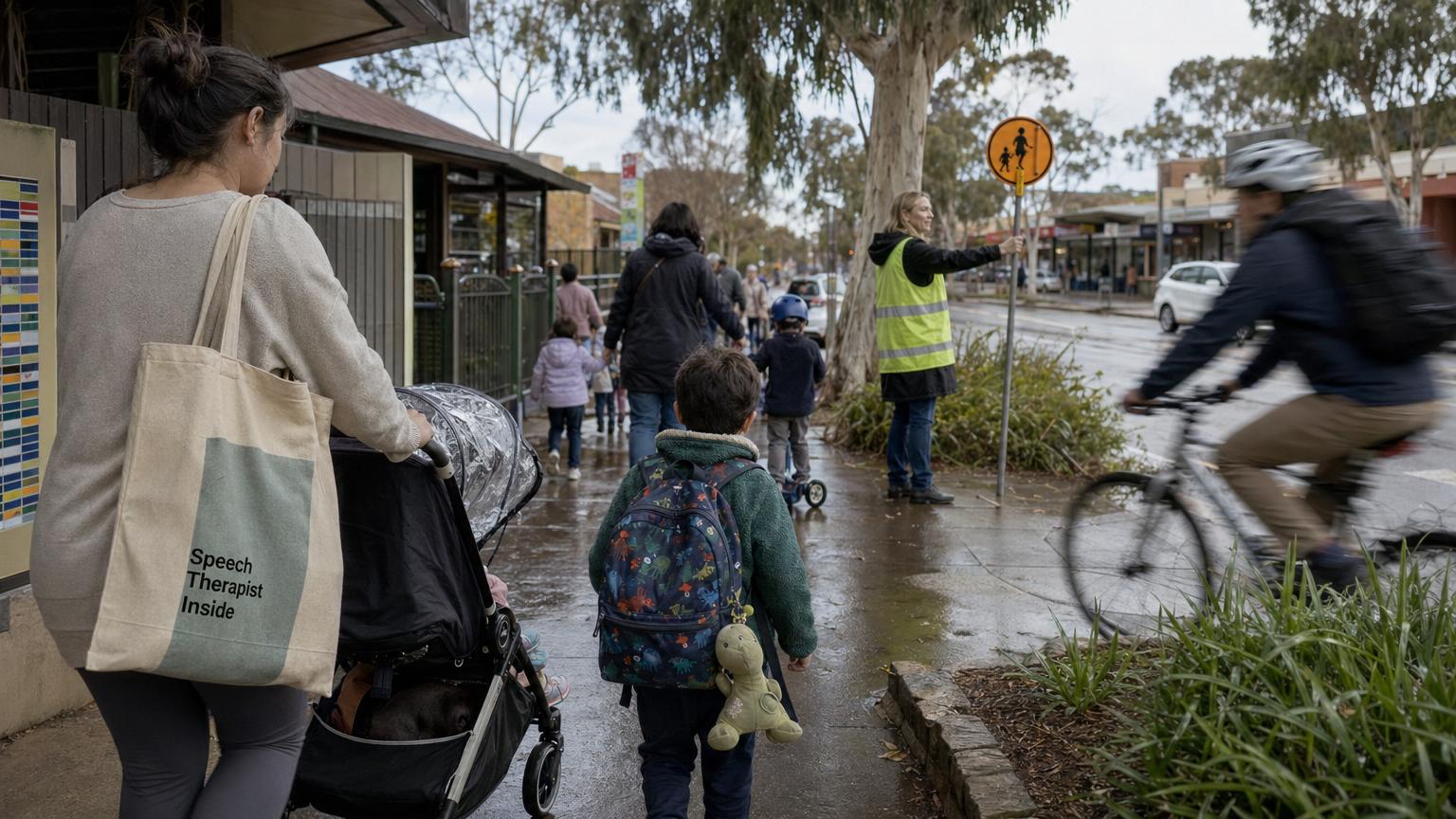
Morning drop-off is a policy system with shoelaces.
Before any government paper becomes real, it has to pass through the small weather of family life: a child who cannot bear socks with seams; a parent trying to remember the lunchbox, the therapy appointment and the password for the school app; a teacher aide watching the gate; a speech pathologist squeezing one more visit into a day already cut into 45-minute squares.
That is where Australia’s National Disability Insurance Scheme, better known as the NDIS, now finds itself: not only in budget tables and ministerial speeches, but on the footpath between home, school, clinic and childcare.
On April 22, ABC News reported a new phase of the Australian government’s attempt to slow the growth of the NDIS. Health and NDIS Minister Mark Butler’s plan would move the scheme away from diagnosis-based access lists and toward assessments of functional capacity — a person’s practical ability to take part in daily life. The reported target is stark: reduce participation from roughly 760,000 people now to about 600,000 by 2030, rather than letting it rise toward earlier projections above 900,000.
Autistic people sit near the centre of that fight because autism has become one of the fastest-growing entry points into the scheme. ABC reported that people with autism are nearly four in five new entrants and nearly half of current participants. The government says the point is not to single out one diagnosis, but to return the NDIS to people with significant and permanent disability and to build supports outside it for people with lower support needs. Disability advocates and families hear a second question underneath: outside it where, exactly?
That sounds like a budget story. It is. The NDIS is one of Australia’s largest social programs, and its growth rate has become a recurring alarm in Canberra. But it is also a Life story, because the thing being redesigned is not abstract care. It is the weekly machinery that lets children communicate, sit in a classroom, tolerate noise, make friends, cross a street safely, sleep, eat, play, recover after a hard day, and give their parents enough room to work, rest or simply stop being the emergency department for the whole household.
The government’s promised alternative for many young children is called Thriving Kids. Officially, it is a national system of supports for children aged 8 and under with developmental delay or autism who have low to moderate support needs, and for their families, carers and kin. It is scheduled to start rolling out state services no later than October 1, 2026, and to be fully rolled out by January 1, 2028. Changes to NDIS access for that group are due to begin from January 1, 2028 and will require amendments to the NDIS Act.
The promise is simple and attractive: help children earlier, closer to where they live, learn and play, without making a formal autism diagnosis the golden ticket to support.
The fear is just as simple: what if the new doorway opens after the old one closes?
Australia is the loud version of a quieter global problem
Australia’s argument landed just weeks after the Organisation for Economic Co-operation and Development published a 260-page report, Policy Responses to Rising Autism Diagnoses in Childhood: Across the Spectrum, on March 26, 2026. The OECD is a forum of mostly high-income countries that compares policies and data. Its report is not a local Australian audit. It is a wider warning label for modern childhood systems.
Across the countries it reviewed, the OECD found that autism diagnoses among children and young people have climbed sharply in recent years, often twofold to fourfold over about 15 years. The report treats that rise carefully. Current evidence points strongly to better recognition, broader diagnostic practice and stronger incentives to seek a diagnosis; it does not prove that the underlying number of autistic children has risen by the same amount.
That distinction matters. If a diagnosis is the only practical route to speech therapy, occupational therapy, school adjustments, respite care or disability payments, families will chase the diagnosis. Clinicians may feel pressure to describe a child in the language the system recognizes when the child’s needs are real, even if the boundary line is hard to draw. Schools may quietly wait for a formal label before adding support. Insurers or public programs may demand the label because it is easier to audit than a messy description of daily life.
The OECD’s most useful idea is not a slogan, but a problem: countries are trying to base support more on individual needs rather than diagnosis alone. That sounds fair. It also sounds hard.
A diagnosis is a blunt key. Needs-based support is a locksmith’s kit. It can fit the door better, but only if enough trained people have time to measure the lock.
What the NDIS changed
The NDIS was built to support Australians with permanent and significant disability. Unlike older block-funded systems, it gives eligible participants individual plans that can pay for supports such as therapy, assistive technology, help with daily living and participation in the community.
For many families, that individual plan was not bureaucratic poetry. It was the first time the system said yes with dollars attached.
The House of Representatives inquiry into Thriving Kids shows how large the children’s side of the scheme has become. As of September 30, 2025, 751,446 people had approved NDIS plans. Among children under 9, 170,786 had approved NDIS plans, and another 27,139 accessed early connections during the quarter. Participation was highest among children aged 5 to 7, with around 10 percent of Australian children in that age group on the NDIS. At age 6, about 16 percent of boys and 7 percent of girls were participants.
Those numbers are the sound of the school gate entering the national budget.
They are also easy to misread. Autistic participants are numerous, but that does not mean every autistic child is receiving a lavish package, or that autism alone explains NDIS spending. The harder story is design. Many children may need moderate support. When many moderate needs are routed through an individualized disability scheme that was built for significant and permanent disability, the queue and the bill grow together.
The government’s answer is to build a middle floor: not ordinary mainstream services alone, and not the full individualized NDIS plan for every child with developmental concerns, but a set of foundational supports that can be used earlier and locally.
Thriving Kids is still a promise with details attached
The official Department of Health, Disability and Ageing page describes Thriving Kids as part of the first phase of Foundational Supports. Governments have committed $4 billion over five years for that phase. At least $1.4 billion of the Commonwealth’s $2 billion contribution is supposed to go directly to states for Thriving Kids services.
The design has several appealing ideas. It aims to identify developmental concerns earlier. It says support should be matched to a child’s needs and circumstances. It promises trusted information, advice and evidence-based child development supports from allied health professionals. The national model includes awareness and early identification, navigation, parenting supports, supported playgroups, group and one-on-one allied health, low-cost assistive technology where needed, and more intensive capacity building for families with complex circumstances. Children with permanent and significant disability, including children with high support needs, are meant to remain eligible for the NDIS.
That model is not nothing. A family should not have to spend thousands of dollars and wait months for an autism assessment before anyone helps with communication, eating, transitions, sleep or sensory overload. A childcare centre should not have to guess alone. A parent should not have to translate daily distress into a funding code before anyone takes it seriously.
But April reporting also sharpened the anxiety. ABC News reported that Queensland was still objecting to the funding deal, even though the Commonwealth described governments as having agreed in principle to the access changes and the broader model. Autism Awareness Australia chief executive Nicole Rogerson supported assessment by need in principle, but warned that the timing was troubling because Thriving Kids had not yet been built in enough detail and workforce questions remained unresolved.
That is the unresolved question in the whole fight: can a system stop using diagnosis as the passport to help before it has built a reliable customs desk for need?
Why labels both help and hurt
Autism is a neurodevelopmental condition, meaning it relates to how the brain develops and processes information. Autistic people may have differences in social communication, sensory processing, routines, movement, attention, language, play and interests. Some autistic people need lifelong intensive support. Others need targeted adjustments at school, work or home. Many need different kinds of help at different ages or in different environments.
The word spectrum can mislead if people imagine a straight line from mild to severe. Autism is more like a soundboard: language, sensory sensitivity, motor skills, anxiety, sleep, learning, safety awareness and social energy can each sit at a different level. A child who speaks fluently may still bolt into traffic. A child who looks calm in class may collapse for hours at home. A child who thrives one year can unravel the next when the classroom, teacher or friendship rules change.
That is why labels are both useful and dangerous.
A formal diagnosis can validate a family’s observations. It can open school accommodations. It can help a child understand themself without assuming they are naughty, lazy or strange. It can connect parents to other parents who know what a supermarket meltdown does to a Tuesday.
But a diagnosis can also become a tollbooth. If help depends on the code, everyone focuses on the code. The question shifts from, What does this child need to function and belong? to, Does this child meet the threshold? That can reward families with time, money, English fluency, flexible jobs and confidence in professional rooms. It can punish families who cannot pay privately, cannot wait two years, or do not know how to turn daily struggle into the language of impairment.
The OECD report flags this inequality across countries. Public diagnostic systems have not always kept pace with demand, and complex pathways can favour families with more health literacy, language access and resources. When public waits stretch, families with money buy private assessments. Families without money wait, improvise or go without.
The waiting room is not neutral
England is a useful comparison because it shows what happens when diagnosis demand grows faster than public capacity.
NHS England’s autism statistics track waiting times for suspected autism referrals. In December 2025, official data showed 254,108 patients with an open referral for suspected autism in England. The National Autistic Society said in its November 2025 analysis that more than 227,000 people were waiting and that average waits were over 16 months. The Nuffield Trust, using NHS data, found that autism referral rates for children and young people more than doubled from January 2022 to December 2024. NICE, the National Institute for Health and Care Excellence, recommends that an autism diagnostic assessment should begin within three months of referral.
A long wait is not just a calendar problem. A toddler waiting for speech support becomes a preschooler. A preschooler becomes a kindergartner. Parents learn the local geography of distress: which hallway is too loud, which socks are impossible, which birthday party will end in the car, which form needs the exact phrase that unlocks a service.
That is why the promise of Thriving Kids is powerful. If it works, families should not need to spend months or years proving a label before getting practical help. Children could receive support in childcare, school, community health, playgroups and family routines while a diagnosis, if needed, proceeds more carefully.
The risk is equally plain. If Thriving Kids becomes thin, generic or hard to navigate, it could leave families with fewer rights than an NDIS plan and less individualized help than their child needs. A brochure is not speech therapy. A parenting course is not respite. A directory is not a workforce.
Australia’s numbers are high, but the pattern is not only Australian
The Australian Bureau of Statistics estimated 290,900 autistic Australians in 2022, about 1.1 percent of the population and a 41.8 percent increase from 2018. Among people aged 5 to 14, the estimated autism rate was 4.3 percent.
The United States has seen a long rise in identified autism too. The Centers for Disease Control and Prevention’s Autism and Developmental Disabilities Monitoring Network reported that, across 16 surveillance sites, about 1 in 31 8-year-old children were identified with autism in 2022. In 2000, the combined estimate across six sites was about 1 in 150. The CDC cautions that these surveillance sites are not a perfect national census and that methods, sites and data access vary over time, but the trend has shaped schools, pediatric offices and insurance systems.
Canada is seeing the same broad pressure. The Public Health Agency of Canada’s chronic disease surveillance data show estimated autism prevalence among children and youth rising from 0.14 percent in 2000-01 to 2.25 percent in 2023-24, or about 1 in 44.
None of those numbers, alone, answers the hardest question: how much of the rise is better recognition, how much is broader definition, how much is policy incentive, how much is changing environment, and how much is still hidden need among groups that were missed before?
Honest reporting has to leave that question partly open. Autism science does not support one tidy explanation. Diagnostic criteria changed. Awareness changed. Stigma changed. Schools changed. Parents share information faster. Adults recognize traits in themselves after their children are assessed. Girls, women, minorities and lower-income families have often been underdiagnosed. At the same time, some researchers and clinicians argue that diagnosis has expanded to include children with lower support needs who might previously have been understood differently.
Both things can be true. A system can miss children who badly need help and also over-rely on a diagnosis for children whose needs might be met better through flexible supports.
The Australian research fight
A recent Australian study has become central to the NDIS debate. Andrew Whitehouse of the University of Western Australia and the Kids Research Institute Australia summarized research using Medicare, NDIS and Australian Bureau of Statistics data to examine whether the staged rollout of the NDIS affected autism diagnosis rates. According to that summary, the study found regions where the NDIS was introduced had autism diagnostic rates about 0.56 percentage points higher than areas without the NDIS. The modelling estimated that the NDIS led to a 32 percent increase in overall autism prevalence in Australia.
That finding is important, but it should not be used as a club.
It does not mean autistic children are pretending. It does not mean families are greedy. It does not mean clinicians are casually handing out labels like stickers at a dentist’s office. It means incentives matter. When the public system says one diagnosis opens the door to real help and another description does not, people move toward the door that opens.
Policy designs shape clinical behavior. That is not scandalous. It is human.
Australia’s next policy design will shape behavior too. If Thriving Kids truly offers useful supports without requiring a formal autism diagnosis, some families may feel less pressure to seek a diagnosis mainly for funding. If Thriving Kids is weak, families may push harder to prove higher need and stay in the NDIS. If assessment tools are too blunt, children who mask distress or fluctuate across environments may be misread. If schools are under-resourced, the pressure will simply move from disability offices to classrooms.
The child in the middle is not an average
One of the most delicate parts of the debate is the phrase low to moderate support needs. It sounds administratively tidy. Children are not tidy.
ABC News reported on April 12 that experts and families feared some children with moderate needs could fall between Thriving Kids and the NDIS. David Trembath of the Kids Research Institute Australia described Thriving Kids as promising on paper but warned that implementation would decide whether children in the middle get the services they need. He also noted that support needs can change across environments: a child may appear to cope at home because the family has built a careful scaffolding around them, then struggle sharply in a playground, classroom or shopping centre where that scaffolding is gone.
That middle group is where policy language can fail. A child may not need 24-hour support, but may need a trained aide during transitions, regular speech therapy, occupational therapy for sensory and motor challenges, and a school that can prevent daily overload. Another child may need only short-term coaching, environmental adjustments and a patient teacher. A third may look mild in a one-hour assessment and be unsafe in a car park, unable to eat enough foods, or too exhausted after school to sleep.
Researchers at the University of Sydney added another complication in February 2026, reporting that a proposed category sometimes called profound autism did not always line up neatly with official diagnostic levels used to determine support. In their study, about 24 percent of autistic children met, or were at risk of meeting, criteria for profound autism, and many had safety-related behaviors. The point is not that every child needs the same package. The point is that labels and levels are imperfect proxies for life.
Needs-based assessment should, in theory, do better. In practice, it will need skilled assessors, time across settings, attention to family stress, cultural humility, appeals processes and enough services to make the assessment meaningful.
Schools cannot be the magic sponge
Whenever a disability system tightens, schools are asked to absorb the difference.
That is not always wrong. Children spend much of their life in early learning settings and schools. Teachers see peer interaction, transitions, noise tolerance, handwriting, lunch routines and fatigue. Support in a classroom can be more natural than support in a clinic.
But schools cannot absorb infinite unmet need with goodwill and laminated visual schedules.
Thriving Kids is supposed to connect families with services in local settings, including early childhood and education environments. That could be wise. It also raises practical questions. Who trains the educators? Who pays for release time? Who decides when group support is enough and when individualized therapy is needed? How does a rural family access the same quality as a family in a wealthy suburb? What happens when a school says it cannot provide an adjustment unless another agency funds it?
The OECD’s comparison is helpful because it shows no country has solved this cleanly. Some systems lean heavily on mainstream schools. Some use special classes or special schools more often. Some attach money to diagnosis. Some attach support to functional assessment. Each choice has trade-offs.
A diagnosis-based model can be predictable but unfair at the edges. A needs-based model can be fairer but slower, more subjective and more vulnerable to local shortages. A universal early-support model can reduce stigma but may be too light for children whose needs are complex. An individualized package can be life-changing but expensive and hard to govern at scale.
There is no free version of care. There are only different places to hide the cost: the federal budget, state services, school staff, parent labor, private bills, child distress.
What would make Thriving Kids credible?
The first test is timing. The government says Thriving Kids services should begin by October 1, 2026, and be at scale by January 1, 2028. The NDIS access changes are expected from January 1, 2028 and require legislation. That sequencing matters. If the new services are not visible, staffed and understandable before reassessments and access changes bite, families will reasonably hear support earlier as support less.
The second test is workforce. Speech pathologists, occupational therapists, psychologists, developmental paediatricians, early childhood educators and school support staff cannot be conjured by renaming a program. If the same scarce professionals are spread across more settings with less individual time, the reform may look efficient on paper and feel thinner in real life.
The third test is the middle. Children with low support needs may do well with information, coaching, group programs and short bursts of therapy. Children with high support needs should remain in the NDIS. The hardest design problem is the child who looks moderate until the environment changes, the family collapses, or the school day proves otherwise.
The fourth test is appeal. A needs-based system without a clear way to challenge decisions will reproduce the worst part of diagnosis-based systems: families learning that the real skill is paperwork combat.
The fifth test is measurement. Australia should publish data on who gets Thriving Kids support, what support they receive, how long they wait, what happens by income, language, Indigenous status, geography and gender, and whether families who leave or miss the NDIS actually receive equivalent or better help elsewhere. If autism diagnosis rates fall after Thriving Kids, that could mean the diagnosis gateway was fixed. It could also mean children are being missed. Only outcomes can tell the difference.
The fair question is not too many diagnoses
The easiest headline asks whether too many children are being diagnosed with autism. The better question is more practical and more humane: why did so many families need a diagnosis to get ordinary help?
When a parent spends thousands of dollars and months of energy seeking an assessment, they are usually not collecting labels. They are trying to make tomorrow less impossible. When a clinician writes a report, they may be trying to describe a real child in the only language the system respects. When a government worries about spending, it is not automatically cruel; sustainability matters if the system is to exist for the children and adults who need it most.
The conflict is not between caring and counting. A serious disability system has to do both.
The NDIS made support visible. It also made a formal pathway so valuable that diagnosis became a crowded bridge. Thriving Kids is meant to build more bridges. The OECD report suggests many countries are trying to do the same in their own ways: move from label-first systems toward needs-first support while keeping diagnostic quality high and equity in view.
On the street outside school, that goal is not ideological. It is whether the child gets through the gate, whether the teacher has help, whether the parent can exhale, and whether the public system can tell the difference between saving money and moving the bill to a kitchen table.
Australia is about to test a proposition other countries will recognize immediately: if help arrives before the label, the label can become what it should have been all along — a tool for understanding a child, not the only key to the door.