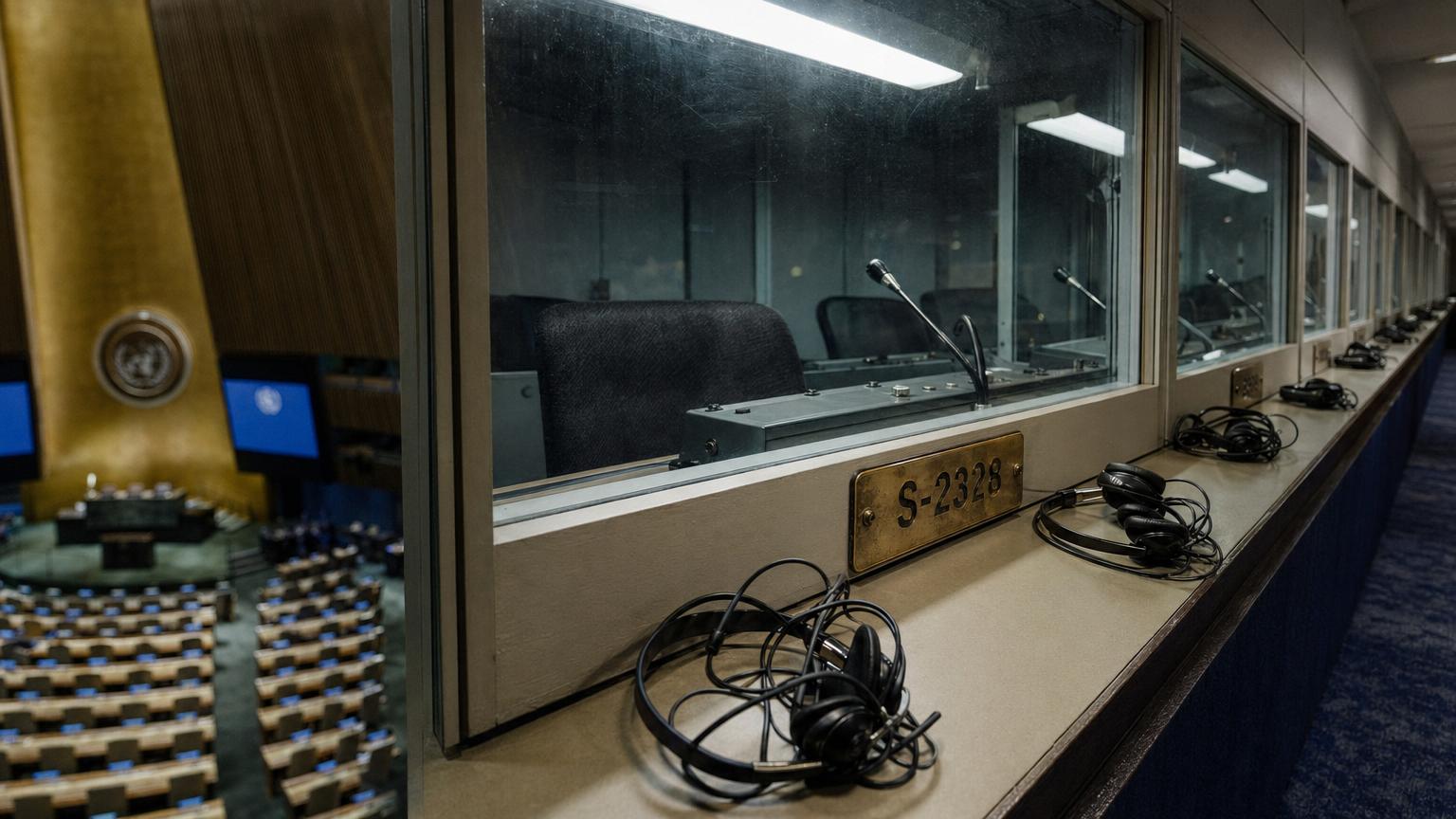
High above the delegates, the first witnesses are the booths.
Not the flags. Not the nameplates. Not even the microphones, those little metal reeds through which governments try to sound calm. The booths matter because every sentence at a nuclear conference has to survive translation before it can become diplomacy. A phrase about strategic stability leaves one desk, climbs into glass, passes through headphones, comes back in another language and lands in front of a country that may hear promise, loophole, threat or insult.
That is the small architecture of the 11th Review Conference of the Parties to the Treaty on the Non-Proliferation of Nuclear Weapons, which opened Monday, April 27, 2026, at United Nations Headquarters in New York and is scheduled to run through May 22. Ambassador Do Hung Viet of Viet Nam is presiding over a meeting whose subject sounds like old Cold War furniture but is suddenly very present: who may have nuclear weapons, who must not, who gets peaceful nuclear technology, who checks the books and what happens when the checking breaks down.
The document under review is usually shortened to NPT, a name with the glamour of a customs form and the weight of a world rulebook. Its basic bargain is simple enough to fit on a placard and hard enough to keep whole for more than half a century: most countries agree not to acquire nuclear weapons; the five states recognized by the treaty as nuclear-weapon states agree to pursue negotiations toward disarmament; all parties retain access to peaceful nuclear technology under safeguards.
It is a bargain with three legs and many bruises.
The NPT has 191 states parties, making it one of the most widely joined security treaties on earth. It entered into force in 1970, when the nuclear age was young enough that many governments feared the bomb could spread quickly to dozens of countries. It did not stop every nuclear program. India, Pakistan and Israel never joined. North Korea announced its withdrawal and built nuclear weapons outside the treaty. But the NPT did help make nuclear-weapon possession unusual rather than ordinary. That achievement is not a small bureaucratic success. It is one reason many countries that could have tried to build bombs did not.
The question in New York is whether unusual is still strong enough.
Old bargain, hotter room
Review conferences are supposed to happen every five years. They do not rewrite the treaty. They take its temperature. Delegations argue over whether the three pillars are holding: non-proliferation, which means preventing the spread of nuclear weapons; disarmament, which means reducing and ultimately eliminating nuclear arsenals; and peaceful uses, which means access to nuclear energy, medicine, agriculture, research and other civilian applications under inspection.
Safeguards are the inspection and accounting rules run by the International Atomic Energy Agency, or IAEA, the Vienna-based body that checks whether declared nuclear material is staying in peaceful use. Think of safeguards less as one lock than as a ledger, camera system, seal, sampling kit, inspector visit and data review all trying to answer the same question: is material that could help make a bomb where a country says it is?
The 2026 conference begins with a procedural cloud already over the ceiling. The last NPT review conference to produce a consensus final document was in 2010. The 2015 conference failed over disputes including the long-promised Middle East zone free of nuclear and other weapons of mass destruction. The 2022 conference failed after Russia objected to language linked to Ukraine and the safety of nuclear facilities under war conditions. A third failure in a row would not automatically kill the treaty. Treaties are not houseplants; they do not die because one meeting goes badly. But repeated failure can make a treaty look less like a common rulebook and more like an annual family argument nobody expects to resolve.
Consensus is a brutal standard. At an NPT review conference, one determined state can block a final document. That gives small and middle powers real leverage, which is part of the point. It also means a document often becomes a diplomatic casserole: some reassurance for nuclear-armed states, some frustration for non-nuclear states, some language on safeguards, some promises on peaceful uses and enough ambiguity to get everybody through the door.
This year, even ambiguity has hard work to do.
New START leaves a hole in the wall
The biggest fresh fact is not inside the UN building. It is the space left by New START, the last major U.S.-Russia treaty limiting deployed strategic nuclear weapons. New START expired on February 5, 2026. Russia had suspended participation in 2023, while saying it would continue to observe the treaty’s central numerical limits. The United States and Russia may still choose restraint. But a choice is not the same as a verified treaty.
That matters because the United States and Russia still hold the vast majority of the world’s nuclear weapons. SIPRI, the Stockholm International Peace Research Institute, estimated that the nine nuclear-armed states together possessed about 12,241 nuclear weapons at the start of 2025, with the United States and Russia holding nearly 90 percent. The Federation of American Scientists estimates that the nine possessed roughly 12,187 warheads at the beginning of 2026, with about 9,745 in military stockpiles and about 3,912 deployed with operational forces. These are estimates, not inventory receipts. Nuclear arsenals are secret by design, and different researchers count deployed, stored and retired warheads differently.
Still, the direction is clear enough to make the conference room feel smaller. The total number of warheads is far below Cold War peaks, but almost every nuclear-armed state is modernizing. Some are expanding. China’s arsenal has been growing. The United Kingdom raised its warhead ceiling in 2021. France’s nuclear posture is being debated in a changed European security climate. India and Pakistan continue to develop systems shaped by rivalry. North Korea remains outside normal inspection. Israel, widely understood to possess nuclear weapons, stays outside the NPT and maintains deliberate ambiguity.
Modernization is a slippery word. Governments use it to mean keeping old systems safe, secure and reliable. Critics hear a quieter version of arms racing. Both readings can contain truth. Replacing aging submarines, missiles, bombers, command systems and warheads can be described as maintenance. But when every nuclear-armed state modernizes at once, each country’s maintenance becomes another country’s planning problem.
That is why the NPT review conference is not only about the number of warheads. It is about whether anyone believes the traffic rules are still visible.
Inspection is the treaty’s daily job
Disarmament gets the speeches. Safeguards get the work orders.
The IAEA’s background paper for the 2026 conference says that in 2025 the agency implemented safeguards at about 1,400 facilities, spent nearly 15,000 calendar days in the field carrying out inspections and verification activities, and safeguarded nuclear material equivalent to about 246,000 significant quantities. A significant quantity is an IAEA yardstick: roughly the amount of nuclear material for which the possibility of making one nuclear explosive device cannot be excluded. It is not a recipe. It is an accounting alarm bell.
Those numbers make the treaty less abstract. Somewhere, an inspector checks seals. Somewhere, a national regulator counts grams. Somewhere, a camera needs maintenance, a lab sample needs analysis, a data stream needs review. The NPT is not only grand strategy. It is a clipboard in a controlled area.
The IAEA also warns that its safeguards workload has risen in a more technologically complex and resource-constrained environment. That sentence is bureaucratic, but the problem is practical. More nuclear facilities, more advanced reactors, more fuel-cycle activity, more digital data and more security risks mean inspectors need money, access, tools and political backing. Efficiency can help only so much. At some point, a thin inspection system becomes like a hospital trying to run more wards with fewer nurses and better software.
Iran is the most urgent inspection problem in the room, even when its name is not on every agenda line. The IAEA’s 2026 conference paper says that after military attacks on Iranian nuclear facilities in June 2025, Iran did not provide required special reports on the affected facilities and nuclear material, and the agency could not conduct verification activities at those facilities. The IAEA says it lost continuity of knowledge over previously declared inventories, including low-enriched and highly enriched uranium. In plain English: inspectors no longer have an unbroken chain of verified information about some material and equipment.
Continuity of knowledge is a boring phrase for a frightening gap. If you are counting library books, a missing afternoon may not matter. If you are accounting for material that can move a country closer to a bomb, missing time changes the confidence level.
Iran says its rights under the NPT matter. It is right that the treaty protects peaceful nuclear activity. Other states say Iran has not provided the cooperation needed to show that its program is exclusively peaceful. They are pointing to a real treaty obligation. That is the NPT’s hardest knot: the same technology family that can fuel reactors can, at higher enrichment levels and under different arrangements, help make weapons material.
Peaceful atoms are not a side chapter
For many countries, the NPT is not mainly a story about missiles. It is about access.
Article IV of the treaty recognizes the right of parties to develop research, production and use of nuclear energy for peaceful purposes, consistent with non-proliferation obligations. That includes nuclear power, but also cancer treatment, crop science, water management, industrial testing and research reactors. For countries facing rising electricity demand and climate pressure, nuclear power is increasingly discussed as one possible low-carbon energy source.
The IAEA has raised its global nuclear power projections for several years in a row. The International Energy Agency reported that global nuclear capacity remained about 420 gigawatts at the end of 2025, with reactors operating in more than 30 countries. Industry data show dozens of countries considering, planning or starting nuclear power programs. The interest is real, although the optimism is uneven. Costs, construction delays, waste, safety, financing, fuel supply and public trust remain hard problems.
This makes the conference more complicated than a morality play in which nuclear technology is either villain or hero. A country trying to build a cancer-treatment program or stabilize a low-carbon grid may see strict supplier controls as unfair gatekeeping. A country worried about enrichment or reprocessing technology may see the same controls as common sense. Both views can come from legitimate concerns.
Small modular reactors add another wrinkle. These are proposed or emerging reactors designed to be smaller than traditional nuclear power plants, sometimes factory-built or deployed in remote grids. Supporters say they could reduce costs and serve countries or regions that cannot manage huge projects. Skeptics warn that many designs are unproven, financing remains uncertain and safeguards approaches must keep pace. The IAEA says it is preparing to safeguard new types of facilities, including small modular reactors, floating reactors and geological repositories.
Peaceful use, in other words, is not the soft chapter of the NPT. It is where climate policy, development, technology control and weapons risk meet in the same corridor.
Different countries hear different failures
If the conference sounds stuck, it is partly because states are not all disappointed by the same thing.
Many NATO countries say nuclear deterrence remains necessary as long as nuclear weapons exist and security conditions are dangerous. NATO’s North Atlantic Council issued a statement before the conference reaffirming commitment to the NPT while also describing the alliance as nuclear for as long as nuclear weapons exist. For NATO members under the U.S. nuclear umbrella, the treaty is not separate from fears about Russia, war in Europe and alliance credibility.
China has a different complaint. Chinese officials argue that the United States and Russia have special responsibility for deeper disarmament because of the size of their arsenals. Beijing also criticizes nuclear-sharing arrangements and the AUKUS submarine partnership among Australia, the United Kingdom and the United States. AUKUS is not a nuclear-weapons transfer, but it involves naval nuclear propulsion, a sensitive area because submarine fuel can involve highly enriched uranium and because military naval fuel is handled differently from ordinary civilian reactor fuel under safeguards.
Non-nuclear-weapon states, especially many in the Non-Aligned Movement and the New Agenda Coalition, often hear the loudest failure in Article VI, the treaty’s disarmament pledge. Their argument is straightforward: if most countries permanently give up nuclear weapons, nuclear-weapon states cannot treat disarmament as a decorative aspiration. They must show measurable progress.
The Treaty on the Prohibition of Nuclear Weapons, which entered into force in 2021, grew from that frustration. Its supporters argue that nuclear weapons should be banned outright because their humanitarian consequences are unacceptable. Nuclear-armed states and most of their allies reject the ban treaty, saying it does not solve the security conditions that lead states to rely on deterrence. That dispute will not be settled at the NPT review conference. But it changes the atmosphere. For many governments and civil society groups, the ban treaty is evidence that patience with step-by-step disarmament has thinned.
Then there is the Middle East. The 1995 NPT Review and Extension Conference, which extended the treaty indefinitely, included a resolution calling for a Middle East zone free of nuclear and other weapons of mass destruction and their delivery systems. Three decades later, the issue remains unresolved. Arab states and Iran point to Israel’s undeclared nuclear capability and non-membership in the NPT. Israel and its supporters point to regional threats and the absence of a broader peace and security arrangement. The zone is both a technical arms-control idea and a symbol of whether the treaty’s bargains are applied evenly.
This is the conference’s real difficulty: almost every delegation can bring receipts.
Final documents are not magic
It is tempting to treat the outcome document as the whole story. That would be too tidy.
A consensus final document would matter. It could reaffirm the treaty’s core bargain, support the global moratorium on nuclear testing, strengthen language on safeguards, encourage risk-reduction measures, back peaceful-use cooperation and give future diplomats text to build on. It would show that 191 parties can still agree on something, even in a rough security climate.
But a final document would not dismantle a warhead. It would not reopen an inspection site by itself. It would not make the United States, Russia and China accept a new arms-control framework. It would not resolve Iran, North Korea, AUKUS, the Middle East zone or nuclear sharing in Europe. A weak document could even paper over real danger with agreeable verbs.
Failure would also be less simple than it sounds. The treaty would remain in force. The IAEA would still inspect where it has agreements and access. Export controls would still operate. National regulators would still count material. Most countries would still have no intention of building nuclear weapons. But another collapse would make the review process look increasingly performative. It would strengthen the argument that nuclear-armed states use the NPT to prevent others from joining the club while moving too slowly on their own obligations.
The best measure of the conference may be less dramatic: whether it leaves behind usable work.
Usable work could include clearer reporting by nuclear-weapon states on arsenals and doctrines. It could include stronger funding and political support for IAEA safeguards. It could include practical language against attacks on nuclear facilities. It could include renewed backing for the Comprehensive Nuclear-Test-Ban Treaty, which bans nuclear test explosions but still has not entered into force because key listed states have not ratified it. It could include serious risk-reduction steps: hotlines, notification rules, crisis communication, military-to-military contacts and limits on the most destabilizing deployments.
None of that is glamorous. Nuclear restraint has always depended on unglamorous things working before panic begins.
Testing taboo, treaty gap
The Comprehensive Nuclear-Test-Ban Treaty, or CTBT, is one of those unglamorous-but-essential pieces. It opened for signature in 1996 and is supported by a global monitoring system designed to detect nuclear explosions. But it has not entered into force because all 44 states listed in Annex 2, countries with relevant nuclear technology at the time, must ratify. India, North Korea and Pakistan have not signed. China, Egypt, Iran, Israel and the United States have signed but not ratified. Russia ratified and later revoked its ratification before entry into force.
Even without entry into force, a testing taboo has held for most nuclear-armed states for decades. North Korea is the only country to have conducted nuclear explosive tests in the 21st century. That taboo is valuable because testing can help states develop new warhead designs and signal a new round of competition. But taboos are not self-maintaining. They need repetition, monitoring and political cost.
The NPT conference cannot bring the CTBT into force. It can make it harder, or easier, for governments to walk away from restraint. Sometimes diplomacy is not a door opening. Sometimes it is a wedge under a door that might slam.
Local stakes hide in global language
The NPT is a world story, but its consequences are not only planetary.
In a country planning its first nuclear power plant, the treaty affects who will sell fuel, train regulators and inspect facilities. In a hospital, isotope supply chains matter for diagnosis and treatment. In a port city near a naval base, arms-control collapse can shape what submarines patrol nearby. In a farming region using nuclear techniques for pest control or crop resilience, peaceful-use cooperation is not theoretical. In a community downwind of past nuclear testing, disarmament language can sound like delayed recognition of harm.
That is why the glass booths at UN Headquarters are more than scenery. They are part of a machine that turns local fears into global phrases and global phrases back into local rules. A small island state worried about sea-level rise may also want nuclear medicine access. A European state worried about Russian threats may also insist it supports eventual disarmament. A Middle Eastern state may talk about regional double standards. A Pacific state may talk about testing legacies. A nuclear-armed state may talk about deterrence, but its words land in countries that chose not to build the same weapons.
The treaty asks all of them to keep sharing one table.
What would count as grown-up success?
A grown-up success in New York probably would not feel like triumph. It would feel like maintenance done under bad weather.
It would begin with honesty: the disarmament pillar is weak, proliferation risks are serious, peaceful nuclear demand is growing and inspection systems need resources. It would avoid pretending that one slogan can settle deterrence, abolition, climate energy, Iran, North Korea and regional security. It would make room for the fact that countries face different dangers, while refusing to let different dangers become an excuse for permanent nuclear privilege.
It would also keep the treaty’s asymmetry visible. The NPT asks non-nuclear states to accept a permanent legal condition: do not acquire nuclear weapons. It asks nuclear-weapon states for a destination: negotiate toward disarmament. One obligation is easier to verify than the other. That imbalance has always been inside the bargain. When arms control is moving, the imbalance is easier to defend. When arms control stalls and modernization accelerates, the bargain looks lopsided.
The nuclear-armed states will say the security environment is too dangerous for big reductions. Many non-nuclear states will say reliance on nuclear weapons is what keeps the environment dangerous. Both arguments circle each other like people trying to pass in a narrow hallway while carrying glass.
The review conference cannot widen the hallway by itself. But it can slow the collision.
For the next four weeks, diplomats will argue through microphones under the interpretation booths. They will debate words such as irreversibility, transparency, accountability, peaceful uses and risk reduction. Some of those words will sound bloodless. Some will be bloodless. But behind them sit real objects: warheads in storage, reactors under construction, inspection seals, submarine fuel, cancer-treatment isotopes, seismic monitors, uranium cylinders, old test sites and new military plans.
The NPT has never been a promise that the world is sensible. It is a device built because the world is not.
On Monday, the device went back on the table in New York. The glass booths lit up. The headsets came on. The old bargain began another month of trying to be heard clearly before the next crisis speaks louder.