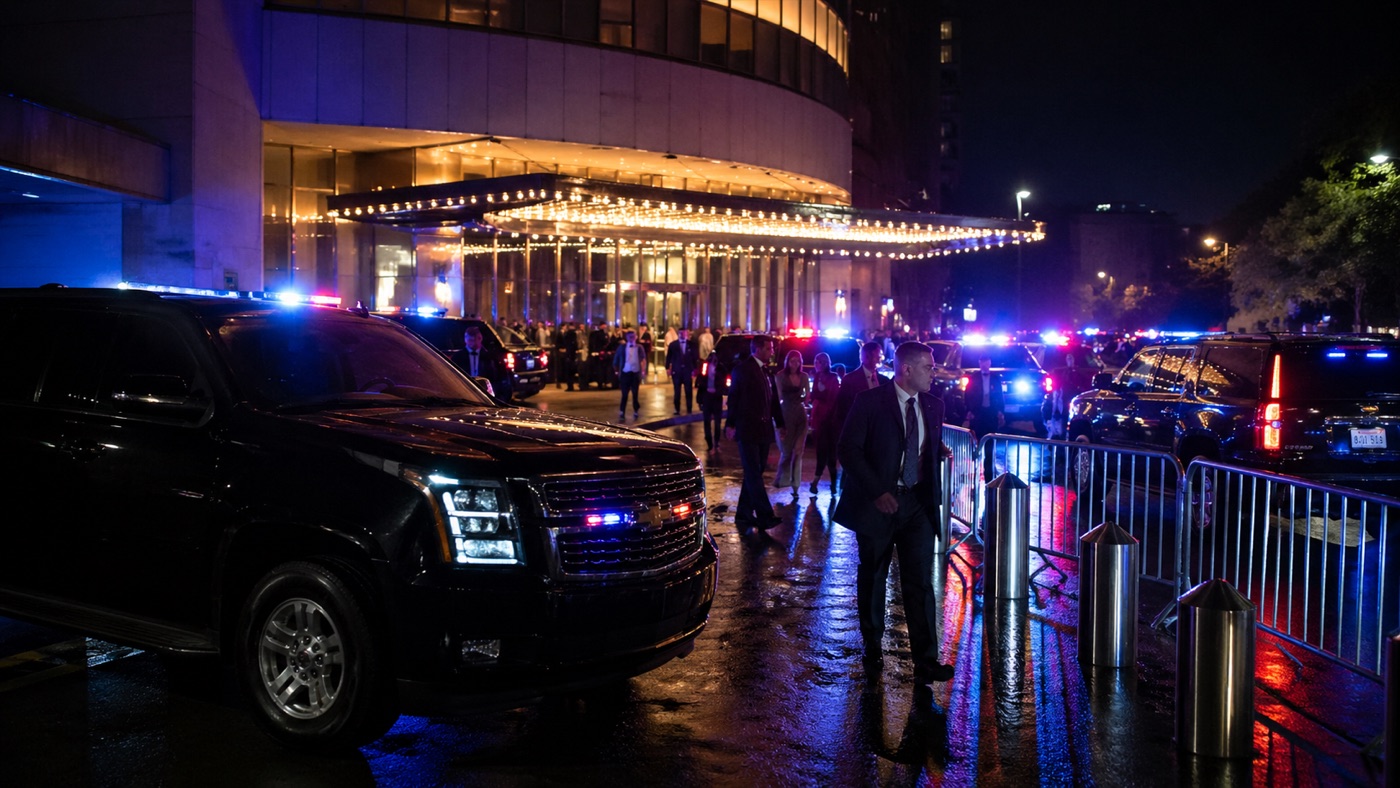
The White House Correspondents’ Dinner is supposed to be one of Washington’s strangest rituals: a black-tie collision of presidents, journalists, Cabinet officials, lawmakers, media executives, celebrities, donors, comedians, and people pretending they are not checking whether they made it into the room’s social hierarchy.
It is part dinner, part roast, part networking event, part press-freedom celebration, and part annual reminder that Washington can turn even public accountability into assigned seating.
But on April 25, 2026, the evening stopped being symbolic and became frighteningly real.
Authorities say a 31-year-old man from Torrance, California, identified as Cole Tomas Allen, attempted to breach security near the White House Correspondents’ Association Dinner at the Washington Hilton while President Donald Trump, First Lady Melania Trump, Vice President JD Vance, senior administration officials, journalists, and guests were inside. Allen has been charged in federal court with attempting to assassinate the President of the United States, along with firearm-related offenses connected to the incident.
According to the Department of Justice, Allen approached a Secret Service checkpoint on the Terrace Level of the Washington Hilton at around 8:40 p.m. while armed with a 12-gauge pump-action shotgun and a .38 caliber pistol. Federal officials say he ran through a magnetometer while holding the long gun. A shot was heard, a Secret Service officer was struck in the chest, and the officer survived because he was wearing a ballistic vest. The officer then fired at Allen, who fell to the ground and was arrested. The Justice Department said Allen had minor injuries but was not shot.
President Trump was not injured. Officials said the suspect was stopped before entering the ballroom.
That last sentence is important. It may also be the only reason this story is not much darker.
A dinner built for jokes and pageantry became a test of presidential protection, hotel security, political restraint, and public trust. It also became another example of how quickly a major news event now splits into two stories: the thing that happened in real life, and the louder, messier version that happens online afterward.
The official timeline
The clearest starting point is the federal account.
The Department of Justice said Allen was arraigned on April 27, 2026, in U.S. District Court on charges tied to the shooting at the dinner. The charges include attempted assassination of the president, transportation of a firearm and ammunition in interstate commerce with intent to commit a felony, and discharge of a firearm during a crime of violence.
Federal authorities say Allen made a reservation at the Washington Hilton for April 24 through April 26. He traveled from California to Washington, D.C., and checked into the same hotel that was hosting the dinner. The next evening, according to the DOJ, he approached the security checkpoint leading toward the ballroom.
The Associated Press reported that Allen had planned the attack in advance, reserved a hotel room, traveled across the country, and brought firearms to the event. The AP also reported that Trump was evacuated and that the Secret Service officer who was hit survived because of protective equipment.
Reuters reported that officials believed Trump was likely the target of the attack and that the suspect was thought to be acting alone. Reuters also reported that the incident prompted new questions about how someone allegedly armed with multiple weapons got close enough to trigger a confrontation near the event.
The Washington Post, citing an FBI affidavit, reported that Allen approached the checkpoint carrying a shotgun and pistol, and that authorities were still working through parts of the shooting sequence, including ballistics. The Wall Street Journal also reported that authorities were still determining exactly who fired the shot that struck the Secret Service officer.
That uncertainty matters. In a breaking-news environment, the first version of events often gets flattened into a simple story before investigators finish the difficult parts. The public may want certainty immediately. Investigators usually need evidence, witnesses, video, ballistics, and time. Annoying, yes. Necessary, absolutely.
Inside the ballroom
Inside the dinner, attendees were suddenly forced to process something almost impossible: a Washington social ritual had turned into a possible assassination attempt.
Reports from the scene described confusion, people taking cover, security rushing through the room, and guests trying to understand whether the noises they heard were part of the program, a disturbance, or something far worse. The AP reported that Trump was briefly held in a secure presidential suite before being returned to the White House. Reuters reported that the president, first lady, vice president, and other officials were moved quickly by security.
The event itself was reportedly canceled and expected to be rescheduled. That detail feels small beside the violence, but it shows how fully the evening was interrupted. This was not a minor disturbance outside a hotel. It was a disruption at one of the capital’s highest-profile annual events, with the sitting president and much of official Washington in attendance.
The White House later praised the Secret Service response. Press Secretary Karoline Leavitt said the president continued to have confidence in the agency and that agents acted quickly. The Washington Post reported that the White House defended the Secret Service against criticism, arguing that the suspect was stopped at the perimeter and that the protected officials were evacuated within minutes.
That defense may be true and still incomplete. Security can work in one sense and still reveal a problem in another. The suspect did not reach the ballroom, which points to a successful intervention. But authorities also say he reached a checkpoint near the ballroom while armed, which raises obvious questions.
Two things can be true at once. This is painful for the internet, which prefers every event to arrive pre-chewed into “total victory” or “total failure.”
Why the Washington Hilton matters
The Washington Hilton is not just any hotel. It has a heavy place in presidential security history because President Ronald Reagan was shot outside the same hotel in 1981 by John Hinckley Jr.
That history returned immediately after the 2026 incident. People reported that Hinckley himself commented on the latest shooting, calling it “spooky” that another violent incident had happened at the same hotel. His comments are not central to the investigation, but they show why the location carries such emotional and historical weight.
Hotels are complicated security environments. They are not built like fortified government facilities. They have lobbies, elevators, kitchens, loading docks, service corridors, guest rooms, staff entrances, parking areas, delivery routes, and hundreds or thousands of people moving through them for reasons unrelated to the event.
A ballroom can be secured. A hotel can be screened. A perimeter can be designed. But a hotel remains a living building. It is not a sealed box.
That is why the incident has revived questions about whether events that bring together the president, vice president, Cabinet officials, lawmakers, journalists, and prominent guests should continue in private hotel spaces. The Washington Hilton said, according to Reuters, that it was operating under strict Secret Service protocols coordinated with D.C. police and hotel security. That is not meaningless. But the existence of protocols is not the end of the conversation. Protocols are only as strong as their design, staffing, execution, and assumptions.
A protocol is not a magic spell. It is paper until reality tests it.
The suspect and the alleged motive
Federal officials have framed the case as an alleged assassination attempt against President Trump. The Justice Department’s announcement said FBI Director Kash Patel described Allen as traveling to Washington for the purpose of assassinating the president and targeting administration officials.
Business Insider reported that Allen allegedly sent an email to family members shortly before the incident, attaching a file described as an “Apology and Explanation.” The DOJ also said investigators found a message in which Allen apologized for the trouble he expected to cause and used aliases including “Friendly Federal Assassin.”
The Guardian reported that an FBI affidavit quoted Allen expressing rage at Trump in extreme language. Some outlets have reported additional details about alleged political beliefs, writings, and possible group connections, but those details should be handled carefully. Investigators may continue developing the case. Prosecutors may present additional claims. Defense attorneys may challenge the government’s account.
For now, the strongest wording is also the safest: authorities allege Allen intended to target Trump and possibly members of the administration. He has been charged, not convicted.
That distinction matters, not because the allegations are minor, but because the rule of law depends on it. The same people who demand justice should also demand accuracy. Otherwise the system becomes just another comments section with marble columns.
The White House response
The White House has used the incident to call for a review of presidential security. Reuters reported that White House Chief of Staff Susie Wiles was expected to meet with officials from the Department of Homeland Security, the Secret Service, and the White House operations team to review protocols.
Leavitt said security changes were not off the table. The Wall Street Journal reported that she said the administration would continue looking for ways to improve the safety of the president, vice president, and Cabinet officials. She also said Trump believed the security response worked during the incident.
The White House also placed the attack within a broader pattern of threats against Trump. Reuters reported that the administration described the dinner shooting as the third major assassination attempt against him since 2024.
That framing has political force, and it will likely shape public debate. It also makes careful reporting even more important. When an administration connects an attack to a broader narrative about political violence, journalists should report the claim, examine the evidence, and resist turning official framing into automatic truth.
The public deserves facts, not a fog machine with a podium.
A new fight over a White House ballroom
One of the stranger political arguments to emerge after the shooting involves a proposed White House ballroom.
Reuters reported that some congressional Republicans pushed legislation to fund and expedite a $400 million ballroom project at the White House, arguing that a secure venue is needed for large presidential events. Supporters say the shooting shows the risk of holding major events in hotels. Critics say using a violent incident to advance a costly construction project raises obvious concerns.
The Washington Post reported that Trump urged the White House Correspondents’ Association to reschedule the dinner within 30 days and renewed arguments for a secure White House ballroom. Some critics argue that the dinner should not be turned into a sales pitch for a new venue. Others say the shooting proves the current arrangement is too vulnerable.
This is Washington at peak Washington: a security crisis, a national debate, a budget fight, a construction plan, a public-relations battle, and probably someone somewhere trying to name a subcommittee after it.
Still, underneath the absurdity is a legitimate issue. If presidents are expected to attend large events with hundreds or thousands of guests, the venue question is real. A hotel is convenient and traditional. A secure government facility could be safer. But safety, cost, public access, press independence, and political optics all matter.
A democracy needs security. It also needs public life not to disappear behind walls.
The misinformation wave
Almost immediately after the shooting, misinformation spread online.
The Associated Press reported that conspiracy theories circulated despite real-time coverage from reporters at the event. Some online users claimed the attack was staged. Others connected the shooting to unrelated political controversies or foreign governments without evidence. The AP noted that these claims fit a pattern seen after previous violent incidents, when uncertainty creates space for conspiracy theories to grow.
The New York Post, citing analysis by the Post and Storyful, reported that an image circulating online that allegedly showed Allen wearing an Israel Defense Forces sweatshirt appeared to be The report pointed to visual inconsistencies and AI-detection findings. Whether someone believes that particular outlet on every issue is not the point. The broader warning is obvious: fake images can enter the bloodstream of a breaking story before the facts have even cleared their throat.
This is one of the defining problems of modern news. The physical event happens once. The online event happens thousands of times in competing versions.
A shooting occurs. Then come the fake screenshots. The out-of-context clips. The dramatic posts from people nowhere near the scene. The alleged “inside sources” with profile pictures of eagles, flags, skulls, anime characters, or sunglasses. The AI images. The partisan claims. The monetized outrage. The instant certainty.
This is why source-heavy articles matter. Not because sources are decoration. Because sources are the scaffolding that keeps a story from collapsing into noise.
The human side of the room
Major political violence is often discussed in cold vocabulary: threat environment, perimeter breach, tactical response, ballistic vest, protective detail, suspect apprehension. Those words are necessary. They are also incomplete.
Inside the room were people who thought they were attending a dinner. Some were journalists. Some were spouses. Some were staff. Some were entertainers. Some were officials. Some were guests who probably spent more time deciding what to wear than thinking about emergency exits.
People reported that Bruce Springsteen, a longtime critic of Trump, said during a concert that he was thankful no one, including the president, had been harmed. The Guardian reported that George Clooney condemned the shooting and broader violence. Entertainment Weekly and People reported that performers and guests described fear, confusion, canceled appearances, and the emotional fallout from the night.
Those reactions should not be the core of the investigation, but they matter. They remind readers that this was not just a security diagram. It was a room full of humans who suddenly had to think about survival.
Political violence turns symbols into people very quickly.
Press freedom in a security age
The White House Correspondents’ Dinner exists partly to celebrate journalism and press freedom. That makes the setting especially sharp.
The president and the press have always had a tense relationship. They should. Reporters are not supposed to be cheerleaders for power. Presidents are not supposed to be immune from questions. The dinner has often been criticized because it can make that relationship look too friendly, too glamorous, too clubby.
That criticism is valid. But the dinner also serves a real symbolic function. It says that political leaders and journalists can sit in the same room without the relationship becoming violence. It says a democracy can handle mockery, questions, conflict, and public scrutiny without collapsing.
The attempted attack changes the emotional meaning of the event. The question is no longer only whether the dinner is too cozy. The question is whether high-profile civic gatherings can still happen without becoming fortresses.
If every event involving the president requires tighter barriers, more secrecy, fewer guests, fewer reporters, and more distance from the public, then American public life gets smaller. That may be necessary in some circumstances. But it should not be treated casually.
Security protects democracy. Excessive isolation can also weaken it. Finding the line between those truths is one of the hardest problems in public life.
A pattern bigger than one night
The Correspondents’ Dinner incident is not only about one suspect and one event. It belongs to a larger American pattern.
Threats against public officials, judges, election workers, journalists, and political figures have become more visible in recent years. The targets vary. The ideologies vary. The methods vary. But the atmosphere is unmistakable. More people appear willing to treat politics as war by other means.
A democracy depends on disagreement. It depends on citizens being able to criticize leaders, organize politically, report aggressively, protest, argue, vote, and lose without reaching for violence. When political opponents become enemies to be destroyed, the system starts to rot.
This does not mean every harsh speech causes violence. It does not mean criticism should be censored. It does not mean politicians are above anger or public judgment. In a free country, people should be able to call leaders wrong, corrupt, dangerous, incompetent, dishonest, or cruel when they believe the evidence supports it.
But public figures and media personalities also know when they are feeding rage instead of argument. They know when they are implying that opponents are not merely wrong, but subhuman, traitorous, or deserving of harm. They know when they are turning politics into a permission structure.
The country does not need softer reporting. It needs cleaner lines between criticism and dehumanization, between accountability and fantasy, between evidence and bloodlust.
What should happen next
The first priority is the criminal case. Prosecutors will have to prove the charges. Investigators will continue examining Allen’s travel, weapons, communications, planning, and any possible connections or influences. Defense attorneys will have their opportunity to respond. Courts will decide what evidence is admissible and what the government can prove.
The second priority is security review. Officials should determine how Allen allegedly reached the checkpoint armed, whether any screening layers failed, whether staffing was adequate, how hotel movement was controlled, and what changes should apply to future events.
The third priority is public honesty. Leaders should condemn political violence without exploiting it before facts are settled. Media outlets should update stories as new evidence emerges. Readers should resist the fake comfort of instant conspiracy. Platforms should expect
The fourth priority is preserving public life. Stronger security may be necessary. But a society cannot let every civic space become unreachable. When leaders can only appear behind sealed doors, when journalists can only cover power from a distance, when public events become fear exercises, democracy loses texture.
The goal should not be panic. The goal should be competence.
The night Washington will remember
The 2026 White House Correspondents’ Dinner will not be remembered for its jokes. It will not be remembered for its red carpet. It will not be remembered for its speeches, its guest list, or the usual Washington ritual of smiling at people you professionally despise.
It will be remembered for the gunman, the checkpoint, the officer hit in the vest, the ballroom full of frightened guests, the president rushed to safety, and the shock that followed.
It will be remembered because it exposed several American problems at once: the risk of political violence, the difficulty of securing public events, the fragility of trust, the speed of misinformation, and the strange stubbornness of Washington ceremony in an age of anger.
It will also be remembered as a warning.
A country cannot normalize assassination attempts. It cannot treat armed attacks at political events as just another headline cycling through the feed. It cannot allow conspiracy theories to outrun facts every time something frightening happens. It cannot keep pretending that public life will remain healthy if every disagreement is turned into an emergency and every opponent into a monster.
The White House Correspondents’ Dinner is often mocked as self-important. Sometimes it deserves it. Washington has never met a mirror it did not want to give an award to.
But beneath the vanity, the dinner represents something real: a room where power and the press are supposed to coexist without violence. On April 25, 2026, that fragile idea came under threat.
The suspect was stopped. The president was unharmed. The injured officer survived. The investigation continues.
That is the good news.
The harder news is that the country still has to decide what it is becoming. A democracy can survive anger. It can survive scandal. It can survive ugly campaigns and brutal criticism. It cannot survive if political violence becomes just another language people use when they run out of arguments.
The dinner was supposed to celebrate the press. Instead, it became a test of whether Americans can still separate facts from chaos, security from fear, and disagreement from destruction.
That test is not over.