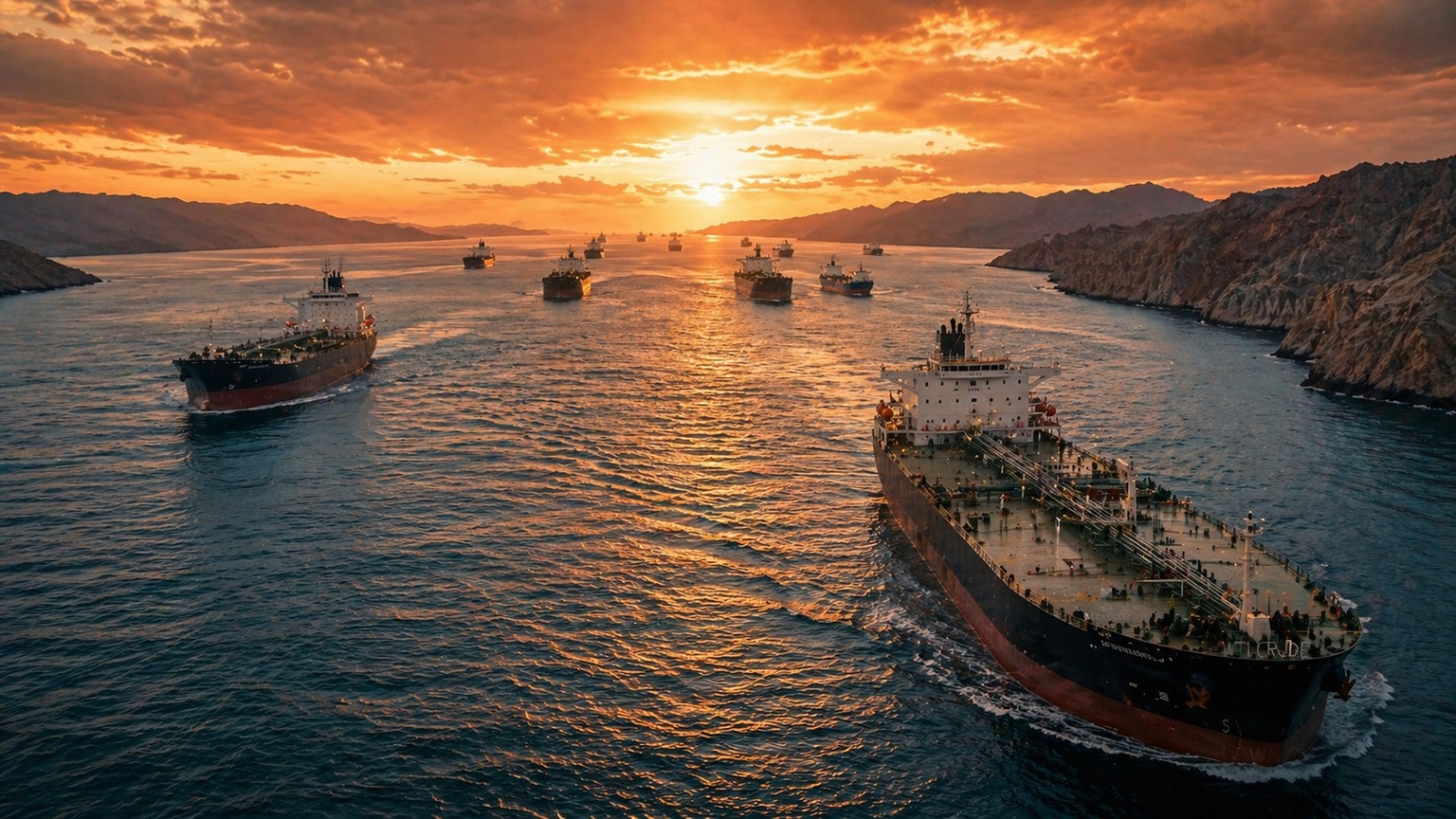
The Strait of Hormuz is only about geography until the ships stop moving. Then it becomes a price signal, a diplomatic weapon, a labor crisis and a reminder that the global economy still depends on narrow pieces of water behaving themselves. That is the uncomfortable lesson of this week’s standoff, as the U.S.-Iran war, a U.S. blockade of Iranian shipping and Iran’s restrictions around the strait have pushed one of the world’s most important energy routes into a state of partial paralysis.
On Tuesday, the visible crisis looked deceptively simple: too few vessels getting through, too many tankers waiting, oil prices climbing and negotiators trying to decide whether a shipping lane can be separated from a nuclear dispute. The deeper problem is more awkward. Hormuz is not just a route for Iranian oil. It is the exit door for energy from the Persian Gulf, a waterway used by Gulf producers, Asian buyers, ship crews, insurers, refiners and governments that would very much prefer their inflation charts not look like a distress flare.
Reuters reported that Brent crude for June rose to $108.68 a barrel early Tuesday, while U.S. West Texas Intermediate moved to $96.96. Those prices are not only a market reaction to speeches or threats. They are a reaction to physical flow: how many ships move, which ships move, what cargo they carry and whether crews believe the trip is survivable. In that sense, the oil screen is reading the strait as much as traders are.
Before the war began on February 28, roughly 125 to 140 ships crossed the strait daily, according to Reuters accounts based on shipping data. This week, data cited by Reuters showed only seven ships had crossed in a day, none carrying oil bound for the global market. Six Iranian oil tankers carrying an estimated 10.5 million barrels were forced back toward Iranian ports, while U.S. forces had turned back 37 vessels since April 13, according to the same reporting. A single successful passage can now be treated almost like a weather report.
One such passage came from an LNG tanker managed by the United Arab Emirates’ ADNOC. Ship-tracking data cited by Reuters suggested the vessel had crossed the strait after weeks without transmitting a signal and later appeared off India’s west coast. That did not mean Hormuz was open in any normal sense. It meant one tanker apparently made it through a route that used to be routine enough to disappear into logistics spreadsheets. The fact that a single crossing looked newsworthy says plenty. Human civilization: still shocked when its own supply chain has hinges.
A chokepoint becomes the story
The Strait of Hormuz has always been treated as the world’s most important oil chokepoint because the numbers are absurdly concentrated. The U.S. Energy Information Administration said oil flows through the strait averaged about 20 million barrels per day in 2024, equal to roughly 20 percent of global petroleum liquids consumption. The International Energy Agency describes the strait as carrying about 20 million barrels per day, around a quarter of world seaborne oil trade, with most of that oil bound for Asia.
Natural gas adds another layer. The IEA says about 93 percent of Qatar’s LNG exports and 96 percent of the UAE’s LNG exports move through Hormuz, representing about 19 percent of global LNG trade. That is why a local naval standoff can become a power-bill issue in Tokyo, a factory-cost issue in Europe and a fertilizer-price issue far from the Gulf. Nobody buying groceries in a suburb asked to be connected to a maritime chokepoint, but the economy enjoys making everyone part of the group project.
The present disruption is dangerous because it is not one problem. It is a layered system failure. Iran has restricted movement through the strait. The United States has maintained a blockade of Iranian ports and Iran-related shipping. Ships have faced seizure, gunfire, mine fears, confusing clearance rules and higher risk premiums. Negotiators are arguing over whether the waterway can reopen before nuclear questions are settled. Markets are trying to price the chance that all of this lasts days, weeks or months.
The usual comfort in chokepoint stories is that alternative routes exist somewhere on a map. In practice, alternatives are partial, expensive and uneven. The IEA estimates that only 3.5 million to 5.5 million barrels per day of pipeline capacity could redirect crude flows away from the strait. Some Gulf exporters can shift volumes toward Red Sea routes. Some buyers can use inventories or swaps. None of that replaces the normal function of Hormuz at full scale, especially for LNG.
The proposal that did not unlock the water
The diplomatic question this week is whether the strait can be reopened without resolving the war’s central political demands. The Associated Press reported that Iran offered to end its chokehold on Hormuz if the United States lifted its blockade and ended the war, while postponing discussion of Iran’s nuclear program. Reuters separately reported that Iranian sources described a proposal that would set aside the nuclear issue until after hostilities and Gulf shipping disputes were resolved.
Washington’s answer, so far, has been cold. Reuters reported that a U.S. official said President Donald Trump was unhappy with the Iranian proposal because it did not address the nuclear program. Secretary of State Marco Rubio has argued that Iran is trying to buy time, while U.S. officials have insisted that nuclear issues must be part of any settlement from the start. Iran has insisted talks cannot proceed while the blockade remains in place.
That leaves the two sides arguing over sequence. Iran wants the blockade lifted and the war ended before the nuclear file moves forward. The United States wants the nuclear issue included up front before accepting a deal that would normalize shipping. The strait is the pressure point between those positions. Every day it stays constrained, the conflict expands outward through oil prices, shipping schedules, insurance costs and political pressure on governments that are not formally in the fight.
Pakistan has been serving as a mediator, according to Reuters and AP accounts, with Iranian officials also seeking support from Russia and Oman. But mediation has not restored normal traffic. The most concrete scoreboard remains maritime movement, and that scoreboard looks ugly. Diplomacy can produce statements faster than ports can clear backlogs, which is inconvenient for everyone except people who enjoy press conferences more than functioning supply chains. There are, regrettably, many of them.
The crews are trapped inside the headline
Energy markets get the loudest headlines because oil prices are easy to chart. The human story is harder to fit on a trading screen. The International Maritime Organization’s secretary-general told a U.N. Security Council debate that roughly 20,000 seafarers and nearly 2,000 vessels remained trapped in the Persian Gulf. AP reported on crews stranded for weeks, including sailors watching drones and missiles explode as they waited for safe passage.
For a crew, a blocked strait is not an abstraction. It is a rotation that never arrives, a food shipment that has to stretch, a family call made from a ship that may not move tomorrow, and a set of orders changing faster than a vessel can safely respond. Commercial shipping works because thousands of workers keep doing routine, unglamorous, highly skilled labor across oceans. When governments turn a chokepoint into leverage, those workers become the soft tissue of the crisis.
The confusion has produced opportunists too. Reuters reported that Greek maritime risk firm MARISKS warned shipping companies about fraudulent messages claiming to offer safe passage through Hormuz in exchange for cryptocurrency payments. MARISKS said those messages were scams and were not sent by Iranian authorities. Even in a naval crisis, apparently someone saw stranded ships and thought, “what if this also had phishing?” The internet remains undefeated in being gross.
Safety fears have been sharpened by the mine threat. AP reported that Trump ordered the U.S. military to target Iranian small boats deploying mines in the strait, while saying mine-clearing operations would intensify. The same AP account said more than 30 ships had come under attack in the waters of the Persian Gulf, the Strait of Hormuz and the Gulf of Oman since the war began. Whether a ship is carrying crude, LNG, containers or bulk cargo, fear changes the route.
Why Asia feels the squeeze first
The crisis is global, but Asia is first in line for much of the pain because so much Gulf oil and LNG moves east. The IEA says about 80 percent of oil transiting Hormuz is destined for Asia. Japan’s JERA, the country’s largest power generator and a major LNG buyer, said it had enough LNG stock to last until July, while also noting that about 5 percent of its Japan-bound shipments pass through the strait. That is what resilience looks like in real life: inventories, swaps, procurement teams and fingers crossed in several languages.
Europe is exposed in a different way. It may not depend on Hormuz in the same direct pattern as some Asian buyers, but it still buys into the global price. AP reported that European Commission President Ursula von der Leyen linked threats to vessels in Hormuz with factories in Europe and said the EU was ready to work with Gulf countries on export infrastructure that would reduce dependence on the bottleneck. In other words: one blocked strait can become an industrial-policy meeting in Nicosia.
France and Italy have moved into the maritime-security conversation. Reuters reported that French President Emmanuel Macron said the goal was full reopening in line with international law and freedom of navigation without tolls. Reuters also reported that Italy was prepared to deploy up to four naval vessels, including two minesweepers, as part of an international mission once conditions allow. The phrase “once conditions allow” is doing a lot of work there, like a tiny bureaucratic mule.
Even if a political deal appeared, the recovery would not be instant. Traders, shipowners and insurers would need clarity about mines, detention risks, military rules, payment restrictions and whether the next escalation would close the route again. Cargoes delayed for weeks do not teleport into refineries. LNG schedules do not heal themselves because diplomats found a comma everyone could tolerate. A reopened strait would still require trust, and trust is usually the last cargo to arrive.
The oil market is not waiting politely
Markets have already started reallocating stress. Reuters reported that the United States has become a kind of emergency swing supplier during the disruption, with U.S. oil exports rising sharply and refined products making up a large share of those flows. That does not mean Washington can replace OPEC or command private producers like a thermostat. It means U.S. production, reserves, sanctions policy and export flows have become important tools for cushioning the shock.
That cushioning has limits. Saudi Arabia can use routes that bypass Hormuz, but not enough to erase the disruption at full scale. The United States can export more, release reserves and adjust sanctions, but it cannot make every refinery compatible with every crude grade or guarantee that fuel prices stay politically harmless. The global oil system is flexible enough to bend, not flexible enough to pretend Hormuz is optional.
The political pressure builds quickly because energy prices leak into everything. Diesel moves food. Natural gas heats homes and powers factories. Fertilizer prices depend on energy costs. Airlines, shipping firms and manufacturers all have to decide whether to absorb higher costs or pass them forward. A blocked strait therefore becomes a tax, unevenly distributed and poorly explained, on people who may never know why their bill changed.
That is the central danger of the Hormuz standoff. It makes a regional war behave like a global utility problem. Every side can claim leverage, but the leverage runs through civilian systems: ship crews, electricity grids, household budgets, food supply chains and countries trying not to import a war through their fuel tanks. A chokepoint is powerful because it touches people who had no vote in the confrontation.
The narrowest part is not the only narrow part
The physical strait is the obvious bottleneck, but the crisis has exposed other narrow passages. Insurance underwriters must decide what risk is tolerable. Port authorities must decide which documents and guarantees are enough. Navies must decide how to communicate rules without escalating. Buyers must decide whether to pay more now, wait for cheaper cargo later or switch suppliers in a market where everyone else is asking the same questions. Each decision can slow the system even when no missile is fired.
That is why the story should not be read only as a question of whether Hormuz is technically open or closed. A waterway can be legally open, militarily contested, commercially avoided and financially toxic all at the same time. For shippers, the practical question is not whether a map shows a route. It is whether a captain, an insurer, a cargo owner and a government can all look at the same route and say yes. Right now, too many of those yeses are missing, and every missing yes becomes another delay in a system that was designed to look boring only when everything works.
What to watch now
The first thing to watch is not rhetoric. It is traffic. If daily crossings climb from single digits toward prewar levels, if loaded oil and LNG tankers begin passing consistently and if crews can rotate safely, the market will read that as real de-escalation. If single crossings remain exceptional, then every diplomatic statement should be treated as provisional stage lighting.
The second thing to watch is sequencing in the talks. A narrow shipping agreement could reduce immediate economic damage, but Washington has signaled it does not want a deal that leaves the nuclear issue untouched. Tehran, according to the proposal described by AP and Reuters, wants shipping and blockade questions settled first. That argument over order may decide whether tankers move before politicians can claim victory.
The third thing to watch is the safety architecture. Minesweepers, escorts, inspections, communications channels and rules for ship clearance matter as much as speeches. The IMO’s warning about seafarers and shipping points to the basic problem: reopening a route is not the same as making it safe. If the waterway becomes a zone where vessels can be stopped by either side, scammed by criminals or frightened by unclear rules, normal commerce will not simply resume.
For now, Hormuz has become the place where diplomacy, oil math and human endurance all meet. It is a narrow waterway carrying a very large argument. The ships waiting inside the Gulf are not only cargo. They are evidence. They show what happens when the world builds an economy on speed, concentration and fragile trust, then acts surprised when a chokepoint starts acting like a chokepoint. Truly, a species that invented both maritime insurance and geopolitical brinkmanship has some nerve acting shocked by paperwork with missiles attached.