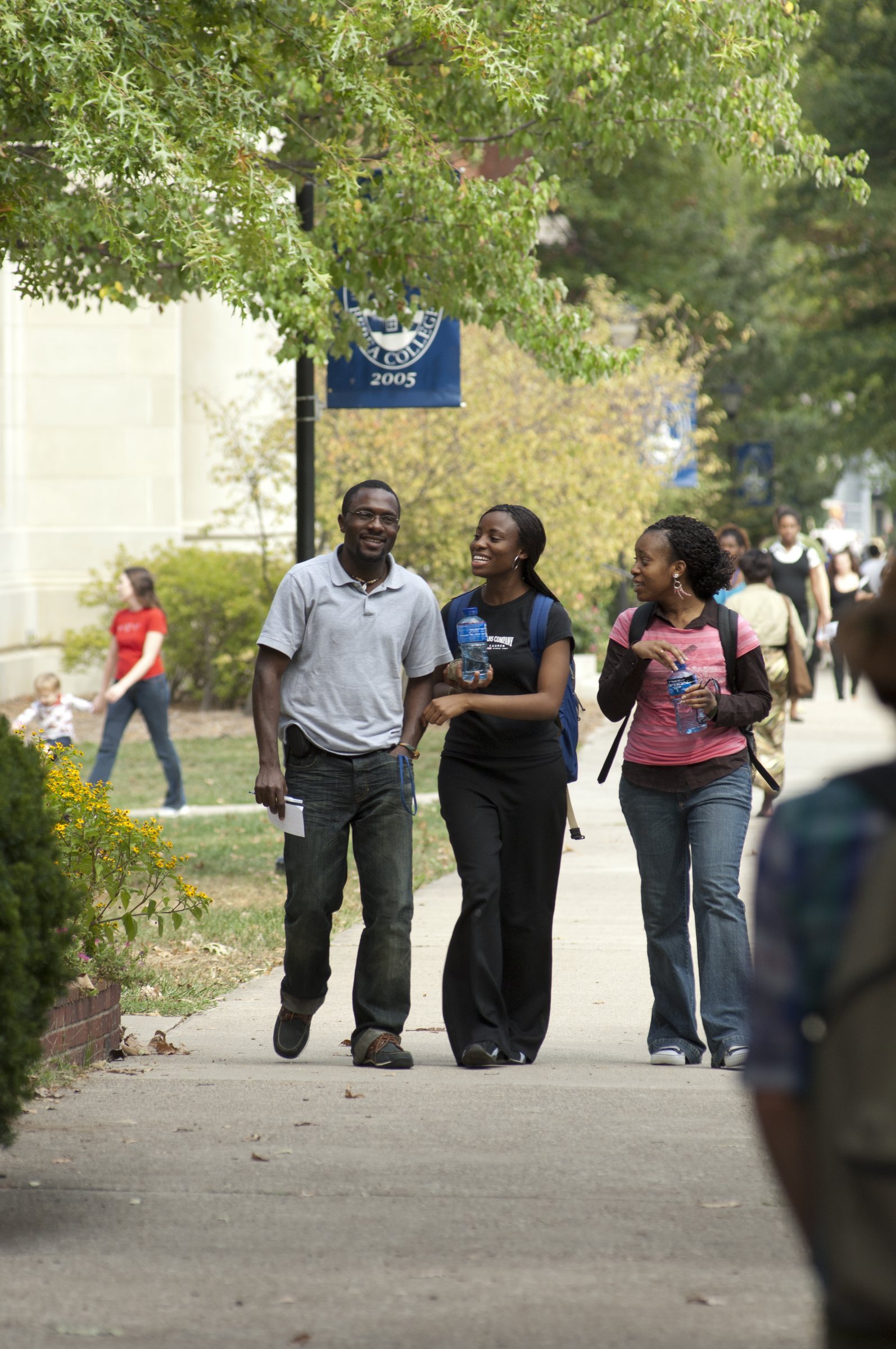
The comeback is visible in the totals
Higher education has spent several years living inside a story of drift. The easy version was that college had become more expensive, less trusted, less demographically favored, and therefore less central. There was truth in that. There was also overstatement. The latest enrollment data suggest that American higher education has found something closer to a floor than a free fall. The National Student Clearinghouse Research Center reported that fall 2025 enrollment topped 19.4 million students, with total postsecondary enrollment up 1.0 percent from the year before. Undergraduate enrollment rose 1.2 percent while graduate enrollment was essentially flat, slipping 0.3 percent.[1]
That is not a boom, and it is not a return to a frictionless belief in the value of college. It is, however, a meaningful correction to the mood that took enrollment decline as destiny. College is still the country’s most visible institution for sorting aspiration into credentials, networks, occupations, and debt. When enrollment stabilizes after a long stretch of anxiety, it suggests that the social demand for postsecondary education never vanished so much as fragmented. Students kept asking whether college was worth it. Many of them did not stop wanting it.[1][4][5][6]
The challenge is that recovery in higher education is rarely a single national story. Sector, selectivity, geography, age, and income matter. A national increase can mask divergence among public institutions, private colleges, community colleges, and graduate programs. That divergence is the real story of the 2025–26 cycle. There is a comeback. It is just not evenly distributed across the institutions that most hoped to benefit from it.[1][2][3]
Community colleges and public campuses did much of the recovering
The Clearinghouse data are clearest on one point: the rebound is being carried disproportionately by parts of the system that had the most ground to regain. Community colleges posted some of the strongest growth, and public four-year institutions also increased enrollment. At the same time, private colleges were softer, and graduate enrollment was not the engine of recovery. The picture is not of a uniformly rising tide. It is of students returning most visibly to institutions that are cheaper, more regionally rooted, and more likely to serve students whose educational decisions are tightly connected to labor markets and affordability.[1]
That matters because community colleges are often treated as the most exposed part of the sector. When enrollment collapses, they are said to be proof that faith in college is breaking. When they recover, the lesson is frequently understated. A community-college rebound suggests that price sensitivity and practical ambition continue to drive demand. It also suggests that the country still needs educational institutions willing to meet students where they actually are: working, commuting, retraining, balancing family obligations, and trying to minimize downside risk.[1][5][6]
The unevenness across sectors also complicates the prestige-heavy narrative of higher education. Elite campuses dominate culture-war debates and media attention, but they do not define most college attendance. If the strongest gains are happening in public systems and community colleges, then the real higher-ed story is not simply about brand damage or elite disillusionment. It is about how affordability, proximity, transfer pathways, and labor-market pragmatism shape demand when households are more careful than they were a decade ago.[1][4][5]
The applicant pipeline is broadening in specific ways
The admissions pipeline offers a second reason to resist lazy decline narratives. Common App’s March 1 update reported that first-generation applicants were up 6 percent year over year, while applicants from ZIP codes below the national median income were up 8 percent. Those numbers do not prove that every affordability or completion problem has been solved. They do show that the applicant pool is still expanding in directions that matter for access. Growth is not being driven only by the already-advantaged. The system is still attracting students who historically had less institutional support navigating it.[2][3]
That is one of the most encouraging facts in the current cycle, and one of the most fragile. Application growth is easier to celebrate than enrollment, persistence, and graduation. A broader applicant pool means the front door is being approached by more students from first-generation and lower-income backgrounds. It does not guarantee that they will get enough aid, attend the right institution for their circumstances, persist through the first year, or finish with a degree that improves their life. Access and success are related. They are not the same variable.[2][3][6]
Still, the pipeline data matter because they push back against a cynical reading of the sector. Students have not concluded en masse that college is a scam. Many are still doing the hard, hopeful work of applying. The more revealing question is what kind of system is waiting for them on the other side: one built to translate interest into completion, or one that treats the application as the last optimistic moment before debt, transfer friction, and institutional complexity take over.[2][3][5][6]
The demographic headwind never left the room
Even with better recent numbers, higher education is not escaping demography. Common App’s February update explicitly noted that growth has begun to slow as the country enters the long-anticipated period in which the number of high-school graduates starts to level off or decline in many places. The National Center for Education Statistics, meanwhile, projects that first-time freshman enrollment will increase over the decade from 2020 to 2030, but those projections sit beside a reality the sector already understands: geography matters, birth cohorts matter, and institutions that relied on a simple surplus of traditional-age students are entering a more competitive era.[3][4]
This is where the current moment becomes strategically interesting. A system can experience short-run recovery while still facing a medium-run population squeeze. That means institutions cannot interpret one good cycle as permission to go back to business as usual. Recruitment, transfer policy, adult re-entry, retention, and workforce relevance all become more important when the demographic tide is no longer carrying campuses effortlessly. Some institutions will adapt by getting better at serving the students they already say they want. Others will spend several more years discovering that hope is not a strategy.[1][3][4][5]
The NCES projections are useful here not because they offer certainty, but because they force the sector to hold two truths at once. Undergraduate enrollment is not doomed to permanent decline, and the supply of students will not solve institutional weakness by itself. Recovery is real. So is competition. The colleges that treat these facts as complementary will look sturdier than the ones that treat every modest upswing as a reprieve from structural change.[4][5]
Enrollment is not completion, and completion is not equality
One reason college debates feel so unresolved is that the system can succeed at the first step and still fail at the second. Students can enroll and still leave without degrees, with credits that do not transfer cleanly, or with debt that outlasts the educational benefit they hoped to gain. That is especially important for the populations now helping to widen the application pipeline. First-generation and lower-income students are often the least well served by institutional complexity, even when they are the most motivated to enter. If the comeback stops at the admissions office, it will not deserve to be called a recovery.[2][3][6]
NCES data from the Condition of Education show that immediate college enrollment after high school remained substantial in 2022, with about 62 percent of completers enrolling right away, including 45 percent in four-year institutions and 17 percent in two-year institutions. That is evidence of ongoing demand. It also underlines how much responsibility falls on the system after matriculation. Large numbers of students still want to continue their education immediately. The national challenge is not persuading them that education matters. It is building institutions that justify the faith students continue to place in them.[6]
The completion question is also where inequality becomes most stubborn. Students with family capital, advising support, and financial flexibility can survive institutional friction that derails others. A missed fee, a bureaucratic hold, a child-care crisis, or a scheduling conflict can become an exit ramp for a working student in ways that a more affluent peer barely notices. The next phase of higher-ed reform, if it is serious, has to treat persistence as an administrative design problem as much as an individual one.[2][5][6]
The comeback is a redistribution of demand, not a restoration of the old order
The temptation in higher education is always to narrate stability as restoration. If enrollment rises, perhaps the old hierarchy is back. If applications grow, perhaps confidence has returned in the old shape. The better reading is harder and more useful. The current recovery appears to be redistributing demand toward institutions and pathways that feel more accountable to cost, labor-market value, and practical flexibility. That does not diminish the importance of residential colleges or research universities. It does mean they no longer get to assume that the public will sustain them out of inherited reverence alone.[1][2][3][4]
In that sense, the college comeback is real precisely because it is not sentimental. Students are still showing up, still applying, still deciding that postsecondary education is central to their future. But they are doing so under tighter financial constraints, with sharper questions, and in ways that reward institutions able to answer those questions credibly. The rebound belongs to colleges that can demonstrate value without requiring students to ignore risk. That is a healthier basis for recovery than nostalgia would be.[1][2][3]
The sector’s task now is not to congratulate itself for surviving the decline narrative. It is to earn the next wave of trust. If community colleges, public campuses, and first-generation applicants are carrying the energy of the moment, then the moral center of higher education is not a return to prestige theater. It is whether the system can turn widened access into durable attainment. The comeback is here. The real test is whether it becomes a broader public good rather than a brief statistical relief rally.[1][2][5][6]
Source notes
Primary documents and reporting used for this story.
- 1. National Student Clearinghouse Research Center, Clearinghouse Enrollment Insights.
- 2. Common App, Reports and insights.
- 3. Common App, Deadline update, 2025–2026: First-year application trends through March 1.
- 4. National Center for Education Statistics, Projections of Education Statistics to 2028 / 2030 section.
- 5. National Center for Education Statistics, COE - Undergraduate Enrollment.
- 6. National Center for Education Statistics, The Condition of Education 2024 At a Glance (Immediate College Enrollment Rate).
Referenced documents
Corrections status
No corrections have been posted to this story as of April 7, 2026 • 11:21 a.m. EDT. For amendments after launch, use the corrections workflow linked in the footer.
Related reading
Education • Report
School Recovery Is Now an Attendance Story.
The next phase of school recovery is less about whether classes reopened and more about whether students are present, focused, and supported often enough for learning to accumulate.
Economics • Analysis
The Consumer Has Not Quit. The Economy Still Feels Cautious.
The American economy is still growing, but it is doing so with less exuberance, less labor-market churn, and more dependence on household spending than the public rhetoric admits.
Opinion • Essay
A Country That Cannot Measure Itself Cannot Govern Itself
Public statistics are not bureaucratic garnish. They are the information infrastructure that lets a democratic state know its labor markets, neighborhoods, businesses, and population well enough to act without governing by mood.