
The bill arrives before the storm
The new climate map does not always look like a map. It can look like a renewal notice on a kitchen table, a mortgage escrow adjustment, or a phone call from an agent explaining that the old policy is gone.
Treasury's insurance analysis, NOAA's disaster records, FEMA's public risk tools, and First Street's housing-risk research all point toward the same pressure: hazard, vulnerability, replacement cost, and capital markets now meet in the price of coverage. [1][2]
That makes insurance a strange but powerful translator. It takes smoke, wind, heat, hail, flood, and rebuilding costs and turns them into a household number that must be paid every month.
Put plainly, this is where the large system becomes readable. The policy language, engineering vocabulary, scientific measurement, and market signals all matter, but the test is more ordinary: whether people can see the risk early enough to make a better decision before the failure becomes personal.
The hard part is that an accurate price can still be unaffordable, while an artificially cheap price can hide danger until the public has to pay later. [3][4]
For a family, the argument is not philosophical. It is whether the payment fits, whether the lender accepts the coverage, whether the roof needs replacement, and whether staying put still feels possible.
The everyday stakes are the reason the receipts matter. A source note can look small at the bottom of a page, but each one is a handhold for the reader: a way to separate what the story knows from what it argues, what has been measured from what still has to be judged.
The insurance bill is becoming a climate document because it is the place where science, finance, construction, and ordinary anxiety all have to fit on one page.
Risk has an address now
Climate risk is not evenly spread, and insurance markets have become very good at noticing that unevenness. One block may flood. One hillside may burn. One roof may survive hail that destroys the house beside it.
FEMA's National Risk Index and flood pricing work show the public version of this logic, while state-level backstops in California and Florida reveal what happens when private insurers decide the ordinary market price no longer carries the risk. [3][9]
The old neighborhood average is giving way to more granular judgment. That can reward mitigation, but it can also make coverage feel arbitrary to people who thought they lived in the same market as everyone else.
Put plainly, this is where the large system becomes readable. The policy language, engineering vocabulary, scientific measurement, and market signals all matter, but the test is more ordinary: whether people can see the risk early enough to make a better decision before the failure becomes personal.
Precision is useful when it sends the right prevention signal. It is brutal when it leaves households with a technically accurate bill they cannot pay. [5][7]
Quick check: what changed if the premium doubled?
A doubled premium is not just a bigger bill. It can change escrow payments, debt-to-income ratios, whether a buyer can close, whether an owner can keep a mortgage current, and whether a community starts to lose ordinary families before the next storm arrives.
A risk score does not trim the tree, clear the culvert, add attic vents, or rebuild a roof. It only points to the work, and the work costs money before any savings arrive.
The everyday stakes are the reason the receipts matter. A source note can look small at the bottom of a page, but each one is a handhold for the reader: a way to separate what the story knows from what it argues, what has been measured from what still has to be judged.
The next argument in insurance will be less about whether risk exists and more about who gets help reducing it before the market punishes them for living with it.
The backstop is becoming the barometer
Residual insurance programs were designed as safety valves. They are supposed to catch people who cannot find coverage in the normal market, not quietly become the normal market for entire risk zones.
California's FAIR Plan and Florida's Citizens Property Insurance both show how public or quasi-public insurance structures can expand when private carriers pull back, while regulators try to keep the wider market from breaking. [6][7]
That expansion is not just an administrative fact. It is a measurement of market stress, because every policy that moves into a backstop says something about where private capital no longer wants to stand alone.
Put plainly, this is where the large system becomes readable. The policy language, engineering vocabulary, scientific measurement, and market signals all matter, but the test is more ordinary: whether people can see the risk early enough to make a better decision before the failure becomes personal.
Backstops protect households from total abandonment, but they can also concentrate risk and leave the public closer to the losses when the next catastrophe arrives. [5][8]
For an owner, the backstop can feel like rescue. For a state, it can feel like a swelling balance sheet. For a buyer, it can be the difference between closing and walking away.
The everyday stakes are the reason the receipts matter. A source note can look small at the bottom of a page, but each one is a handhold for the reader: a way to separate what the story knows from what it argues, what has been measured from what still has to be judged.
The goal should not be to shame backstops. It should be to make sure they buy time for mitigation, better building, and more honest pricing rather than becoming permanent climate triage.
The roof is climate policy
The most useful climate adaptation may not always look heroic. It may look like a stronger roof, cleared brush, a raised appliance, a shaded window, a bigger culvert, or a neighborhood drainage project that nobody photographs when it works.
Disaster and insurance sources show why small physical details matter: hail, wind, fire, flood, and replacement costs move through claims, and claims move into premiums, underwriting rules, and lender requirements. [10][2]
That turns maintenance into policy. A roof is not just private property when its failure becomes a claim, a neighborhood vulnerability, and a premium signal for everyone nearby.
Put plainly, this is where the large system becomes readable. The policy language, engineering vocabulary, scientific measurement, and market signals all matter, but the test is more ordinary: whether people can see the risk early enough to make a better decision before the failure becomes personal.
The unfairness is obvious: people with cash can harden a home before the bill arrives, while people without cash may be priced as risky because they cannot afford the improvements that would reduce the risk. [3][9]
This is where climate policy meets the contractor schedule. The repair that looks optional in March can decide whether a policy renews in September.
The everyday stakes are the reason the receipts matter. A source note can look small at the bottom of a page, but each one is a handhold for the reader: a way to separate what the story knows from what it argues, what has been measured from what still has to be judged.
If governments want insurance to remain available, mitigation cannot be a boutique rebate. It has to become the boring, financed, inspected, and repeated work of keeping homes insurable.
Insurance is part of the mortgage now
Housing stories usually talk about prices, rates, supply, and wages. Insurance used to sit below the headline as one of those necessary costs that buyers noticed late and sellers hoped would not interrupt the deal.
The source trail now suggests that insurance deserves a place in the main equation. Premiums, flood coverage, deductibles, and availability can affect escrow payments, buyer qualification, and the basic question of whether a property is financeable. [1][4]
That means climate risk can move into home values through a side door. A house does not need to be underwater or burned to lose appeal; it only needs to become expensive or uncertain to insure.
Put plainly, this is where the large system becomes readable. The policy language, engineering vocabulary, scientific measurement, and market signals all matter, but the test is more ordinary: whether people can see the risk early enough to make a better decision before the failure becomes personal.
Markets can adjust through price, but communities are made of people who cannot always adjust by moving. If risk repricing happens faster than adaptation funding, the social cost lands unevenly. [9][10]
Quick check: what changed if the premium doubled?
A doubled premium is not just a bigger bill. It can change escrow payments, debt-to-income ratios, whether a buyer can close, whether an owner can keep a mortgage current, and whether a community starts to lose ordinary families before the next storm arrives.
A buyer may discover the problem at the worst possible time: after the dream, after the inspection, after the offer, but before the final signature.
The everyday stakes are the reason the receipts matter. A source note can look small at the bottom of a page, but each one is a handhold for the reader: a way to separate what the story knows from what it argues, what has been measured from what still has to be judged.
The housing market will need to treat insurance as infrastructure, because a mortgage system that assumes coverage is easy will struggle in places where coverage becomes the hard part.
Fairness is harder than cheapness
It is tempting to define a fair insurance system as one with low premiums. That is understandable, but incomplete. A low premium that hides risk can become a public debt disguised as a bargain.
State reforms, NAIC climate-risk work, and global reinsurance research all revolve around the same balancing act: keep coverage available, keep insurers solvent, keep prices honest, and avoid pushing entire communities into abandonment. [5][8]
Those goals do not naturally harmonize. Availability can conflict with actuarial price. Solvency can conflict with affordability. Fast modeling can conflict with public trust.
Put plainly, this is where the large system becomes readable. The policy language, engineering vocabulary, scientific measurement, and market signals all matter, but the test is more ordinary: whether people can see the risk early enough to make a better decision before the failure becomes personal.
The question is not whether someone pays for risk. Someone always pays. The question is whether the payment arrives as a premium, a subsidy, a tax, a disaster appropriation, a lost home value, or an uninsured loss. [11][12]
Fairness, in practice, may mean helping people reduce risk before charging them for it, and helping them understand the bill before the bill becomes a threat.
The everyday stakes are the reason the receipts matter. A source note can look small at the bottom of a page, but each one is a handhold for the reader: a way to separate what the story knows from what it argues, what has been measured from what still has to be judged.
The next generation of insurance policy will be judged by whether it can tell the truth about risk without turning truth into exile.
Adaptation needs a payment plan
The country has learned how to talk about resilience, but not always how to finance it at the household scale. A grant program can sound generous until the waiting list meets the roofer's invoice.
Risk maps, state insurance reforms, and climate-housing research all point toward the same practical need: prevention has to arrive before cancellation, not after a family has already been told its home is too risky. [3][5]
That implies a new civic bargain. If society wants people to live in safer structures, it has to make safety affordable enough to install.
Put plainly, this is where the large system becomes readable. The policy language, engineering vocabulary, scientific measurement, and market signals all matter, but the test is more ordinary: whether people can see the risk early enough to make a better decision before the failure becomes personal.
The danger is a two-tier adaptation market: hardened homes for people with capital, exposed homes for everyone else, and public backstops trying to hold the middle. [4][2]
The most humane policy may be the least glamorous one: inspection, financing, verified improvements, premium credit, and a clear explanation of what actually reduces risk.
The everyday stakes are the reason the receipts matter. A source note can look small at the bottom of a page, but each one is a handhold for the reader: a way to separate what the story knows from what it argues, what has been measured from what still has to be judged.
Climate adaptation will become real when the paperwork for resilience is as ordinary as the paperwork for a mortgage.
The new map is not destiny
Insurance can make climate risk feel fatal because the bill arrives with a number and a due date. But a price signal is not destiny. It is a warning, and warnings are useful only if they create time to act.
The federal, state, disaster, and reinsurance sources do not support a simple story of doom. They support a story of tightening constraints: more expensive losses, more granular models, stressed backstops, and a public that needs clearer choices. [1][2]
That is the productive way to read the insurance bill. It is not only a punishment for living in the wrong place. It is also a demand for better roofs, better drainage, better maps, better public finance, and more honest land-use decisions.
Put plainly, this is where the large system becomes readable. The policy language, engineering vocabulary, scientific measurement, and market signals all matter, but the test is more ordinary: whether people can see the risk early enough to make a better decision before the failure becomes personal.
Some places will face terrible choices. Denying that helps nobody. But treating every risk as abandonment also lets institutions avoid the hard work of reducing danger. [11][12]
A family opening a renewal notice deserves more than a lecture about climate. It deserves options that make sense before the next storm, fire season, or lender deadline.
The everyday stakes are the reason the receipts matter. A source note can look small at the bottom of a page, but each one is a handhold for the reader: a way to separate what the story knows from what it argues, what has been measured from what still has to be judged.
The new climate map is being mailed one policy at a time. The question is whether the country reads it as a cancellation notice or as an instruction manual.
Source notes
Federal data, state insurance records, insurer and reinsurer research, risk maps, and consumer-facing public sources used to fact-check this story.
- U.S. Treasury, FIO homeowners insurance report and data release. Federal baseline on premiums, availability, and climate-related insurance stress.
- NOAA NCEI, U.S. Billion-Dollar Weather and Climate Disasters. Used for context on repeated expensive weather disasters.
- FEMA, National Risk Index for Natural Hazards. Used to explain that risk differs by place and by vulnerability.
- First Street Foundation, The 9th National Risk Assessment: The Insurance Issue. Used for the idea that insurance stress can expose hidden property risk.
- California Department of Insurance, Sustainable Insurance Strategy. Used for the state-policy response to insurer retreat and wildfire exposure.
- California FAIR Plan, About the FAIR Plan. Used to describe residual-market coverage as a stress signal.
- Citizens Property Insurance, Policies in Force. Used for Florida context on public insurance backstops.
- California Department of Insurance / NAIC, NAIC Climate Risk Disclosure Survey. Used for the regulatory frame around climate-risk disclosure.
- National Flood Insurance Program, Risk Rating 2.0: What Goes Into a Rate?. Used to explain flood premiums and individualized risk.
- Insurance Information Institute, Facts and Statistics: U.S. Catastrophes. Used for insured-loss and catastrophe context.
- Swiss Re Institute, sigma research on natural catastrophe losses. Used to explain the global capital layer behind local premiums.
- Munich Re, Natural disaster review and loss statistics. Used for global loss trends and risk framing.
Related reading
Climate • Feature
The Mountain That Fell Into the Sea
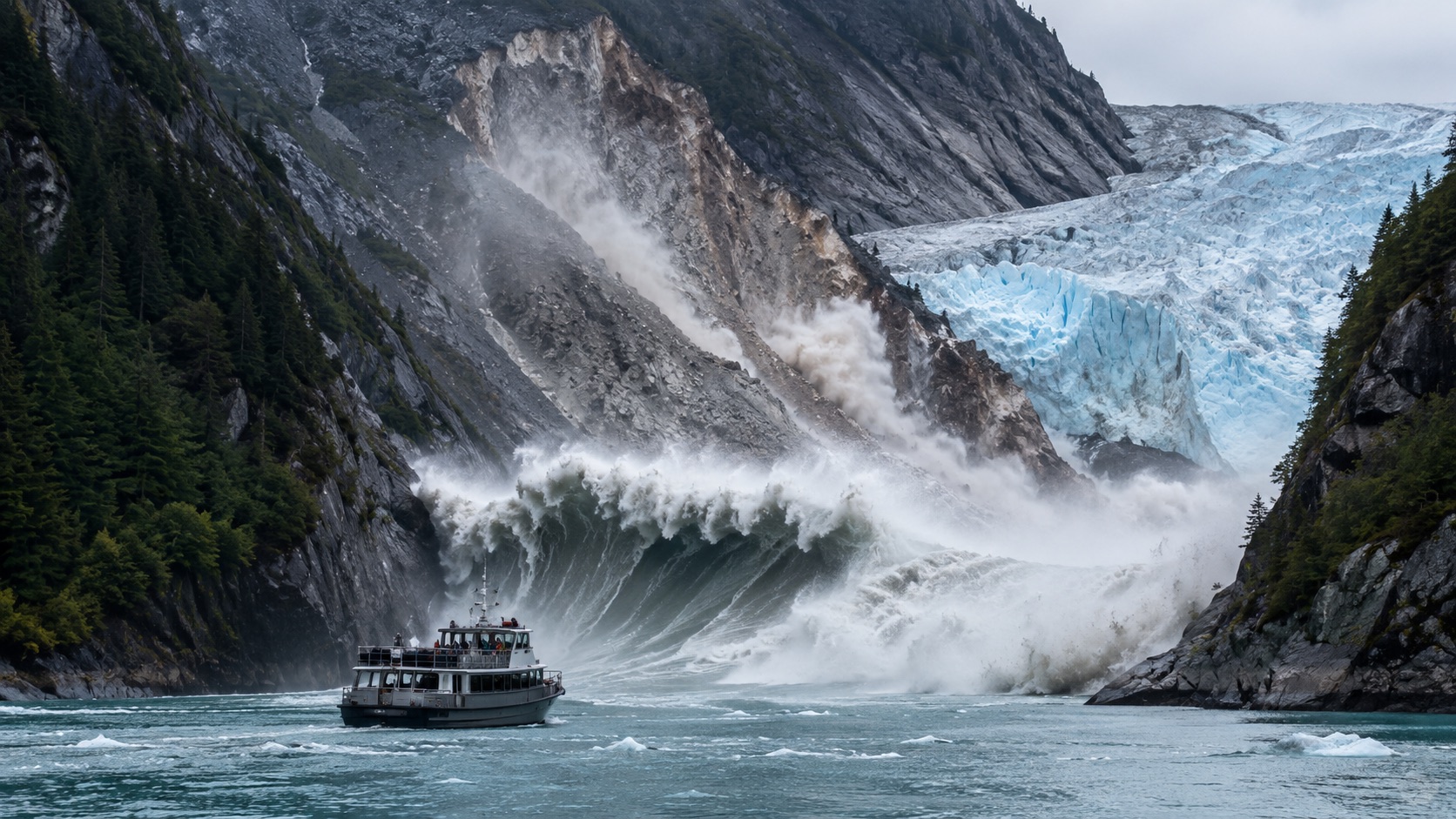
Alaska's Tracy Arm megatsunami sent water nearly 1,580 feet up a fjord wall. The real story is the narrow escape: glacier retreat, cruise traffic, seismic whispers, and a warning system built for a slower kind of wave.
By Mira Sato • May 8, 2026 • 9:00 a.m. EDT

Memory • Visual Dossier
Mob Ties
Thirty-one illustrated plates move from Prohibition Chicago to the Ravenite raid—a working visual sequence of faces, raids, tools, crime scenes and underworld mythology.
By The Press • July 18, 2026 • Local draft

Culture • Illustrated Feature
A Love Letter to New York
A newspaper-style illustrated edition of New York City, built from full-page visual stories about the places, teams, institutions, and civic systems that make the city feel alive.
By Nia Calder • June 15, 2026 • 9:00 a.m. EDT