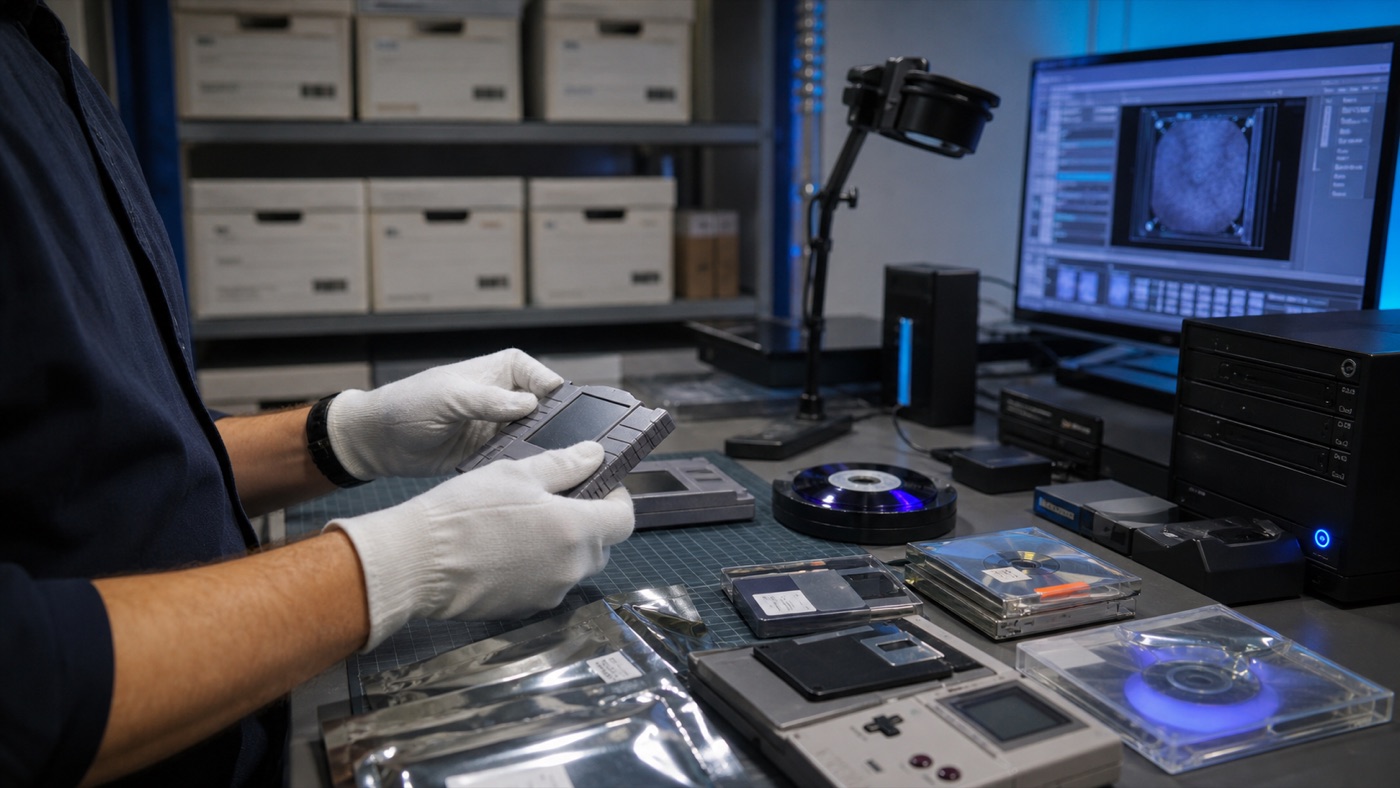
The illusion of permanence
Digital culture feels permanent because it is everywhere. That is the trap. A thing can be copied endlessly and still become inaccessible almost overnight.
Library of Congress preservation guidance, web archives, software collections, and the Video Game History Foundation's availability study all challenge the lazy assumption that digital abundance equals cultural memory. [3][11]
The internet does not preserve by existing. It preserves when institutions, communities, companies, and laws make deliberate choices to keep things findable and usable.
Put plainly, this is where the large system becomes readable. The policy language, engineering vocabulary, scientific measurement, and market signals all matter, but the test is more ordinary: whether people can see the risk early enough to make a better decision before the failure becomes personal.
A book can burn, but a server can vanish silently. A cartridge can survive in a drawer while the patch, account server, manual, soundtrack license, or storefront listing disappears. [5][1]
The loss often feels small until someone tries to study a game, a fan site, a tool, a video, or an early online world and discovers only broken links.
The everyday stakes are the reason the receipts matter. A source note can look small at the bottom of a page, but each one is a handhold for the reader: a way to separate what the story knows from what it argues, what has been measured from what still has to be judged.
The recent past is becoming archival before the public has learned to treat it as fragile.
Games are hard to save because they are not only files
A video game is not just a title on a list. It is code, art, interface, hardware behavior, controller feel, manuals, patches, network services, regional versions, player practice, and memory.
Game preservation sources from VGHF, the Library of Congress, MAME, and The Strong show why games require more than a screenshot and a release date. [1][4]
This is why preservation can look obsessive from outside and obvious from inside. Without the right environment, the work may exist but no longer behave like itself.
Put plainly, this is where the large system becomes readable. The policy language, engineering vocabulary, scientific measurement, and market signals all matter, but the test is more ordinary: whether people can see the risk early enough to make a better decision before the failure becomes personal.
Companies often preserve what they can sell. Historians need to preserve what explains the medium, including failures, experiments, regional oddities, licensed works, and games nobody remasters. [10][7]
Shelf test: could a student study it?
A preserved work is not only a file that exists somewhere. It is a work a researcher can find, identify, run or inspect legally, cite, compare, and understand in context. Availability is cultural access, not just storage.
The student trying to understand a design movement cannot rely only on greatest-hits collections. Culture is made from the ordinary shelf too.
The everyday stakes are the reason the receipts matter. A source note can look small at the bottom of a page, but each one is a handhold for the reader: a way to separate what the story knows from what it argues, what has been measured from what still has to be judged.
If games are a major art and technology form, they need preservation rules worthy of a major art and technology form.
Copyright is the lock and the shelter
Copyright is not the villain of preservation. It pays creators, protects markets, and gives owners rights that matter. But it can also lock memory inside legal uncertainty.
Copyright Office rulemaking records, EFF advocacy, Software Preservation Network work, and the VGHF study show how anti-circumvention law and access limits complicate preservation by libraries and archives. [2][9]
The legal problem is subtle. An archive may have the will and the expertise to preserve a work, but not the permission to make it accessible in the way scholarship requires.
Put plainly, this is where the large system becomes readable. The policy language, engineering vocabulary, scientific measurement, and market signals all matter, but the test is more ordinary: whether people can see the risk early enough to make a better decision before the failure becomes personal.
Rights owners fear uncontrolled distribution. Archivists fear cultural disappearance. Both fears can be legitimate, which is why blanket slogans do not solve the problem. [6][1]
A librarian should not have to choose between breaking the law and losing the only working copy of a cultural object.
The everyday stakes are the reason the receipts matter. A source note can look small at the bottom of a page, but each one is a handhold for the reader: a way to separate what the story knows from what it argues, what has been measured from what still has to be judged.
The legal future needs more precise tools: preservation access that is real enough for research and narrow enough to respect living markets.
Platforms are not libraries
A storefront can feel like a library until the license changes. A streaming catalog can feel like an archive until a title disappears. A social feed can feel like a record until the platform pivots.
Commercial preservation programs, public software archives, the Wayback Machine, and library preservation guidance show the difference between access by business model and preservation by mission. [8][5]
Platforms are built to serve users now. Archives are built to serve memory later. Sometimes those goals overlap, but they are not the same job.
Put plainly, this is where the large system becomes readable. The policy language, engineering vocabulary, scientific measurement, and market signals all matter, but the test is more ordinary: whether people can see the risk early enough to make a better decision before the failure becomes personal.
The public often discovers this only after something vanishes. What looked like ownership was access. What looked like a permanent URL was a temporary permission slip. [11][3]
People build identities around digital culture: games played with siblings, forums where they learned to code, videos that shaped humor, songs tied to a platform that no longer wants them.
The everyday stakes are the reason the receipts matter. A source note can look small at the bottom of a page, but each one is a handhold for the reader: a way to separate what the story knows from what it argues, what has been measured from what still has to be judged.
A serious digital culture needs commercial access and public memory, because either one alone is too fragile.
Emulation is historical machinery
Emulation is often discussed as if it were only piracy wearing a clever hat. That misses the preservation point. Emulation can be the machine that lets old software speak.
MAME, Internet Archive software collections, Software Preservation Network, and Copyright Office rulemaking all show that emulation sits at the center of practical software preservation. [10][5]
When original hardware fails or becomes rare, emulation can preserve behavior, timing, interface, and playability in a way a video clip cannot.
Put plainly, this is where the large system becomes readable. The policy language, engineering vocabulary, scientific measurement, and market signals all matter, but the test is more ordinary: whether people can see the risk early enough to make a better decision before the failure becomes personal.
The same tool can be used for legitimate scholarship and unauthorized distribution. That dual use makes policy hard, but it does not make the legitimate use imaginary. [6][2]
Shelf test: could a student study it?
A preserved work is not only a file that exists somewhere. It is a work a researcher can find, identify, run or inspect legally, cite, compare, and understand in context. Availability is cultural access, not just storage.
An arcade cabinet in a museum is wonderful. It is also scarce. Emulation can let more people study the experience without pretending the digital copy is the original object.
The everyday stakes are the reason the receipts matter. A source note can look small at the bottom of a page, but each one is a handhold for the reader: a way to separate what the story knows from what it argues, what has been measured from what still has to be judged.
The future of memory will depend on treating emulation as infrastructure and regulating misuse without criminalizing history.
Fans are unofficial archivists
Long before institutions learned to collect digital culture seriously, fans were saving manuals, dumping cartridges, scanning box art, mapping worlds, maintaining wikis, and writing down how things worked.
Museum collections, preservation networks, web archives, and availability research all reveal the importance of communities that preserved what companies and institutions did not. [7][6]
Fan labor is messy, uneven, passionate, sometimes legally gray, and often historically invaluable. It is the attic of digital culture.
Put plainly, this is where the large system becomes readable. The policy language, engineering vocabulary, scientific measurement, and market signals all matter, but the test is more ordinary: whether people can see the risk early enough to make a better decision before the failure becomes personal.
Institutions need standards, metadata, rights clarity, and durability. Fans often have speed, memory, enthusiasm, and the only surviving copy. [11][1]
The person who kept a strategy guide in a closet or mirrored a forum before shutdown may have saved a piece of culture nobody official had thought to value.
The everyday stakes are the reason the receipts matter. A source note can look small at the bottom of a page, but each one is a handhold for the reader: a way to separate what the story knows from what it argues, what has been measured from what still has to be judged.
The healthiest preservation future will connect fans and institutions instead of pretending one can replace the other.
Commercial preservation counts, but it cannot be the whole plan
When a company restores an old game for modern systems, that matters. It gives players legal access, pays rights holders, and proves that preservation can have a market.
GOG's preservation program, VGHF's availability study, Library of Congress resources, and public software archives show the value and limits of commercial access. [8][1]
The limit is selection. Markets preserve what can be sold, licensed, and supported. History also needs the strange, the broken, the minor, the obsolete, and the commercially inconvenient.
Put plainly, this is where the large system becomes readable. The policy language, engineering vocabulary, scientific measurement, and market signals all matter, but the test is more ordinary: whether people can see the risk early enough to make a better decision before the failure becomes personal.
A remaster can become a replacement in public memory, flattening differences between versions and making the accessible edition seem like the original. [4][5]
Players deserve playable classics. Researchers deserve the record of how those classics changed, failed, traveled, and were received.
The everyday stakes are the reason the receipts matter. A source note can look small at the bottom of a page, but each one is a handhold for the reader: a way to separate what the story knows from what it argues, what has been measured from what still has to be judged.
Commercial preservation should be celebrated as one lane, not mistaken for the entire road.
Memory is a choice, not a default setting
The culture most at risk is often the culture that feels too recent to be endangered. People assume someone is saving it because everyone remembers it.
Library preservation guidance, copyright records, preservation networks, and game-availability research all say otherwise: digital memory requires policy, institutions, tools, and permission. [3][2]
The internet is eating its own memory because convenience taught us to confuse access with preservation.
Put plainly, this is where the large system becomes readable. The policy language, engineering vocabulary, scientific measurement, and market signals all matter, but the test is more ordinary: whether people can see the risk early enough to make a better decision before the failure becomes personal.
We do not need to save everything in the same way. But we do need a public method for deciding what matters before platforms, drives, servers, and licenses decide for us. [6][1]
A future reader should be able to study what we made without excavating rumors from dead links and screenshots of menus that no longer open.
The everyday stakes are the reason the receipts matter. A source note can look small at the bottom of a page, but each one is a handhold for the reader: a way to separate what the story knows from what it argues, what has been measured from what still has to be judged.
Memory is a choice. The uncomfortable part is that choosing later often means choosing from what survived by accident.
Source notes
Preservation studies, copyright rulemaking records, library resources, museum collections, archive projects, and platform preservation sources used for this story.
- Video Game History Foundation, 87% Missing: the Disappearance of Classic Video Games. Used for the 87 percent availability finding and preservation frame.
- U.S. Copyright Office, Section 1201 Rulemaking. Used for legal context around preservation and access.
- Library of Congress, Digital Preservation. Used for preservation principles and library context.
- Library of Congress, Digital Preservation at the Library of Congress. Used for games as archival and research objects.
- Internet Archive, Software Collection. Used for public software access and emulation context.
- Software Preservation Network, Software Preservation Network. Used for institutional preservation network context.
- The Strong National Museum of Play, Collections. Used for museum preservation context.
- GOG, GOG Preservation Program. Used for commercial access and compatibility context.
- Electronic Frontier Foundation, DMCA Rulemaking and Preservation. Used for advocacy and legal-access context.
- MAME, MAME Project. Used for emulation as preservation infrastructure.
- Internet Archive, Wayback Machine. Used for link rot and web memory context.
Related reading

Memory • Visual Dossier
Mob Ties
Thirty-one illustrated plates move from Prohibition Chicago to the Ravenite raid—a working visual sequence of faces, raids, tools, crime scenes and underworld mythology.
By The Press • July 18, 2026 • Local draft
Culture • Illustrated Feature
A Love Letter to New York
A newspaper-style illustrated edition of New York City, built from full-page visual stories about the places, teams, institutions, and civic systems that make the city feel alive.
By Nia Calder • June 15, 2026 • 9:00 a.m. EDT

World • Investigation
Cartels Beneath the State
A source-forward investigation into how modern cartels recruit labor, tax local economies, launder money, exploit global demand, corrupt institutions, and govern by fear beneath the state.
By Samir Haddad • June 8, 2026 • 9:00 a.m. EDT