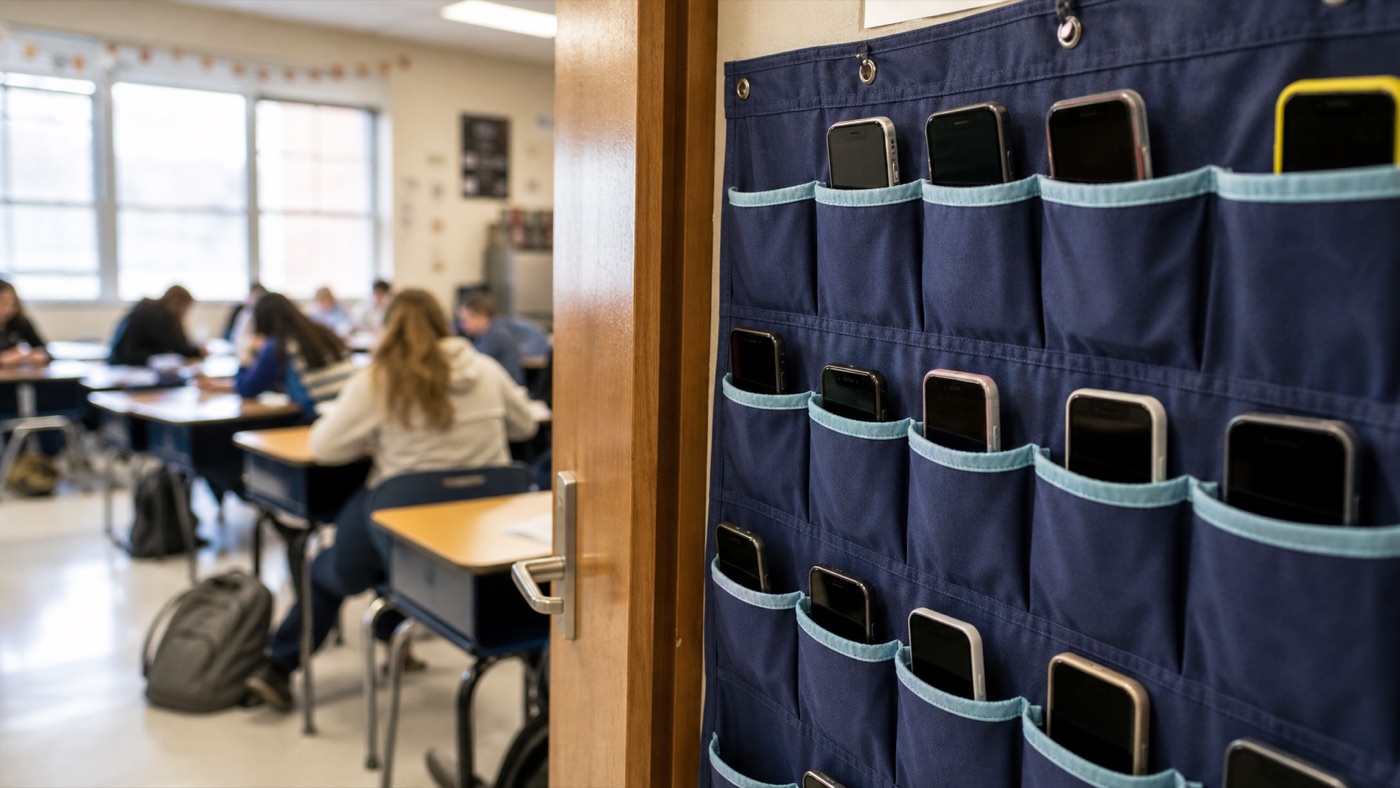
Attention is part of the curriculum
The phone-free school day begins with a claim so simple it sounds almost old-fashioned: attention is not extra. It is the condition that lets learning happen.
Pew's teacher survey, UNESCO's education-technology report, Common Sense's youth phone-use research, and Pew's teen access data all show why the phone has become a classroom policy problem rather than a private habit. [2][1]
The issue is not that every student is always distracted. The issue is that the possibility of distraction sits within reach all day, turning teaching into a competition with a device built to win attention.
Put plainly, this is where the large system becomes readable. The policy language, engineering vocabulary, scientific measurement, and market signals all matter, but the test is more ordinary: whether people can see the risk early enough to make a better decision before the failure becomes personal.
Schools do not want to demonize technology. They also cannot pretend that a pocket-sized social universe has no effect on the room. [4][3]
A teacher can lose a lesson not through rebellion but through glances, buzzes, side messages, and the tiny social negotiations that pull a class out of sync.
The everyday stakes are the reason the receipts matter. A source note can look small at the bottom of a page, but each one is a handhold for the reader: a way to separate what the story knows from what it argues, what has been measured from what still has to be judged.
The phone-free experiment asks whether school can reclaim shared time without pretending students live in 1998.
This is not only a mental-health story
The mental-health debate around phones and social media is serious, but the school phone question does not depend on solving every causal argument in adolescent psychology.
The Surgeon General's advisory, CDC youth health data, Common Sense phone-use research, and teacher survey data together show a complicated landscape of distress, exposure, notifications, and classroom disruption. [5][6]
That complexity should make policy careful, not paralyzed. A school can decide that phones interfere with learning even while researchers continue debating exactly how social media affects mental health.
Put plainly, this is where the large system becomes readable. The policy language, engineering vocabulary, scientific measurement, and market signals all matter, but the test is more ordinary: whether people can see the risk early enough to make a better decision before the failure becomes personal.
Overclaiming is risky. A phone pouch will not cure loneliness, anxiety, bullying, or sleep deprivation. But underclaiming is also risky if schools ignore a device that constantly interrupts the day. [4][2]
Classroom test: ban, pouch, or culture?
A rule can remove the device, but culture decides whether students see the rule as punishment, relief, or theater. The strongest policies usually answer storage, exceptions, parent communication, teacher enforcement, and what students get back when the phone disappears.
Students deserve more than slogans about addiction. They deserve adults who can separate evidence from panic and still make a usable rule.
The everyday stakes are the reason the receipts matter. A source note can look small at the bottom of a page, but each one is a handhold for the reader: a way to separate what the story knows from what it argues, what has been measured from what still has to be judged.
The strongest case for phone-free school may be practical: fewer interruptions, more presence, and a clearer boundary around the school day.
The emergency objection has to be answered
Every phone ban meets the same emotional wall: what if something happens? In the United States, that question carries the weight of school shootings, medical needs, family emergencies, and parental fear.
Policy trackers and state examples show that phone rules increasingly include exceptions, communication plans, storage requirements, and local implementation choices rather than a single universal model. [7][10]
The emergency concern cannot be mocked away. A policy that ignores it will lose public trust before it reaches the hallway.
Put plainly, this is where the large system becomes readable. The policy language, engineering vocabulary, scientific measurement, and market signals all matter, but the test is more ordinary: whether people can see the risk early enough to make a better decision before the failure becomes personal.
At the same time, emergency anxiety can become a veto on any rule. Schools have to explain how parents reach students, how students reach help, and why hundreds of phones can complicate a crisis too. [8][3]
A parent does not hand over trust easily. The school has to earn it with a plan that is boring, specific, and repeated until everyone knows it.
The everyday stakes are the reason the receipts matter. A source note can look small at the bottom of a page, but each one is a handhold for the reader: a way to separate what the story knows from what it argues, what has been measured from what still has to be judged.
Phone-free policies will survive only if they treat safety communication as part of the design, not as a FAQ added after protest.
Pouches are culture disguised as hardware
The physical object matters: pouch, locker, basket, cubby, magnet, bag, or locked case. But the object is only the visible part of the culture.
Implementation sources and classroom surveys show that enforcement consistency, teacher workload, and student buy-in can matter as much as the device chosen to store the phone. [10][7]
A pouch can create relief if the whole school uses it fairly. It can create resentment if it becomes another uneven rule enforced hardest against the students already watched most closely.
Put plainly, this is where the large system becomes readable. The policy language, engineering vocabulary, scientific measurement, and market signals all matter, but the test is more ordinary: whether people can see the risk early enough to make a better decision before the failure becomes personal.
The policy must decide whether phones disappear for the whole day, only during class, or only after a violation. Each choice sends a different message about trust. [2][4]
Students are excellent readers of adult inconsistency. If one teacher enforces and another shrugs, the rule becomes a game before it becomes a habit.
The everyday stakes are the reason the receipts matter. A source note can look small at the bottom of a page, but each one is a handhold for the reader: a way to separate what the story knows from what it argues, what has been measured from what still has to be judged.
The pouch is not the policy. The policy is the daily ritual the pouch makes possible.
What do students get back?
A phone-free school day is usually described by what it removes. The better question is what it returns.
UNESCO, OECD, CDC, and health-advisory sources all point toward broader goals than compliance: learning quality, school connectedness, attention, mental health, and technology use that serves a purpose. [1][9]
The promise is not silence for silence's sake. It is a room where students can be bored, curious, socially awkward, focused, annoyed, playful, and present without a feed filling every gap.
Put plainly, this is where the large system becomes readable. The policy language, engineering vocabulary, scientific measurement, and market signals all matter, but the test is more ordinary: whether people can see the risk early enough to make a better decision before the failure becomes personal.
That promise can sound sentimental if schools do not replace phone time with something worth having: strong instruction, clubs, counseling, recess, conversation, and real belonging. [6][5]
Classroom test: ban, pouch, or culture?
A rule can remove the device, but culture decides whether students see the rule as punishment, relief, or theater. The strongest policies usually answer storage, exceptions, parent communication, teacher enforcement, and what students get back when the phone disappears.
A student who loses a phone but gains nothing except stricter surveillance will not experience the policy as care.
The everyday stakes are the reason the receipts matter. A source note can look small at the bottom of a page, but each one is a handhold for the reader: a way to separate what the story knows from what it argues, what has been measured from what still has to be judged.
The most successful phone-free schools will sell the rule less as prohibition and more as restoration.
Equity lives in the exceptions
A universal rule can still land unevenly. Some students use phones for translation, health monitoring, family caregiving, transportation coordination, or disability support.
Policy sources and youth-data context show why implementation has to define exceptions carefully and protect legitimate needs without turning every exception into a loophole. [10][8]
Equity is not the enemy of a phone policy. It is the part that keeps the policy from becoming lazy.
Put plainly, this is where the large system becomes readable. The policy language, engineering vocabulary, scientific measurement, and market signals all matter, but the test is more ordinary: whether people can see the risk early enough to make a better decision before the failure becomes personal.
Too few exceptions can harm students who need support. Too many exceptions can swallow the rule and return the school to the old chaos. [6][3]
The student with diabetes, the newcomer translating a message, or the teenager responsible for a younger sibling is not a hypothetical. Good policy can see them.
The everyday stakes are the reason the receipts matter. A source note can look small at the bottom of a page, but each one is a handhold for the reader: a way to separate what the story knows from what it argues, what has been measured from what still has to be judged.
Phone-free schools will need disciplined compassion: clear boundaries, documented exceptions, and adults trusted to tell the difference.
Parents are part of the classroom weather
A student phone is often a parent phone by proxy. The text from home enters the classroom, and the classroom enters the family group chat.
Teen access data, phone-use research, and policy reporting show that student devices are now woven into family logistics, which means schools cannot change phone rules without changing parent behavior too. [3][4]
This is why some phone policies fail before first period. Parents may say they want focus and still text during class because the habit feels harmless from the outside.
Put plainly, this is where the large system becomes readable. The policy language, engineering vocabulary, scientific measurement, and market signals all matter, but the test is more ordinary: whether people can see the risk early enough to make a better decision before the failure becomes personal.
Schools have to ask parents for restraint while offering reliable channels for urgent contact. That is a delicate bargain because families have reasons to be anxious. [7][10]
A parent who sends a lunch reminder may not think of it as disruption. A teacher watching twenty reminders land at once sees a different weather system.
The everyday stakes are the reason the receipts matter. A source note can look small at the bottom of a page, but each one is a handhold for the reader: a way to separate what the story knows from what it argues, what has been measured from what still has to be judged.
The phone-free school day will require adults outside the building to act like the rule is real.
The measurement problem
The phone-free movement needs better evidence than vibes. A calmer hallway is useful, but schools should measure more than adult relief.
Education and health sources suggest multiple outcomes worth tracking: attendance, grades, disciplinary referrals, bullying reports, student connectedness, teacher retention, sleep, anxiety, and classroom climate. [1][9]
The best policies will be treated as experiments with feedback, not commandments carved into a wall.
Put plainly, this is where the large system becomes readable. The policy language, engineering vocabulary, scientific measurement, and market signals all matter, but the test is more ordinary: whether people can see the risk early enough to make a better decision before the failure becomes personal.
If a ban improves attention but increases punishment, that matters. If it helps ninth grade and not twelfth, that matters. If students feel more connected or more controlled, that matters too. [2][6]
Students should be asked what changed. Teachers should be asked what became easier and what became harder. Parents should be asked whether emergency communication still works.
The everyday stakes are the reason the receipts matter. A source note can look small at the bottom of a page, but each one is a handhold for the reader: a way to separate what the story knows from what it argues, what has been measured from what still has to be judged.
The phone-free school day will be groundbreaking only if it learns from itself.
Source notes
Education, health, survey, policy, and youth-media sources used to fact-check the phone-free school story.
- UNESCO, Global Education Monitoring Report 2023: Technology in education. Used for the global frame on technology in education.
- Pew Research Center, 72% of U.S. high school teachers say cellphone distraction is a major problem. Used for teacher-reported cellphone distraction.
- Pew Research Center, Teens and Internet, Device Access Fact Sheet. Used for device-access context.
- Common Sense Media, Constant Companion: A Week in the Life of a Young Person's Smartphone Use. Used for day-to-day smartphone-use context.
- U.S. Surgeon General, Social Media and Youth Mental Health Advisory. Used for health context without overstating causality.
- CDC, Youth Risk Behavior Survey Data Summary and Trends Report. Used for the adolescent health backdrop.
- Education Week, Which States Ban or Restrict Cellphones in Schools?. Used for policy spread context.
- California Legislature, AB 3216: Phone-Free Schools Act. Used for a state policy example.
- OECD, PISA 2022 Results. Used for international education context.
- Education Commission of the States, Cell Phone Use Policies: State Information Request. Used for policy design and implementation context.
Related reading

Education • Analysis
The College Comeback Is Real. It Is Also Uneven.
Enrollment finally looks steadier across higher education, but the recovery belongs more to community colleges and public campuses than to the sector as a whole, and the applicant pipeline is widening in ways that still demand better support after admission.
By Lena Park • April 7, 2026 • 10:40 a.m. EDT
Education • Report
School Recovery Is Now an Attendance Story.
The next phase of school recovery is less about whether classes reopened and more about whether students are present, focused, and supported often enough for learning to accumulate.
By Lena Park • April 6, 2026 • 12:25 p.m. EDT

Memory • Visual Dossier
Mob Ties
Thirty-one illustrated plates move from Prohibition Chicago to the Ravenite raid—a working visual sequence of faces, raids, tools, crime scenes and underworld mythology.
By The Press • July 18, 2026 • Local draft