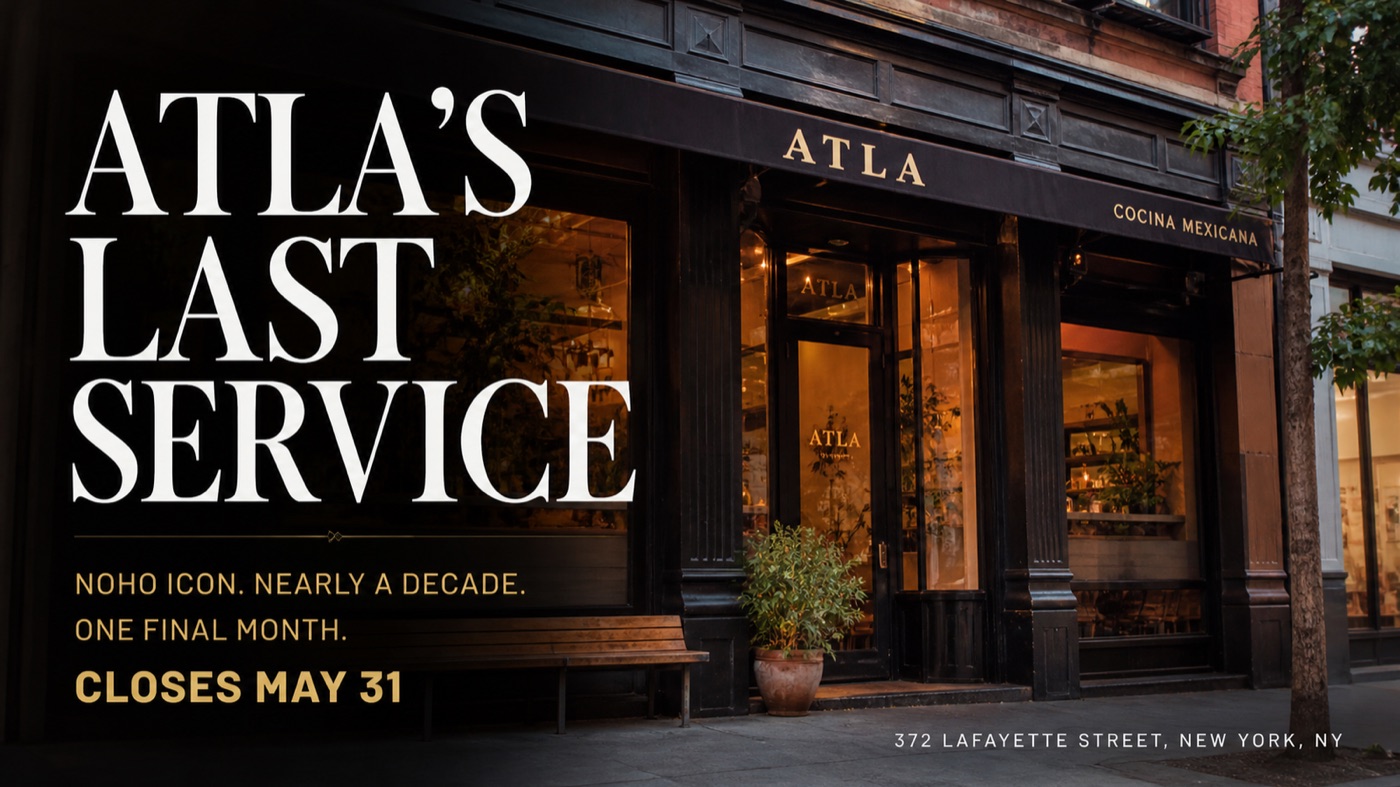
The last month at Atla
Atla is entering its last month with the strange composure of a restaurant that knows how to leave a room. There is no mystery box of rumors, no dramatic mid-service disappearance, no plywood finale where diners learn the ending from a darkened window. There is a date. There is a public announcement. There is a room on Lafayette Street still doing what rooms do: taking reservations, pouring drinks, turning a table over, sending out food while people begin to speak of it in the past tense too early.
The record is clean enough to be almost cruel. Eater NY reports that Enrique Olvera’s all-day Mexican restaurant in NoHo will close on Sunday, May 31, 2026, after nearly a decade at 372 Lafayette Street, and that Casamata plans a new restaurant in the same space this fall. 1 ATLA’s official page still describes the place in the present tense: a casual all-day eatery in the heart of NoHo, built around simple but inventive Mexican cooking, local and seasonal ingredients, and the flavor of Mexico in New York. 5 That gap between the present tense of a restaurant website and the future tense of a closing report is where the whole story lives.
A closing like this is not only a business item. It is a change in the city’s appetite. Atla was not the biggest restaurant in New York, not the oldest, not the grandest, not the one with the loudest mythology. But it occupied a very particular corner of modern dining: famous chef, casual format, serious food, daylight room, high design, social-media friendliness, neighborhood utility, global reputation. It was a restaurant that made a certain New York fantasy feel temporarily reasonable: that you could stop in for something quick and still be close to the center of the culinary weather.
What the closing actually says
The word “closing” is blunt. It lands like a pan dropped on tile. But Atla’s ending is more precise than that. WhatNow New York also reported the May 31 final service and the plan to transform the restaurant into a new concept from Olvera and Alonso de Garay. 4 Casamata’s own project page already described Atla as a restaurant flexible enough to evolve from relaxed all-day room into a sleek night-time venue, which now reads less like a brand paragraph and more like a clue. 7
This is not a landlord story, at least not from the evidence on the table. It is not a chef walking away from New York. It is a conversion. The public announcement frames the end as reinvention, and the most important word in the report may be “same.” Same address. Same hospitality group. Same corner. Different restaurant. New York diners understand this language. They know that a restaurant can die and still leave its body to the next idea.
That makes the farewell more interesting than a simple obituary. Atla is not being erased from the map so much as folded into the next draft. The group is keeping the room and changing the argument. The fall opening, still unnamed, is the sequel everyone will inspect with unreasonable confidence. What will it keep? What will it bury? What will it admit Atla could no longer do? Restaurant people rarely answer those questions directly. They answer in lighting, table spacing, menu verbs, price points, and whether the first thing you notice when you sit down is the bread, the tortilla, the cocktail, or the check.
The room was part of the dish
Atla’s address always did some of the work. The restaurant sits at Lafayette and Great Jones, one of those downtown crossings where the street feels both expensive and unfinished, polished by fashion and still able to cough up something odd. The NoHo dining guide calls ATLA an award-winning all-day cafe on the scenic corner of Lafayette and Great Jones, with modern Mexican cooking and a beloved patio. 29 Time Out’s review placed it between Great Jones and Bond and described a NoHo room that was slick but not over-styled, minimalist but convivial. 14
That matters because Atla was not only an idea of Mexican food. It was an idea of how to behave around Mexican food in New York. You could come in sunlit and underdressed. You could come in with a shopping bag, a stroller, a date, a laptop, a friend who said they were not that hungry and then ate half the guacamole. Condé Nast Traveler’s review caught that range: after-work dinners, neighborhood energy, weekend brunch, and a modern room that did not feel cold. 19
The windows were not neutral. Daylight at Atla made the room feel almost too legible. You saw the mezcal bottles, the pale surfaces, the plants, the people pretending not to watch each other. Food in that kind of room has to be exact, because the atmosphere gives it nowhere to hide. A dark dining room can make a dish mysterious. Atla’s light made food declare itself. A tortilla had to taste like a tortilla. A salsa had to cut. A cocktail had to earn its glass. Even the casualness had to be engineered.
The all-day promise
To understand why Atla mattered, return to 2017, when “all-day dining” was more than a schedule. It was a theory about rent, labor, prestige, and modern appetite. Eater’s national trend report placed Atla among the restaurants defining the all-day wave, with Olvera explaining that the restaurant was not meant to be planned only as a special occasion and that diners were growing tired of formalities. 10 That sentence has aged well because it describes a whole generation of restaurants that wanted craft without ceremony.
Atla did not treat breakfast as a warm-up act. Ryan Sutton’s Eater review argued that the restaurant was best during the day, when its light and menu made the strongest case. 9 Resy’s later story on Atla’s coffee program makes the same point from another angle: the all-day format ran through the café con leche, the Buna coffee connection, the conchas, the Mexican coffee vocabulary, and the restaurant’s willingness to be bar, cafe, and dining room in one continuous day. 20
The best all-day restaurants do not feel like three restaurants stitched together. They feel like one appetite changing clothes. Morning wants softness, lunch wants speed, afternoon wants a reason not to go home, dinner wants heat, and late night wants permission. Atla’s trick was to give each hour enough of what it wanted without turning the restaurant into a buffet of identities. It was a cafe with a chef’s discipline, a bar with masa in its bones, a casual room with a serious inheritance.
The food kept its knife edge
The danger with famous-chef casual restaurants is that they can become souvenirs of the serious place. They borrow the name, loosen the plating, thin the ambition, and hope the diner mistakes accessibility for soul. Atla mostly avoided that trap because it treated small forms as worthy of precision. A taco was not filler. A quesadilla was not a child’s compromise. A soup was not an apology for wanting comfort. The Infatuation’s review captured that paradox, calling Atla bright and all-day while arguing that the food carried the kind of textures and flavors diners might usually associate with New York’s highest-end restaurants. 17
Michelin lists Atla as a Bib Gourmand restaurant, the guide’s category for good food at comparatively good value, and its page keeps the restaurant in the public record beyond the churn of social feeds. 23 Grub Street’s 2017 review went even further in spirit, seeing Atla as a modern answer to several New York dining needs at once: coffee shop, juice bar, breakfast joint, mezcal bar, cocktail lounge, and serious Mexican restaurant. 13
That many-functioned identity could have turned shapeless. Atla made it edible by keeping the grammar short. Tortilla. Salsa. Aguachile. Pambazo. Chilaquiles. Churros. Margarita. Coffee. The menu did not have to perform difficulty to be difficult. It had to make dishes that people thought they already understood and then sharpen them just enough to make the familiar seem slightly dangerous. The pleasure was not in being confused. It was in being corrected by flavor.
The critics did not all eat the same restaurant
One of the best signs that a restaurant is alive is that intelligent people can disagree about it without sounding insane. Atla had that kind of life. The New Yorker’s early notice saw a chic all-day cafe where a chef known for Pujol and Cosme tried a different tack with tostadas, avocado toast, guacamole, micheladas, and conchas. 12 Time Out later made an even bigger claim, arguing that Atla represented where New York dining was in 2019 and treating approachability as part of its power. 14
But the record was not pure praise, and the article is better for admitting that. Gothamist’s early review was sharply disappointed by the giant chip, guacamole, fish Milanese, and other dishes, while still singling out the mushroom quesadilla as a bright spot. 28 That dissent belongs in the story because restaurants do not become beloved by being universally liked. They become legible by being argued over.
Thrillist’s 2017 feature recorded Daniela Soto-Innes describing the menu as based on how people in Mexico eat daily, not on the American caricature of Mexican food as a heavy plate of meat, cheese, sour cream, and sugar. 16 The line helps explain why the restaurant produced both affection and resistance. Atla was easy to enter, but it was not always interested in confirming what every diner thought they had ordered. Some people loved that. Some people wanted the chip to behave.
The feed is part of the farewell
The farewell is happening in the room, but it is also happening in the feed. The official Instagram announcement, Eater’s social post, public reposts, creator Reels, and old diner photos form a second dining room around the first one. The official ATLA post and Eater post are the clean receipts; public creator posts and older diner posts show the softer archive of meals people bothered to document. 2 3 48
Restaurant memory has always worked this way, just with different tools. A regular remembers the window table. A critic remembers the dish that made the room make sense. A stranger remembers the photo they took before the first bite because the plate looked briefly too composed to disturb. By the final month, all of those fragments start behaving like evidence.
The feed does not replace the room. It trails after it. It catches the official goodbye, the repost, the quick Reel, the older plate of food, the caption someone wrote before the closing had meaning. Together, those posts make Atla feel less like a headline and more like a place with witnesses.
The pedigree behind the casualness
Atla’s casualness only made sense because of the pedigree behind it. The Culinary Institute of America’s Olvera bio traces the chef’s education and restaurant career, while Casamata describes Pujol as his first project, opened in 2000, rooted in high-quality ingredients and Mexican technique. 34 7 Michelin now lists Pujol with two stars and calls it one of Mexico’s most famous dining rooms. 35
That is a lot of shadow for a bright cafe to carry. The casual restaurant from a famous chef is always trying to outrun two suspicions at once: that it is not serious enough for the chef’s name, and that it is too self-conscious to be truly casual. Atla’s best moments dissolved both. It did not ask you to bow to it. It asked you to order something that looked ordinary and then notice the work hidden in the ordinary.
Casamata’s team page also matters for the next chapter because the official announcement names not only Olvera but Alonso de Garay, the group’s architecture partner, as part of the coming concept. 8 A restaurant replacement is not only a new menu. It is a new room language. De Garay’s involvement suggests that whatever comes this fall will not merely swap dishes under the same lights. It may change how the corner wants diners to sit, look, drink, linger, and spend.
Daniela Soto-Innes and the opening moment
Atla’s origin story also belongs to Daniela Soto-Innes. Before the restaurant opened, World’s 50 Best interviewed her about Cosme, Olvera, and plans for a smaller, more laidback NoHo restaurant she described as something like a Mexican diner. 32 That is a useful phrase because it carries the democratic promise of Atla without pretending the restaurant would ever be a literal diner. The point was not chrome counters and bottomless coffee. The point was a restaurant you could return to.
By then, Cosme had already given New York a different vocabulary for contemporary Mexican cooking. World’s 50 Best describes Cosme as a hit destination since its 2014 opening and notes its global accolades, including Daniela Soto-Innes’s 2019 recognition. 31 Atla arrived as the more approachable sibling, but it was born from a kitchen culture already carrying major expectation.
The fact that Atla could be remembered as breezy is part of its achievement. Breezy is not easy. Breezy means the diner does not see the strain. Breezy means the guest believes the restaurant simply woke up like that, clean and sunlit, with tortillas warm and cocktails cold. The work hides under the ease. That, more than any single dish, was Atla’s most modern trick.
NoHo was not a backdrop
NoHo was never just scenery. It gave Atla both polish and pressure. The neighborhood is small enough to feel like an address book and visible enough to operate as a stage. The official NoHo site frames the area through historic architecture, artists, and creative downtown life. 30 The Infatuation’s NoHo guide reads Atla through that everyday mix: gym clothes, families, daytime meetups, bright windows, chicken soup, tacos, churros. 18
That range is the reason the closing lands differently from the loss of a remote destination restaurant. A destination restaurant can disappear from a city’s prestige map. A neighborhood-destination hybrid disappears from people’s habits. It changes where someone goes after a meeting, where a visitor is taken to seem casually informed, where a friend group pretends to be spontaneous. Atla was famous enough to draw outsiders and convenient enough to become routine. That combination is rare, and often temporary.
NoHo is also a neighborhood that constantly tests whether old textures can survive new money and new design. A restaurant like Atla did not solve that tension, but it benefited from it. It looked good in the area because the area itself is a collage: historic buildings, luxury retail, artists’ ghosts, fashion people, tourists, residents, and the constant low hum of downtown reinvention. A restaurant closing there never feels like an isolated event. It feels like the street changing costume.
The Los Angeles echo
The New York closing becomes more interesting when placed beside Los Angeles. The Los Angeles Times reported that Olvera is opening San Damián, a modern mariscos restaurant, in Venice this summer in the former Atla space, after the L.A. Atla outpost opened in 2023 and the space sat vacant. 40 Eater LA’s earlier opening report described Atla Venice as a West Coast outpost of the New York restaurant, larger in scale and adapted to California produce, tastes, and ingredients. 41
In other words, both coasts are telling a related story: Atla as a vessel, then Atla as a room ready for a more specific next act. Resy’s Venice feature traced how the L.A. restaurant riffed on Mexican classics with dishes like pork al pastor gringa and a lobster burrito inflected by the West Coast setting. 42 OpenTable’s opening feature emphasized everyday Mexican cooking with a coastal twist and noted the Venice room’s airy design and local sourcing. 43
This does not mean New York’s replacement will copy San Damián. It means Casamata appears willing to let a concept end when a sharper one presents itself. That can be sad for diners and smart for operators at the same time. A restaurant brand can become a cage if it keeps a room from becoming what the moment needs. Atla was built to be flexible. Now that flexibility is being used against its own name.
How to eat a restaurant before it becomes history
There is a strange etiquette to eating at a restaurant in its final weeks. You should not arrive as if attending a funeral unless the food asks for mourning. You should not make the staff carry your nostalgia like an extra tray. You should order well, tip well, stay curious, and let the restaurant be a restaurant until the end. The final month is not only a museum exhibit. It is service.
The practical move is simple: go while the restaurant is still alive enough to feed you honestly. Start with the dish that made you curious. Add the thing you somehow never ordered. Drink something that belongs to the room. Do not build the meal only from internet consensus. Let one plate surprise you. Michelin’s Bib Gourmand record, the current menu, and the restaurant’s own reservation links are useful here, but the better instruction is bodily: pay attention. 23 6
Food in a closing restaurant tastes different because the diner changes. The tortilla may be the same tortilla, but now it has a clock inside it. The salsa may be the same salsa, but now it cuts through memory. A lobster burrito in an ordinary month can be an indulgence; in a final month it becomes evidence. You are not only eating what the kitchen made. You are eating proof that a place existed in exactly this form and will not exist that way again.
The record, and the deadline
The record says Atla opened in 2017 as Enrique Olvera and Daniela Soto-Innes extended the Cosme universe into a more relaxed all-day form. It was praised by major critics and national magazines, argued over by others, included in guide culture, and eventually woven into Casamata’s wider network of restaurants. The record also says that on May 31, 2026, this chapter ends. 1 21 24
The source list under this story is longer now because the restaurant deserves more than a one-link farewell. It needs the current report, the official post, the menu, the neighborhood sources, the old criticism, the national praise, the Michelin archive, the social posts, the L.A. echo, the Cosme and Pujol context, and the independent voices that saw the restaurant from outside the usual power map. A restaurant is not one story. It is a stack of receipts: critical, social, geographic, sensory, financial, emotional.
So the final instruction is not complicated. Go, if you are going. Let the room do what it can still do. Watch the light. Listen to the door. Notice the table next to you. Order something with acid, something with corn, something you can only call a memory once the check is paid. Atla was named for fire and water, and for nearly a decade it made those elements behave on a NoHo corner. Now the fire moves on, the water changes shape, and the city waits for the next thing to rise from the same address.
Source notes
Primary reporting, official restaurant materials, social posts, critic reviews, guide listings, neighborhood sources, and related Casamata/Olvera context used for this version.
- Eater NY — “An Enrique Olvera Restaurant Is Closing in NYC”
- ATLA Instagram — official closing announcement
- Eater NY Instagram — Atla closing post
- WhatNow New York — Chef Enrique Olvera’s NoHo Mexican Restaurant to Close This May
- ATLA official — ATLA NoHo location/about page
- ATLA official — Menus
- Casamata — Projects
- Casamata — Team
- Eater NY — Atla Blurs the Lines Between Breakfast and Dinner
- Eater — Why All-Day Dining Was the Breakout Trend of 2017
- Eater NY — ATLA venue page
- The New Yorker — Enrique Olvera Goes Casual with Atla
- Grub Street — Atla Is a Mexican Restaurant Designed for How New Yorkers Eat Now
- Time Out New York — Atla
- Esquire — Best New Restaurants in America 2017: Atla
- Thrillist — Best New Restaurants 2017: Atla
- The Infatuation — Atla review
- The Infatuation — The 9 Best Restaurants in NoHo
- Condé Nast Traveler — Atla review
- Resy — Mexican Tradition is at the Heart of ATLA’s Unique Coffee Program
- 50 Best Discovery — Atla
- Postcard — ATLA NoHo place page
- MICHELIN Guide — Atla
- MICHELIN Guide — New York City 2019 Bib Gourmands
- Eater NY — Michelin Leaves Spotted Pig Off the 2019 Bib Gourmands
- Food Republic — These Are The New York Times’ Top NYC Restaurants of 2017
- The Curious Mexican — Atla NYC
- Gothamist — Even This Comically Large Chip at Enrique Olvera’s Atla Badly Disappoints
- NoHo NYC — The NoHo Dining Guide
- NoHo NYC — neighborhood homepage
- 50 Best Discovery — Cosme
- World’s 50 Best — Daniela Soto-Innes on Cosme, Olvera, and plans for Atla
- World’s 50 Best — Daniela Soto-Innes, Cosme, Atla, and lockdown
- Culinary Institute of America — Enrique Olvera alumni bio
- MICHELIN Guide — Pujol
- MICHELIN Guide — Enrique Olvera Mentor Chef Award 2024
- Bon Appétit — These Are Mexico’s First Michelin-Starred Restaurants, 2024
- World’s 50 Best Latin America — Pujol
- Resy — How Cosme Created Its Most Iconic Dish
- Los Angeles Times — Enrique Olvera to open San Damián in Venice
- Eater LA — Celebrated Chef Enrique Olvera Is Opening Another LA Restaurant in Venice
- Resy — How ATLA Venice Riffs on Mexican Classics, in Five Dishes
- OpenTable — Legendary chef Enrique Olvera’s second LA restaurant is all about everyday Mexican cooking
- Resy — The Mexico City to Los Angeles Restaurant Pipeline Has Never Been Stronger
- The Infatuation LA — Atla Venice review
- Los Angeles Times — Pujol. Damian. With Atla in Venice, Enrique Olvera expands his restaurant empire
- Los Angeles Times on X — San Damián post
- Instagram Reel — public creator post at Atla NoHo
- Instagram — public Atla NoHo food post
- Instagram — public Atla NoHo quesadilla post
- Instagram — public repost of ATLA announcement
Related reading
Culture • Analysis
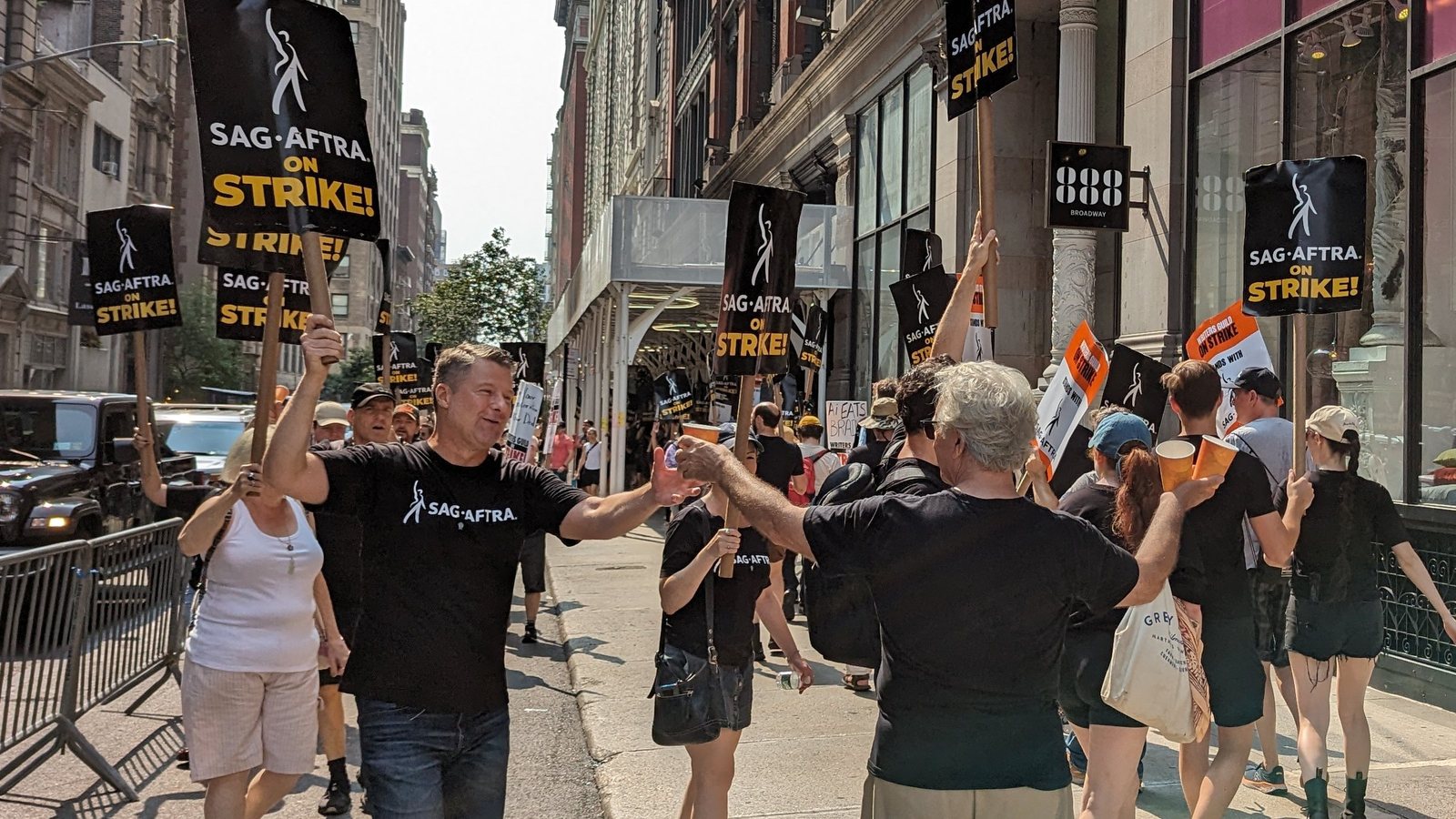
Streaming Grew Up and Became TV Again.
Streaming still dominates attention, but its business now looks far less like disruption and far more like television: ad tiers, sports, bundles, labor formulas, and arguments over who shares in the success of a hit.
By Nia Calder • April 7, 2026 • 2:15 p.m. EDT
Culture • Feature
The Crowd Came Back. The Old Economics Did Not.
Broadway’s record grosses and rising attendance across the arts show that American cultural life is alive again — but not evenly, and not on the same business terms as before.
By Nia Calder • April 6, 2026 • 9:40 a.m. EDT

Economics • Analysis
The Consumer Has Not Quit. The Economy Still Feels Cautious.
The American economy is still growing, but it is doing so with less exuberance, less labor-market churn, and more dependence on household spending than the public rhetoric admits.
By Owen Barrett • April 6, 2026 • 11:05 a.m. EDT