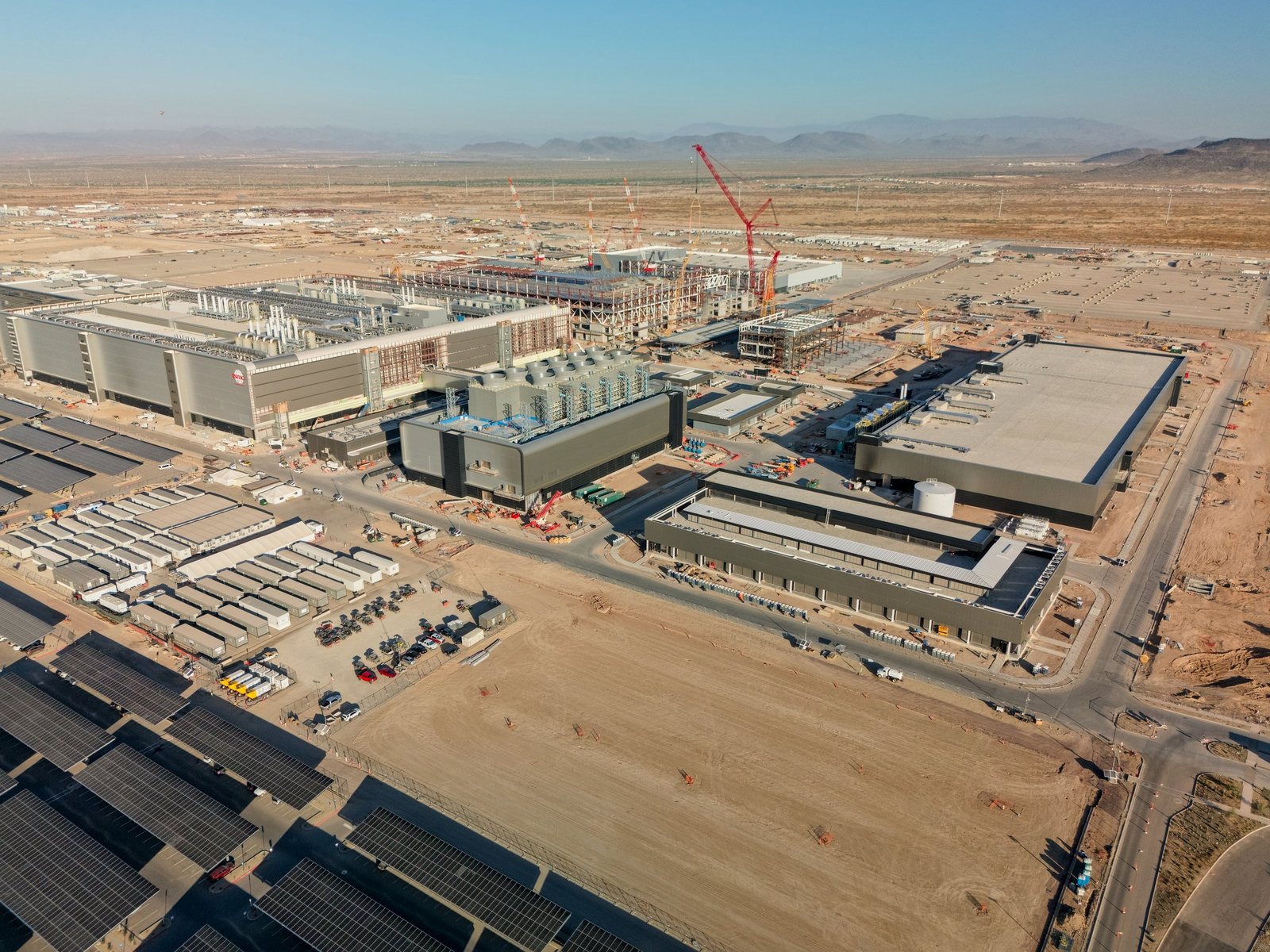
The AI story is happening under the ground as much as in the cloud
Artificial intelligence is usually marketed as weightless. The product demos live in browsers. The investor language is all about models, agents, inference, and scale. Even the metaphor most people use — “the cloud” — suggests something floating above the ordinary economy. But the real race is material. It runs through substations, transformer yards, high-voltage lines, cooling systems, chip packaging, and giant buildings full of racks that have to stay powered all day and all night.[1][2][3]
There is a reason Phoenix, Arizona, has become one of the most revealing places in the AI economy. TSMC’s Arizona operation says its first fab entered high-volume production on N4 technology in the fourth quarter of 2024, that construction of the second fab structure was completed in 2025, and that the third fab site broke ground in April 2025. That is not a side story to the AI boom. It is the boom in physical form: wafers, cleanrooms, process technology, and capital deployed on a timeline that software alone cannot compress.[7][8]
If the last few years trained the public to see AI as a competition in algorithms, the next few years will make the hardware truth impossible to ignore. The central strategic question is no longer just who can build the smartest model. It is who can deliver the power, chips, facilities, and workforce those models require at industrial scale.[1][3][5]
The demand shock is real even if the exact number is still moving
The International Energy Agency’s special report on energy and AI says data centres accounted for about 1.5% of global electricity demand in 2024, or roughly 415 terawatt-hours, and projects that global data-centre electricity consumption will more than double to around 945 terawatt-hours by 2030. The IEA also says the United States accounted for by far the largest share of data-centre electricity use and that, in the U.S., data centres could represent nearly half of electricity-demand growth through 2030. In plain English: the AI era is no longer an edge case in the power system. It is becoming one of the main stories in the power system.[1][2]
EPRI’s 2026 scenarios push the same point from a U.S. utility perspective. Its new estimates say data centres could account for 9% to 17% of all U.S. electricity consumption by 2030, up from about 4% to 5% today, depending on how many projects currently under construction, in advanced planning, or still early in development actually get built. EPRI pegs current U.S. data-centre use at about 177 to 192 terawatt-hours in 2024, rising to somewhere between 380 and 790 terawatt-hours by 2030.[3][4]
Lawrence Berkeley National Laboratory’s 2024 report is slightly different in method and timeframe, but not in direction. It estimates data centres used about 176 terawatt-hours in 2023, roughly 4.4% of total U.S. electricity, and projects a range of 6.7% to 12% by 2028. That matters for one reason above all: even when reputable institutions use different models, the same conclusion keeps returning. Electricity demand from data centres is climbing faster than the grid and its planning culture have been used to handling for much of the past decade.[5][6]
The uncertainty is real, and it should not be ignored. AI demand forecasts can run ahead of physical execution. Some announced campuses never materialize. Some are scaled down. Some are delayed by utility constraints, financing, or permitting. But uncertainty in this case does not mean the infrastructure challenge is imaginary. It means the range of outcomes is wide while the pressure on utilities, state regulators, and regional planners is already tangible.[3][4][5]
The grid’s biggest problem is time
The reason AI feels destabilizing to the power sector is not merely size. It is speed. Data centres can be proposed, financed, and brought close to operation much faster than new transmission lines, major substations, or large generation projects. The IEA says one in five planned data-centre projects could face delay if grid bottlenecks are not resolved, notes that transmission lines can take four to eight years to develop, and reports that wait times for critical equipment such as transformers and cables have roughly doubled in the last three years.[1][2]
EPRI describes the same challenge in more domestic terms: the U.S. grid can support major data-centre growth, but the timing mismatch is severe because power plants, transmission, and substations take years while data-centre campuses can come online much more quickly. The scale is easy to miss until it is translated into something familiar. EPRI says a single large data centre drawing 100 to 1,000 megawatts can use about as much electricity as 80,000 to 800,000 homes. That is not a software deployment. That is a new city’s worth of electrical load landing in one place.[3][4]
The geographic concentration makes the problem sharper. EPRI says Virginia is already the only state where data centres consume more than one-fifth of all electricity, and that the share could climb into a range of roughly 39% to 57% by 2030 depending on growth assumptions. It also says additional states could cross the 20% threshold this decade, including Arizona, Indiana, Iowa, Nebraska, Nevada, Oregon, and Wyoming. In one of its scenario summaries, it also points to new capacity emerging in places such as Ohio, Pennsylvania, and Louisiana. The geography of the AI boom is widening from the traditional data-centre hubs into new power-rich or land-rich states.[4]
That makes AI an industrial policy story at the state level, not just a Silicon Valley story. Governors see tax base. Utilities see load. Local communities see land use, trucks, and water questions. Grid operators see reliability and queue management. Regulators see rate design. A single project can mean all of those things at once.[3][4]
Speed, reliability, and carbon goals do not line up neatly
The power mix tells its own story of competing priorities. Under reference policies, EPRI expects natural gas to dominate much of the incremental supply needed to serve data-centre growth in the near term because it is dispatchable and available on a timetable closer to what developers want. But the organization also notes that if companies and utilities try to meet stronger around-the-clock carbon-free goals, the buildout would lean much more heavily toward renewables, batteries, and in some cases new nuclear. In other words, the physical AI boom is also a policy choice about what kind of power system the United States wants to lock in while demand surges.[3][4]
The IEA makes a similar point from the global angle. It does not present AI as a simple climate catastrophe or as a self-correcting efficiency machine. Instead, it shows that rising demand can be met in different ways depending on investment patterns, permitting speed, and local resource mix. That is why AI infrastructure debates are increasingly blending questions that used to live in separate worlds: data-centre economics, electricity reliability, industrial emissions, and national competitiveness.[1][2]
The temptation in public debate is to choose a single lens. One camp treats every new data centre as evidence that the U.S. should build faster and worry later. Another treats each one as a warning sign that AI’s growth model is physically reckless. The more serious reading is harder and less satisfying. The country is likely to keep building because AI demand is real, but the cost, pace, and power mix of that buildout will differ dramatically depending on local infrastructure and policy choices.[1][3][4]
AI is physical twice: once in the server hall, again in the fab
Electricity is only half the story. AI’s hardware dependency also runs through semiconductors, which is why the CHIPS buildout matters so much. The Commerce Department’s award to TSMC Arizona includes up to $6.6 billion in direct funding and supports more than $65 billion in planned investment in three leading-edge fabs in Phoenix. The award announcement ties that expansion explicitly to advanced applications such as AI and high-performance computing and says the Arizona project is expected to support more than 20,000 unique construction jobs and more than 6,000 direct manufacturing jobs.[7]
Micron’s December 2024 award tells a different but equally important part of the story. Commerce said up to $6.165 billion in direct funding would support the first phase of Micron’s long-range plan to invest about $100 billion in New York and $25 billion in Idaho. The department linked that investment to the domestic production of leading-edge DRAM, including the high-bandwidth memory that has become essential for advanced AI systems. The same announcement said the project could help lift the U.S. share of advanced memory manufacturing from less than 2% to roughly 10% by 2035.[9]
Samsung’s Texas award operates on similar logic: more than $37 billion in planned ecosystem investment and up to $4.745 billion in direct funding tied to fabs and research capability in Taylor and the surrounding region. The common thread is easy to miss if AI is framed only as software. The country is not simply trying to host more data centres. It is also trying to reassemble pieces of the semiconductor supply chain needed to equip those centres with advanced chips and memory closer to home.[10]
Seen together, those projects make clear that the infrastructure race beneath AI has at least three layers. First comes the electricity system that feeds the data centre. Second comes the chip supply chain that fills the servers. Third comes the logistics and workforce network needed to construct, service, and expand both. Lose any one of those layers and the rest slows down.[7][8][9][10]
The workforce bottleneck may outlast the capital boom
Capital announcements attract headlines because they are large and cleanly expressed in dollars. Workforces are less photogenic, but they are just as decisive. NIST’s launch of the National Semiconductor Technology Center’s Workforce Center of Excellence came with an expected $250 million investment over ten years. That announcement was a quiet acknowledgment that fabs do not run themselves and that a modern semiconductor strategy depends on much more than elite design talent. It needs technicians, process engineers, tool installers, maintenance specialists, and training systems that can operate at national scale.[11]
The same is true on the power side. Building a more electricity-hungry AI economy requires line workers, substation crews, planners, permitting staff, utility engineers, and equipment manufacturers. One of the least glamorous facts in the IEA and EPRI material is also one of the most important: long waits for grid equipment and long development times for transmission mean that labor and manufacturing capacity outside the data-centre industry itself can end up setting the pace for the whole sector.[1][3][4]
This is where the current AI conversation often feels thin. Public arguments linger on benchmarks, bots, and product releases because those are easier to compare week to week. But the national advantage may hinge on whether the United States can synchronize utilities, semiconductor incentives, industrial construction, training programs, and permitting timelines well enough to turn ambition into operating capacity. That is a harder story to tell, though it is likely the one that matters longer.[5][7][11]
Fast code now depends on slow metal
The most accurate metaphor for the AI buildout may no longer be “cloud computing.” It may be “infrastructure coordination.” The IEA’s projections, EPRI’s utility scenarios, Berkeley Lab’s estimates, the Commerce Department’s CHIPS awards, and TSMC’s Arizona milestones all point in the same direction. AI is not escaping the physical world. It is colliding with it. The bottlenecks are no longer only mathematical. They are electrical, industrial, and institutional.[1][3][5][7][8][9][10][11]
That does not make the boom unreal or doomed. It makes it legible. The winners in this next phase will not only be the companies with the most compelling model demos. They will also be the states, utilities, manufacturers, and research ecosystems that can get power to the rack, wafers through the fab, and skilled workers onto the site without turning every large project into a multi-year bottleneck. AI still looks digital on the screen. Underneath the screen, it increasingly looks like steel, copper, silicon, and time.[1][3][4][7][8]
Source notes
Primary documents and reporting used for this story.
- 1. International Energy Agency, Energy and AI — Executive summary.
- 2. International Energy Agency, Energy and AI — Energy demand from AI.
- 3. Electric Power Research Institute, Powering Intelligence 2026 FAQs.
- 4. Electric Power Research Institute, Powering Intelligence 2026 — Executive Summary.
- 5. Lawrence Berkeley National Laboratory, 2024 United States Data Center Energy Usage Report.
- 6. Lawrence Berkeley National Laboratory, Berkeley Lab Report Evaluates Increase in Electricity Demand from Data Centers.
- 7. U.S. Department of Commerce, CHIPS Incentives Award to TSMC.
- 8. Taiwan Semiconductor Manufacturing Co., TSMC Arizona.
- 9. U.S. Department of Commerce, CHIPS Incentives Award to Micron.
- 10. U.S. Department of Commerce, CHIPS Incentives Award to Samsung.
- 11. National Institute of Standards and Technology, NSTC Workforce Center of Excellence.
Referenced documents
Corrections status
No corrections have been posted to this story as of April 6, 2026 • 10:12 a.m. EDT. For amendments after launch, use the corrections workflow linked in the footer.
Related reading

Science • Report
Artemis II Proved the Moon Is an Engineering Project Again
The launch mattered, but the deeper achievement was operational: human-rated hardware, multinational systems, and a lunar mission that generated evidence rather than nostalgia.

Economics • Analysis
The Consumer Has Not Quit. The Economy Still Feels Cautious.
The American economy is still growing, but it is doing so with less exuberance, less labor-market churn, and more dependence on household spending than the public rhetoric admits.

World • Analysis
Europe’s Defense Turn Is Now a Budget, Supply-Chain, and Time Problem
The continent has moved beyond vague seriousness. The next test is whether spending pledges and white papers can become production, movement, and usable deterrence before strategic time runs out.