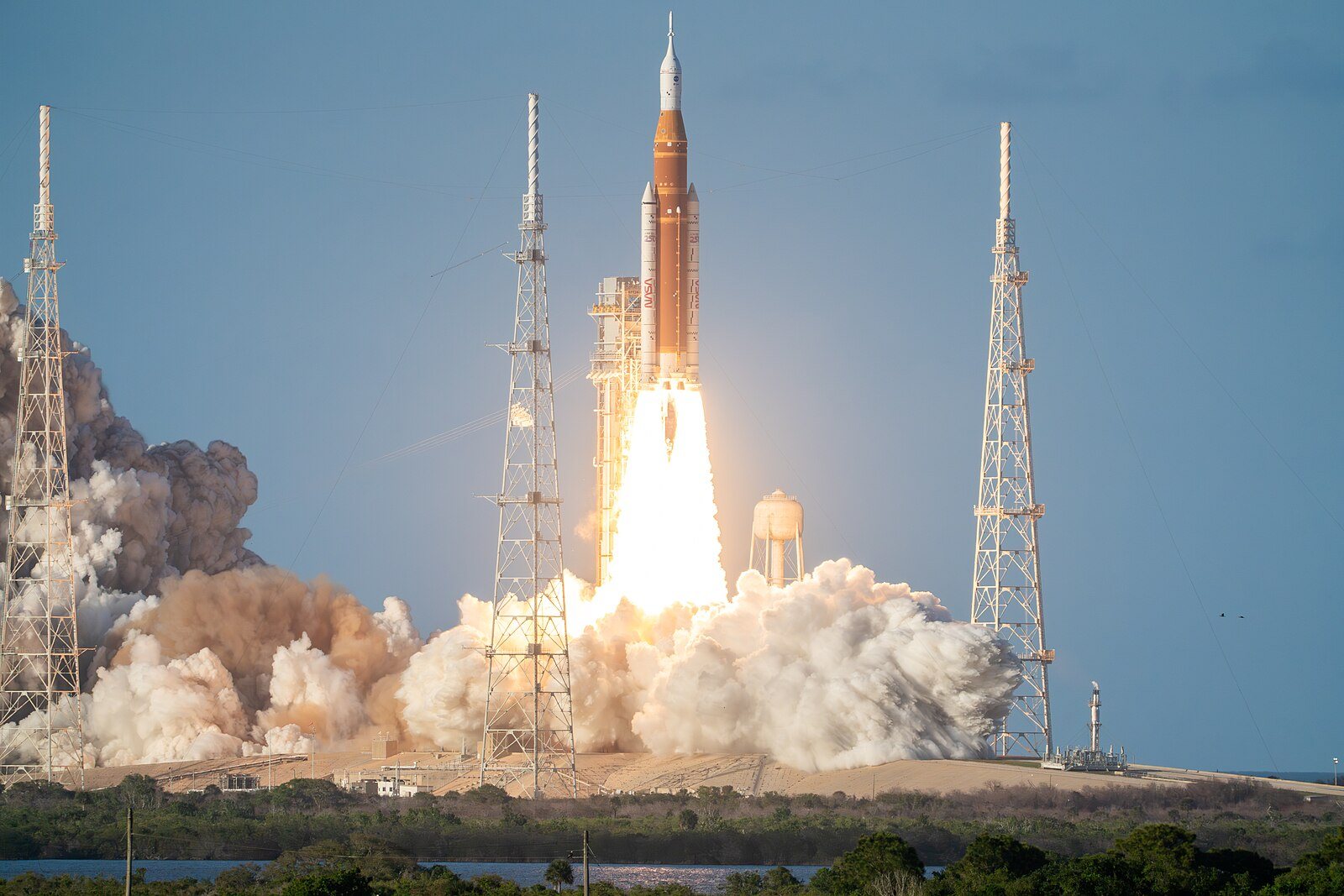
The launch was the loud part. The point of the mission was quieter.
When Artemis II rose from Launch Complex 39B on April 1, the easy headline wrote itself. Human beings were going back around the Moon. NASA said the four-person crew lifted off at 6:35 p.m. EDT for an approximately 10-day mission, the first crewed lunar flyby in half a century.[1][3] The spectacle deserved the attention. A rocket this large, this delayed, and this politically scrutinized has to clear a very public bar simply by leaving the ground.
But the deeper meaning of Artemis II is not that the launch finally happened. It is that the United States and its partners have begun turning lunar ambition back into operational routine. The mission is less a reprise of Apollo-style national theater than a proving run for a chain of engineering facts: crewed Orion operations, deep-space navigation, power generation, communications, life-support performance, international hardware integration, and recovery procedures that must work together if later lunar missions are to be more than posters.[2][3][5]
That difference matters. Apollo was built for a race. Artemis is being built for continuity. A race tolerates exceptional effort and one-off solutions. Continuity does not. It asks whether the system can be used, maintained, repeated, and trusted across multiple missions with crews aboard. Artemis II is the mission that begins answering that harder question.
The most important line in the NASA release was not poetic. It was procedural.
NASA’s own language after translunar injection was restrained in exactly the way a serious program should be restrained. The agency said that, for the first time since Apollo 17 in 1972, humans had departed Earth orbit and that Orion was operating with crew in space while mission teams gathered critical data and learned from each step.[2] That sentence is easy to skim past. It is also the whole mission.
The United States did not need Artemis II to prove that large rockets are photogenic. It needed Artemis II to prove that a crewed spacecraft, its service module, the launch vehicle, the ground systems, and the mission-control chain could behave coherently outside the relatively forgiving environment of low Earth orbit. The mission profile itself makes the point. Artemis II is not a docking mission or a brief high-altitude demonstration. It is a translunar voyage that sends a live crew around the Moon and back, asking every system to perform while time delays lengthen, distances grow, and the margin for improvisation shrinks.[3][5]
That is why NASA highlighted apparently modest milestones during launch-day operations. Shortly after liftoff, the agency reported the successful deployment of Orion’s four solar-array wings, a configuration step that sounds routine only because it has to become routine. A deep-space crew vehicle is not credible because its subsystems are ingenious in theory. It is credible because power, telemetry, propulsion, thermal management, and human-rated operations all behave as expected in sequence and under load.[1]
Distance is not just romance. It changes the engineering argument.
On April 6, NASA said the Artemis II crew had surpassed the farthest distance ever traveled by humans in space, passing the Apollo 13 record at roughly 252,756 miles from Earth.[4] It is a marvelous public-relations line, and it deserves to be. But it also matters for more practical reasons. Distance is when the vocabulary of “spaceflight” stops being generic and becomes specific. Communications latency matters differently. Navigation matters differently. Crew autonomy matters differently. Consumables, power margins, and operational discipline all matter differently when the vehicle is not a short sprint from home.
Space agencies know this, which is why the technical detail attached to Artemis II is so revealing. ESA describes the European Service Module for the mission as the power-and-propulsion backbone of Orion: a 13,500-kilogram element carrying propellant, water, nitrogen, and oxygen for a roughly 10-day flight.[5][6] That is not decorative internationalism. It is life-support and mission architecture made multinational. The spacecraft flies because the partnership is real at the hardware level.
That fact, too, changes the meaning of success. Artemis is not a closed national machine. It is an interdependent program whose credibility depends on interfaces: not only metal joining to metal, but institutions joining to institutions. Mission assurance is therefore also diplomatic assurance. When Orion performs, the performance belongs not only to NASA but also to European industrial contractors, to the launch and recovery teams, and to the many layers of program management that kept a complex transatlantic vehicle moving toward the pad.
Artemis II is not trying to be Apollo again, and that is the point
Every American lunar mission lives under the shadow of Apollo. The comparison is inevitable, often inspiring, and usually a little misleading. Apollo proved that the United States could get to the Moon under extraordinary political pressure and with extraordinary national resources concentrated on one goal. Artemis is trying to prove something subtler and in some ways harder: that human lunar operations can be resumed inside a modern ecosystem of budget scrutiny, international partnerships, safety culture, industrial fragmentation, digital simulation, and long program timelines.
That is why Artemis II feels, to some observers, almost too careful. It circles the Moon rather than landing. It looks like a test flight because it is a test flight. But the caution is not timidity. It is a recognition that a sustainable lunar program has to be assembled from verified pieces. NASA’s mission page calls Artemis II the agency’s first crewed lunar flyby in 50 years and lays out a 10-day mission meant to exercise the systems, the vehicle, and the operational chain that later missions will depend on.[3] In that sense Artemis II is not an interlude before the “real” program begins. It is the moment when the program becomes real enough to risk people.
The scientific and technical work folded into the mission underscores the point. NASA notes that Artemis II includes investigations and operational objectives intended to inform future exploration, from crewed-spacecraft performance to biological and human-systems questions that only become serious once a program expects repetition rather than rarity.[3] A space program becomes durable not when it produces a glorious image but when it learns systematically from each trip.
The moonshot has become an industrial program again
One of the most important things Artemis II clarifies is that returning to deep space is not chiefly a rhetorical problem. It is an industrial one. Huge rockets, crew vehicles, life-support systems, propulsion modules, launch infrastructure, software, training, and recovery assets do not materialize because a country feels inspired. They materialize because supply chains are maintained, contracts are managed, facilities are upgraded, and large organizations stay patient enough to finish complicated things.
NASA’s Artemis mission page says the Space Launch System is the only rocket that can send Orion, astronauts, and cargo directly to the Moon in a single launch.[3] Whether one treats that as strategic justification or as evidence of the program’s chosen architecture, it points to the same reality: a crewed lunar mission is an infrastructure claim. The rocket, the capsule, the service module, the launch complex, the recovery fleet, and the training pipeline all have to exist at the same time, in working order, under common management, with enough confidence to strap in four people.
That is why Artemis II should also be read as a statement about institutional memory. Programs like this are vulnerable to calendar drift. Managers retire. Contractors consolidate. Legislatures lose interest. Mission designs mutate. Artemis II is therefore valuable not only because it succeeded as an event but because it pulled a diffuse and delay-prone apparatus through the narrow gate of actual execution. Once a program has flown crew, its future arguments change. Critics and supporters alike have to deal with a system that is no longer hypothetical.
Success here means narrowing uncertainty, not eliminating it
It is tempting, after a dramatic mission milestone, to talk as though the road ahead has been settled. Artemis II does not settle it. What it does is shrink the space of guesswork. It tells planners more about how Orion behaves with crew aboard. It tells engineers more about operations farther from Earth. It tells international partners more about how the joint hardware performs in practice. And it tells the public something useful too: the post-Apollo lunar project has moved out of pure promise and into evidence.
This is how serious exploration programs mature. Not by leaping directly from aspiration to permanence, but by converting unknowns into documented experience. NASA’s releases after launch were careful to emphasize data collection, operational learning, and the credibility that comes from actual flight.[1][2] That tone is a virtue. A mature program does not need to pretend that one mission answers every budgetary, technical, or strategic question. It needs to show that questions are now being answered in flight rather than in PowerPoint.
The return to the moon is not a memory project anymore
There will always be nostalgia attached to any human journey beyond Earth orbit. The names are too large, the symbolism too durable, the archive too luminous for that not to be true. But Artemis II is more interesting than nostalgia. It suggests that the moon is once again becoming a place around which institutions can plan instead of merely reminisce. That shift matters for science, for engineering, for geopolitics, and for the way public programs justify themselves.
The mission’s value lies precisely in its refusal to be only a cinematic callback. It launched on schedule enough to matter, crossed the right thresholds, broke the right record, deployed the right hardware, and generated the right kind of evidence.[1][4][5] For the first time in a very long time, talking about the next chapter of human lunar flight sounds a little less like tribute and a little more like program management. That may be the most hopeful sign of all.
Source notes
Primary mission documents, releases, and official program material used for this story.
- 1. NASA, Artemis II Launch Day Updates.
- 2. NASA, NASA’s Artemis II Mission Leaves Earth Orbit for Flight around Moon.
- 3. NASA, Artemis II: NASA’s First Crewed Lunar Flyby in 50 Years.
- 4. NASA, Artemis II Astronauts Set Record for Farthest Distance Traveled by Humans in Space.
- 5. European Space Agency, Artemis II.
- 6. European Space Agency, Artemis II technical details.
Referenced documents
Corrections status
No corrections have been posted to this story as of April 7, 2026 • 7:35 a.m. EDT. Any updates will be noted here and on the Corrections page.
Related reading
Technology • Report
AI Needs Electricity, Steel, and Time
Behind the chatbot boom is a slower race over transformers, substations, fabs, and the people who know how to build them.

World • Analysis
Europe’s Defense Turn Is Now a Budget, Supply-Chain, and Time Problem
The continent has moved beyond vague seriousness. The next test is whether spending pledges and white papers can become production, movement, and usable deterrence before strategic time runs out.

Philosophy • Essay
The Missing Word in the AI Debate Is Judgment.
AI governance keeps reaching for better standards, better tests, and better risk language. None of that removes the need for institutions to judge well in public.