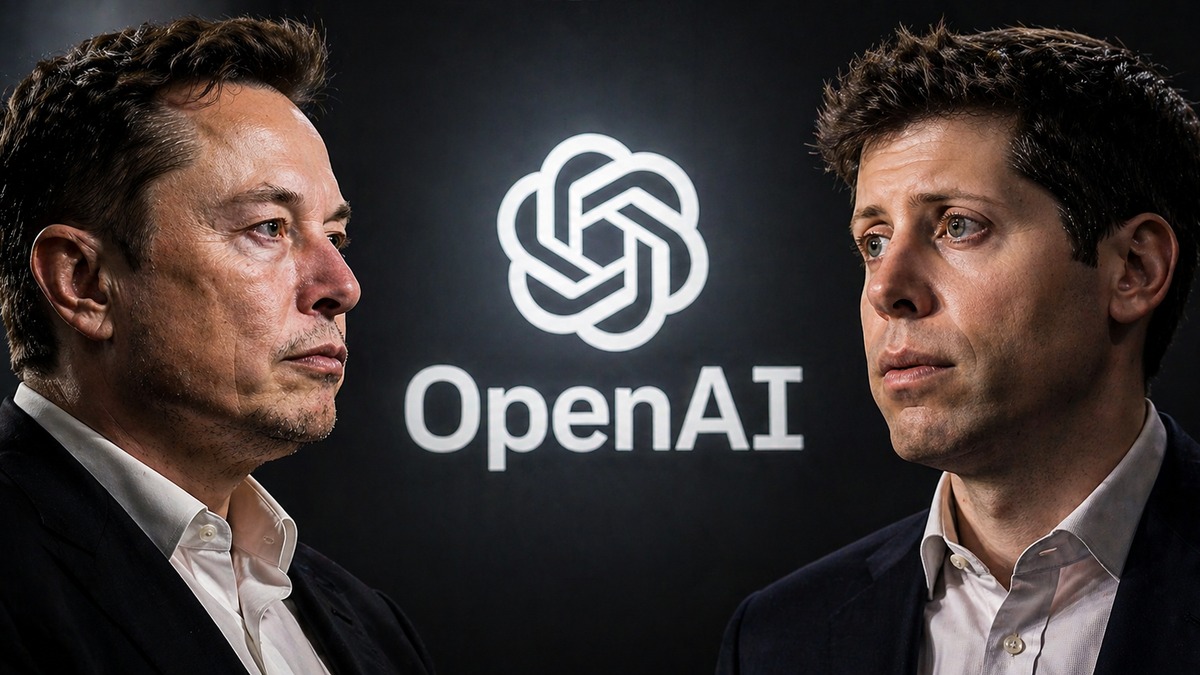
Disclosure: The thumbnail for this story is an Because apparently even images now need lawyers.
A founding promise becomes evidence
The courtroom in Oakland is not where the future of artificial intelligence was supposed to be decided. The future was supposed to arrive in research papers, model cards, launch notes, product demos, congressional hearings, and solemn blog posts about benefiting humanity. Silicon Valley has always liked to imagine that history is made by people in black T-shirts standing beside slides. Yet the battle over OpenAI, Sam Altman, Elon Musk, Microsoft, nonprofit purpose, investor rights, and the public meaning of artificial intelligence has arrived in a federal courtroom, which is what happens when a grand ideal discovers lawyers.[1][2][4]
Musk’s case against OpenAI and its leaders is not just a celebrity lawsuit with better tailoring. It is a test of whether a company can use a nonprofit promise to attract money, talent, trust, and moral legitimacy, then grow into a commercial giant without betraying the mission that made it persuasive in the first place. Musk says OpenAI was founded as a charity for the public good and then converted into what his side describes as a wealth machine. OpenAI says Musk is not defending a charity. It says he is a disappointed former insider, now an AI competitor through xAI, using the courts to attack the company he failed to control.[1][2][11][12]
The dispute has the surface grammar of a Silicon Valley breakup: old emails, founding memories, boardroom grievances, public insults, private ambitions, and a lot of people insisting they alone remember the sacred original plan. But underneath the personality drama is a harder institutional question. If advanced AI is powerful enough to reshape labor markets, education, science, public administration, war, and culture, who gets to build it, who gets to profit from it, and who gets to say that the work is being done for humanity rather than for shareholders, cloud contracts, and executive legend?[7][10]
OpenAI entered public life in 2015 with a startlingly elevated claim. It would be a nonprofit artificial intelligence research company. Its aim was to advance digital intelligence in a way most likely to benefit humanity as a whole. It said it was unconstrained by a need to generate financial return. That language mattered. It separated OpenAI from ordinary startups. It positioned the organization as a public-interest counterweight to the fear that artificial general intelligence, if it arrived, might be built inside a single dominant corporation and controlled by a narrow group of owners.[6][7]
That fear was not invented for litigation. In the middle of the last decade, Google had acquired DeepMind, Meta was investing heavily in AI research, Microsoft and Amazon controlled enormous cloud infrastructure, and the idea of artificial general intelligence was migrating from technical subculture to boardroom strategy. Musk, Altman, Greg Brockman, Ilya Sutskever, and others gave OpenAI a founding story that was part warning, part promise. They were not merely building software. They were building an institutional answer to a terrifying possibility: that intelligence itself might become a private platform.[6]
The founding story gave OpenAI something more valuable than seed capital. It gave the organization moral authority. Researchers could tell themselves they were not just joining a company. Donors could tell themselves they were not just backing a product. The public could tell itself, with the fragile optimism humans keep misplacing around technology, that this organization would be different. OpenAI would pursue powerful AI with caution, openness, and broad benefit in mind. It would not be another corporate race dressed in ethical stationery.[6][7]
The bill for frontier AI
Then came the bill. Frontier AI is expensive in a way that makes ordinary startup costs look quaint. It requires massive computing clusters, scarce chips, elite researchers, huge engineering teams, safety testing, product infrastructure, legal departments, policy teams, and the constant ability to train larger systems before competitors do. A purely donation-funded research lab might have sounded noble, but nobility does not rent cloud capacity. In 2019, OpenAI created a capped-profit structure, OpenAI LP, saying the change was necessary to attract capital while still preserving the nonprofit’s mission and control.[8][9]
That 2019 move sits at the center of the current fight. OpenAI’s defenders describe it as a practical adaptation. The organization could not compete with Google DeepMind, Meta, Amazon, Microsoft, Anthropic, and later xAI if it relied only on donations. It needed investors who could tolerate long timelines and huge costs. It needed a way to pay employees in a talent market where top researchers could command fortunes. It needed infrastructure. It needed scale. In this view, commercialization was not the abandonment of the mission. It was the only route left for pursuing it.[8][9][10]
Musk’s side sees something darker. The argument is not that OpenAI needed money. Everyone in the room knows it did. The argument is that the public mission became the bait and the private structure became the hook. The charitable promise helped OpenAI attract donations, early credibility, and extraordinary talent. Then the organization created a commercial arm, built a close partnership with Microsoft, released ChatGPT, became the face of the generative AI boom, and found itself discussed as a company that could one day command a trillion-dollar valuation. For Musk’s lawyers, that is not evolution. It is conversion.[1][8][13]
The lawsuit has already changed shape. Musk’s fraud and constructive fraud claims were dropped before trial, narrowing the case to claims including breach of charitable trust, unjust enrichment, and related theories involving Microsoft. The shift matters because fraud would have focused heavily on whether Musk personally was deceived. Breach of charitable trust points to a broader issue: whether OpenAI’s leaders stayed faithful to duties attached to the nonprofit’s assets, mission, and public commitments. It turns the trial away from a billionaire’s wounded expectations and toward the legal status of a public-interest promise.[3][4][5]
Musk’s case and OpenAI’s reply
That is a better question, frankly, because Musk is a complicated messenger for institutional purity. He is not an innocent retiree who mailed a donation to a hospital and later discovered the gift shop had become a hedge fund. He is Elon Musk: Tesla, SpaceX, X, Neuralink, The Boring Company, xAI, rockets, cars, satellites, social media chaos, and the world’s most industrialized talent for turning conflict into spectacle. OpenAI’s defense is built partly around this fact. The company argues that Musk wanted control, wanted OpenAI connected to Tesla, and left when he could not get the structure he preferred.[11][12][22][23][24]
OpenAI has published its own version of the early history, saying Musk supported a for-profit model when OpenAI realized the cost of competing at the frontier. According to OpenAI, Musk pushed for majority equity, board control, and a CEO role, then proposed folding OpenAI into Tesla. The company says he walked away after his control bid failed and later founded xAI as a rival. That timeline is central to OpenAI’s effort to frame the case not as a principled rescue mission but as competitive combat. In the defense version, Musk is not trying to restore a charity. He is trying to damage a competitor that became more valuable than the organization he imagined leaving behind.[11][12]
Musk’s competitive position cannot be ignored. xAI launched in 2023 and has since become part of the same frantic AI race that OpenAI helped ignite. Musk’s companies are now deeply invested in AI infrastructure, model development, and distribution. His separate legal attacks involving OpenAI, Apple, and app-store competition have reinforced OpenAI’s claim that the lawsuit is part of a broader campaign. This does not automatically make Musk wrong. A rival can still identify a real governance failure. But it does make the moral simplicity of his argument harder to swallow without chewing.[17][18][19][20][21]
OpenAI’s position is also not morally clean just because Musk is messy. The company began with language about being free from financial-return obligations. It now operates through complex corporate structures, enormous commercial partnerships, enterprise products, subscription revenue, investor expectations, and strategic dependence on cloud infrastructure. Microsoft’s multibillion-dollar investment gave OpenAI the compute muscle to scale and gave Microsoft a privileged place in the generative AI boom. That partnership has been repeatedly revised, but it remains one of the most consequential alliances in technology.[6][8][13][14][15]
This is where the case becomes larger than Musk and Altman. Nonprofit status is not decorative. It is not supposed to be a mood board. A nonprofit can own or control commercial subsidiaries, and many do. Universities license technology. Hospitals operate revenue-generating systems. Museums run shops. But the direction of control matters. The commercial activity is supposed to serve the charitable mission, not quietly become the real enterprise while the mission sits around like a framed inspirational quote in the lobby.[10][15][16]
The governance problem underneath the feud
OpenAI says the mission still controls the company. In 2025 it announced that the nonprofit would continue to oversee the business while the for-profit arm would become a public benefit corporation. A public benefit corporation can consider public purpose alongside shareholder value, which sounds reassuring until one remembers that every corporate structure still has to survive markets, competitors, investors, and human ambition. The new structure may improve governance clarity. It does not eliminate the contradiction. OpenAI is still trying to prove that it can be both mission-bound and market-scale.[15][16]
Altman’s role in this story is as complicated as Musk’s, though in a quieter register. Musk is theatrical conflict. Altman is institutional acceleration with a calm voice. Under Altman, OpenAI moved from research lab to product company, from demo to platform, from ChatGPT surprise to enterprise dependency, from nonprofit aura to global corporate power. His defenders see him as the leader who made OpenAI real. His critics see him as the executive who turned the lab’s founding ideal into a commercial empire while continuing to speak in the language of public benefit.[10][25][26][27]
The 2023 board crisis still shadows him. OpenAI’s board briefly removed Altman, saying he had not been consistently candid in his communications. The decision triggered employee revolt, investor pressure, Microsoft maneuvering, and Altman’s rapid return. That episode mattered because it exposed the fragility of OpenAI’s governance at the very moment the company was asking the world to trust it with increasingly powerful systems. The board had formal authority. The company, the employees, and the capital stack had practical power. Formal power blinked.[25][26][27]
For Musk’s lawyers, that crisis supports the idea that OpenAI’s nonprofit governance is weaker than advertised. If the board could not remove the CEO without nearly collapsing the company, what does nonprofit control mean in practice? For OpenAI’s defenders, the episode is painful but not decisive. Organizations survive crises. Boards make mistakes. Employees can revolt for rational reasons. Partners can react because operational continuity matters. The legal question is not whether OpenAI’s governance has been elegant. The legal question is whether it violated enforceable duties.[3][25][26][27]
The jury will not simply be asked to choose which billionaire seems less annoying, though that would at least be an honest civic exercise. It will hear about charitable trust, unjust enrichment, corporate form, donations, early promises, investor caps, Microsoft’s role, and the relationship between nonprofit parent and commercial subsidiary. It will hear Musk describe OpenAI as a stolen charity. It will hear OpenAI describe Musk as a man who wanted the keys, failed to get them, and now wants to rewrite history. It will hear Microsoft argue that it funded the mission rather than captured it.[1][2][3][4][5]
The word “charity” does unusual work here. To most people, a charity feeds people, funds medical care, shelters families, educates children, or supports public goods in obvious ways. OpenAI’s charitable mission was more abstract and more ambitious: ensure that advanced digital intelligence benefits humanity. That mission is so large it almost resists normal governance. How does one measure whether humanity has benefited from a model release, a cloud contract, a product roadmap, or a safety delay? How does a court translate civilizational language into legal duty?[6][7][8]
That problem is not unique to OpenAI. The modern AI industry is crowded with companies making claims that sound public even when the structures are private. Labs talk about safety, alignment, democratic input, equitable benefit, open science, responsible deployment, and human flourishing. Then they sign enterprise contracts, chase distribution, protect model weights, lobby governments, recruit from rivals, and raise astonishing sums of money. The language is moral. The machinery is commercial. The public is asked to trust the gap.[7][10][15]
Why the whole AI industry should care
One reason the Musk-Altman case matters is that it puts that gap on trial. Not perfectly, not cleanly, and not through an ideal plaintiff. But it forces documents, testimony, and corporate structure into the open. It asks whether a mission statement can be more than public relations. It asks whether donors and early supporters can rely on nonprofit commitments when the organization later becomes commercially valuable. It asks whether a public-benefit promise is enforceable when the technology being developed is too expensive to build without private capital.[1][3][4][5][10]
OpenAI’s strongest defense is necessity. Without capital, there may have been no ChatGPT, no frontier competition, no ability to attract top talent, no capacity to test or deploy the systems now driving the industry. The company can argue that a mission without operational strength is just a sermon. If Google, Meta, Amazon, Anthropic, xAI, and other players are racing ahead, then a nonprofit lab that refuses commercial tools may simply become irrelevant. In that view, OpenAI did not betray its mission by raising money. It betrayed nothing because failure would have served no one.[8][9][10]
Musk’s strongest case is drift. The more valuable OpenAI becomes, the harder it is to believe that investor pressure, partner dependence, and product ambition do not affect mission decisions. A company can say the nonprofit remains in charge, but power often follows money, infrastructure, and market necessity. If Microsoft supplies the compute, investors supply the capital, employees hold valuable equity, and products generate revenue, the mission may still exist but no longer command the room. Mission drift rarely announces itself by tearing down the sign. It simply changes what the sign is allowed to mean.[10][13][14][15]
The possible remedies are dramatic. Musk wants OpenAI returned to nonprofit status, wants leadership changes, and has sought enormous damages that would go to the charitable arm. OpenAI says such remedies would be destructive and unjustified. Any ruling that disrupts OpenAI’s structure could complicate product development, investor confidence, Microsoft’s role, and potential public-market plans. A ruling in OpenAI’s favor, meanwhile, could strengthen the legitimacy of hybrid nonprofit-commercial AI structures, encouraging other labs to wrap public missions around private capital with fewer legal fears.[1][3][15][16]
That is why the trial is not simply about the past. It is about the templates future AI organizations will use. If OpenAI can keep its mission language, preserve nonprofit oversight on paper, and still operate as one of the richest private technology companies on Earth, others will study that structure. If Musk proves that the conversion violated charitable obligations, the entire industry will be forced to rethink how public-interest promises, investor rights, and corporate control fit together. Either outcome will teach the market something. Markets, tragically, are excellent students when the lesson involves money.[1][3][10][15][16]
The public should resist the temptation to read the case as a morality play with one hero and one villain. Musk’s motives may be mixed. OpenAI’s choices may be defensible and still troubling. Microsoft may have enabled OpenAI’s scale while also gaining extraordinary leverage. Altman may have transformed an idealistic lab into a world-shaping company while preserving more of the mission than critics admit. The nonprofit promise may be both sincere and insufficient. Real institutional stories are usually like that: less clean than slogans, more consequential than gossip.[1][2][10][13]
What is clear is that OpenAI’s founding sentence has become harder to carry. To advance digital intelligence for the benefit of humanity, unconstrained by financial return, is one kind of promise when the organization is a small research nonprofit. It is another when the same institution sits at the center of billion-dollar cloud deals, global product adoption, government attention, enterprise dependency, and IPO speculation. The words do not disappear. They become heavier.[6][8][13][14][15]
The trial will continue through testimony, filings, objections, headlines, and the usual courtroom ritual in which history is reduced to exhibits and everyone pretends email threads were written with future cross-examination in mind. Outside the courthouse, the AI race will not pause. Models will keep improving. Companies will keep announcing partnerships. Regulators will keep trying to understand systems that change faster than the hearings about them. Users will keep using the tools because usefulness has a way of outrunning governance.[1][2][4][5]
What the verdict cannot solve
That is the final irony. The lawsuit asks whether OpenAI betrayed humanity, but humanity is already entangled with OpenAI’s products, competitors, and infrastructure. The public debate is no longer theoretical. Students, programmers, lawyers, doctors, journalists, teachers, companies, agencies, and ordinary users have already absorbed generative AI into daily life. The court can examine OpenAI’s corporate soul, but the technology has left the monastery.[1][2][7][10]
The question before the court is whether OpenAI’s mission survived that escape. Musk says the charity was stolen. OpenAI says the mission was scaled. Microsoft says it was a partner, not a captor. Altman says, in effect, that the work required the structure. The law will decide claims and remedies. The public will be left with the larger problem: whether any private institution, however mission-branded, should be trusted to build technology this powerful with only its own structure standing between public benefit and private reward.[1][2][3][13][14]
The answer may not fit neatly into a verdict. But the trial has already made one thing impossible to ignore. When a company promises to build artificial intelligence for humanity, the promise cannot remain poetry forever. At some point, somebody will ask what it means, who controls it, who profits from it, and what happens when the money arrives. In Oakland, that somebody is a courtroom. History has chosen stranger venues, but not many more fitting ones.[1][2][6][7]
Source notes
Primary documents, public reporting, company statements, court materials, and analysis used for this story.
- Reuters, OpenAI trial pitting Elon Musk against Sam Altman kicks off.
- Associated Press, Elon Musk takes stand in trial vs. Sam Altman that could reshape AI's future.
- Reuters, US judge dismisses Musk's fraud claims in OpenAI case, plans to proceed to trial.
- CourtListener, Musk v. Altman docket.
- Musk v. Altman Document Index, Docket and primary document tracker.
- OpenAI, Introducing OpenAI.
- OpenAI, OpenAI Charter.
- OpenAI, OpenAI LP / capped-profit announcement.
- TechCrunch, OpenAI shifts from nonprofit to capped-profit to attract capital.
- AI Now Institute, AI-generated business: OpenAI and institutional structure.
- OpenAI, The truth about Elon Musk and OpenAI.
- OpenAI, Elon Musk wanted an OpenAI for-profit.
- Microsoft, Microsoft and OpenAI extend partnership.
- Microsoft, The next phase of the Microsoft-OpenAI partnership.
- OpenAI, Evolving OpenAI’s structure.
- TechCrunch, OpenAI reverses course, says nonprofit will remain in control.
- Reuters, OpenAI countersues Elon Musk and claims harassment.
- Reuters, Musk bid to dismiss OpenAI harassment claims denied.
- Reuters, Elon Musk's AI firm xAI launches website.
- Reuters, xAI sues Apple and OpenAI over AI competition and App Store rankings.
- Reuters, Apple and OpenAI must face X Corp lawsuit for now.
- The Washington Post, Elon Musk testifies in trial over OpenAI.
- The Verge, Elon Musk takes the stand in trial against OpenAI and Sam Altman.
- Wired, Elon Musk testifies at Musk v. Altman trial.
- OpenAI, OpenAI announces leadership transition.
- OpenAI, Sam Altman returns as CEO, OpenAI has a new initial board.
- OpenAI, Review completed and Altman, Brockman to continue to lead OpenAI.
Corrections status
No corrections have been posted to this story as of April 29, 2026. For amendments after launch, use the corrections workflow linked in the footer.
Related reading
Technology • Report
AI Needs Electricity, Steel, and Time
Behind the chatbot boom is a slower race over transformers, substations, fabs, and the people who know how to build them.

Philosophy • Essay
The Missing Word in the AI Debate Is Judgment.
AI governance keeps reaching for better standards, better tests, and better risk language. None of that removes the need for institutions to judge well in public.
Opinion • Essay
A Country That Cannot Measure Itself Cannot Govern Itself
Public statistics are not bureaucratic garnish. They are the information infrastructure that lets a democratic state know its labor markets, neighborhoods, businesses, and population well enough to act without governing by mood.