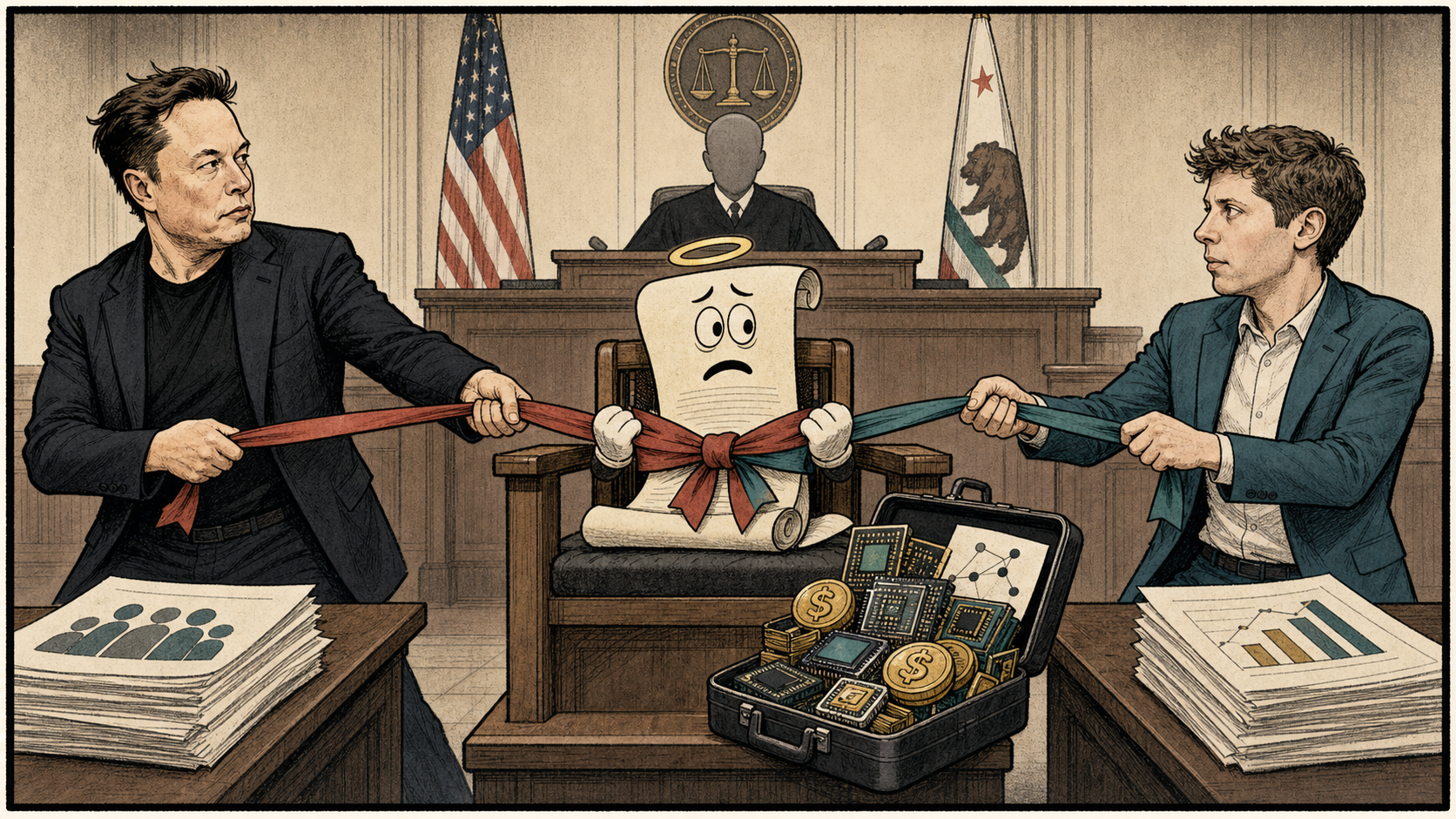
Editorial cartoon: This cartoon uses caricatures of public figures Elon Musk and Sam Altman to comment on a real public dispute over OpenAI's nonprofit mission, commercial structure, and control. The scene is symbolic,
Caption
The Mission Statement Takes the Stand: The jury decided the clock. The witness chair still has a question in it.
The joke
In the cartoon, the mission statement is not framed as a poster on the wall. It is the witness. Musk and Altman pull from opposite sides, while the briefcase on the floor says what everyone in the AI boom already knows: values do not argue in a vacuum. They argue beside chips, capital, cloud contracts, market power, and the cost of staying in the race.
That is the point. The court fight can end on timing and still leave a public question alive. If a lab begins with a public-interest promise and later becomes one of the most consequential commercial technology companies in the world, the legal claim is only one part of the story. The governance question keeps breathing after the docket closes.
The record
Elon Musk accused OpenAI, Sam Altman, and others of abandoning OpenAI's founding nonprofit mission. OpenAI denied that account and argued that Musk knew about, and at times supported, commercialization plans before leaving and later building a competitor. A May 2026 Associated Press report said jurors sided with OpenAI because Musk's lawsuit was not filed in time, leaving the deeper merits of the mission fight unresolved. AP
OpenAI has separately described its current structure as one where the nonprofit remains in control while the business arm becomes a public benefit corporation. That is the official promise the cartoon is needling: not that a court found the mission fake, but that the mission now has to survive the gravitational pull of frontier-AI money. OpenAI
Why draw it
A straight article can track filings, verdicts, claims, and counterclaims. A cartoon can compress the weirdness: the public mission, personified, sitting in a witness chair while two famous builders of the AI age tug at the ribbon around it.
The joke does not require declaring one side pure and the other corrupt. It asks the more useful question: when an ideal becomes valuable, who owns the ideal's afterlife?
Cartoon note
This is visual commentary on public figures and public institutions. It does not assert that either figure committed a crime, lied in court, or personally handled the symbolic money and chips shown in the image.
Related reading
Technology • Analysis
The Trial Over OpenAI’s Soul
Elon Musk says OpenAI betrayed its nonprofit mission. OpenAI says Musk wanted control and lost. The court battle is really about whether the most powerful AI company in the world can still claim to serve humanity after becoming one of the richest corporate prizes in technology.
Philosophy • Essay
The Missing Word in the AI Debate Is Judgment.
AI governance keeps reaching for better standards, better tests, and better risk language. None of that removes the need for institutions to judge well in public.

Technology • Investigation
The Data Center Is the New Utility Bill
AI data centers have moved from cloud strategy into utility-bill math. A new Press analysis of EIA electricity data tracks the fight over megawatts, water, local consent, and who pays when private compute demand lands on public grids.