There is a peculiar kind of silence that settles over a poker table when a player moves all in. It is not the silence of boredom. It is the silence of calculation, memory, ego, fear, and performance all squeezed into one human face. A hand trembles. A stare hardens. A stack of chips becomes a life decision. The cards are small, but the moment gets very large.

For years, that was the magic trick television poker had to perform: make stillness feel like action. Make math feel like danger. Make a person in sunglasses staring at felt feel like a fourth-quarter drive, a ninth-inning at-bat, a penalty kick, a championship putt. When poker worked on television, it worked because viewers were not simply watching cards. They were watching people try not to reveal themselves.

Now poker is getting another chance to prove that trick still works.

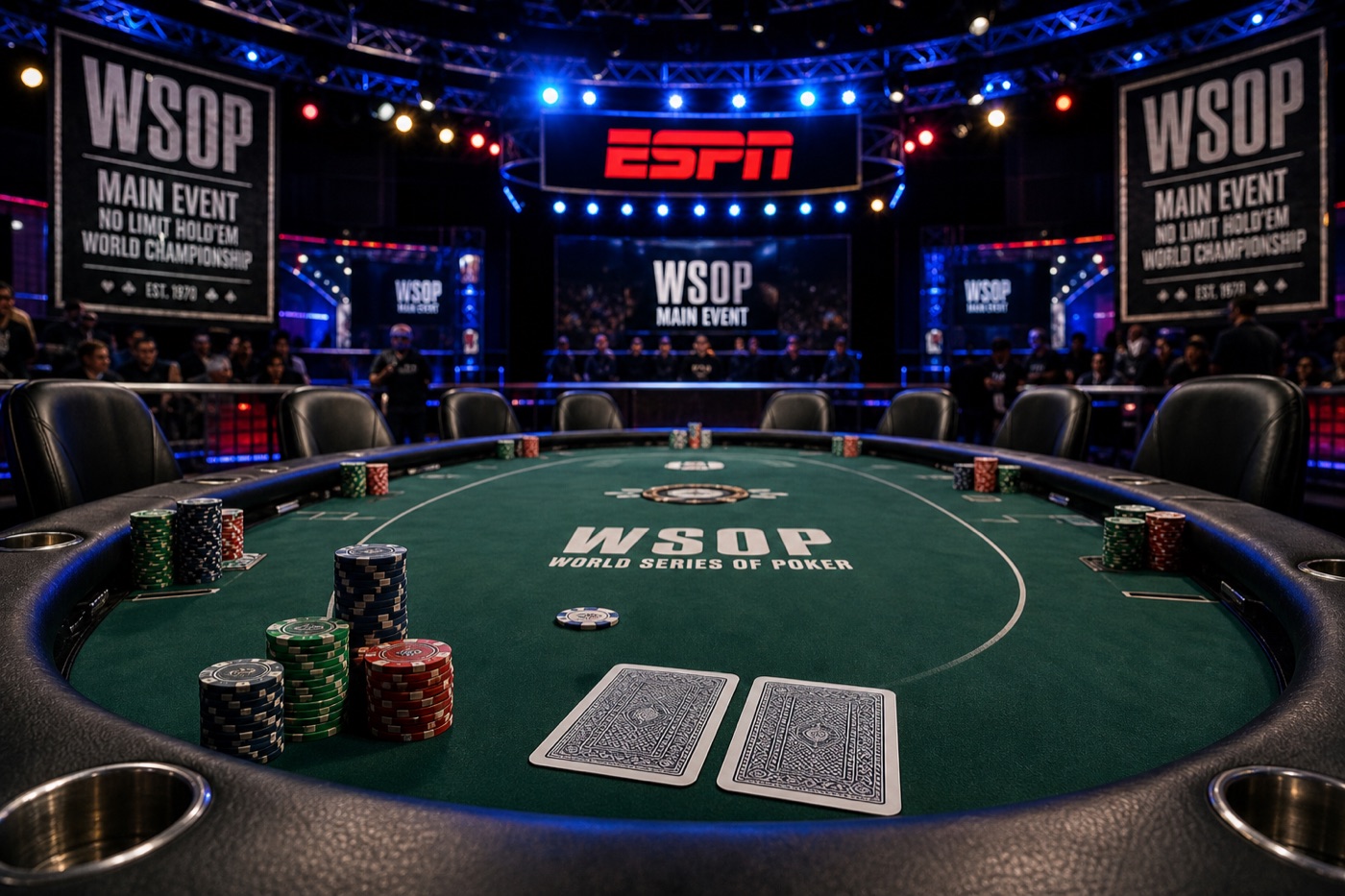
The World Series of Poker’s $10,000 No-Limit Hold’em Main Event is returning to ESPN in 2026 under a multi-year agreement. ESPN says the deal includes more than 100 hours of Main Event coverage and a three-night live final table scheduled for August 3–5. The 2026 WSOP runs May 26 through July 15 at Horseshoe and Paris Las Vegas, with 100 bracelet events and the Main Event beginning July 2. ESPN Press Room WSOP

That sounds like a broadcast deal. It is bigger than that.

This is poker trying to reclaim its old public square. Not the private high-stakes room. Not the subscription-only stream. Not the clipped hand where a billionaire punts into a pro and everyone in the comments argues about whether the call was genius, boredom, or a very expensive shrug. This is poker attempting, again, to become a shared sports story: a tournament with a calendar, a stage, a buildup, a cast, a final table, and a finish that casual fans can understand without already knowing what a solver would do on a paired board.

The headline is simple. Texas Hold’em gets its prime-time moment back. The question is whether poker can still use it.

The Main Event is not just another tournament

The WSOP Main Event has always been a strange hybrid: part championship, part lottery, part convention, part pilgrimage. The buy-in is $10,000, which is enough money to keep the event serious but not so much that it belongs only to billionaires, hedge-fund assassins, and men who say “variance” when they lose the grocery budget. It is expensive enough to hurt. It is reachable enough to dream about.

That dream is the Main Event’s greatest asset. The WSOP describes the Main Event as the series’ featured world championship, and the $10,000 No-Limit Hold’em format has become the game’s defining annual title fight. The phrase “world champion” can get fuzzy in poker because there are many games, many tours, and many ways to measure greatness, but the Main Event still carries the cleanest public meaning. Win that tournament, and even people who barely know poker understand what happened. WSOP About WSOP History

The structure matters. In the Main Event, when your chips are gone, you are gone. No rebuy button saves you from disaster. No second stack arrives because the bankroll can absorb it. A cash-game player can reload, sigh, and start building a new tower of chips. A Main Event player who busts walks through the casino with the same two thoughts almost everyone has after elimination: the hand that ended it, and the hand that could have changed everything before it.

That is why the Main Event is different from poker’s ultra-high-roller circuit. Triton, PokerGO Tour events, and private streamed cash games may feature tougher lineups and larger individual pots, but the Main Event has a democratic violence to it. A professional can sit next to an accountant. A bracelet winner can bust to a recreational player who qualified online. A dreamer with one bullet can outlast the best player in the room because No-Limit Hold’em is cruel, elastic, and just generous enough to keep hope alive.

The game’s television appeal comes from that mixture. Expertise matters, but expertise is never total protection. A perfect strategy can still lose. A bad call can still spike the river. The professional knows the math; the amateur sometimes knows the person. Poker is not fair in the way chess is fair, and that unfairness is part of its hold on the public imagination. Viewers do not need to believe they could beat the best chess player in the world, score in the NBA Finals, or return a serve at Wimbledon. Poker sells a more dangerous idea: under the right lights, with the right read, and maybe with the right river card, it could be you.

ESPN helped teach America that idea once.

Why ESPN matters

The modern poker boom was not born from cards alone. It needed cameras.

Poker was difficult television before the hole-card camera because the audience could not see the secret. Without the secret, a hand can look like a group of people folding laundry very slowly. The viewer sees chips move but not why. The hole-card camera changed that. It let the audience know who was bluffing, who was trapping, who was terrified, and who was about to make a mistake. The audience could finally become the only person at the table who knew almost everything.

That shift did not just make poker easier to watch. It made poker narratable. A commentator could explain why a player’s story did not add up. A casual fan could understand that a stare across the table was not empty theater. A fold could become heroic because the viewer knew what was being folded. A bluff could become thrilling because the viewer knew how thin the lie was. Casino.org World Poker Tour

Then came Chris Moneymaker.

In 2003, Moneymaker, an amateur player and accountant, won the WSOP Main Event after qualifying through an online satellite. He turned that seat into a $2.5 million title and became poker’s perfect folk hero: ordinary name, impossible result, televised proof. ESPN and WSOP’s own materials both describe his victory as a central spark in the poker boom, because it connected three things at once: online access, television visibility, and the fantasy that an unknown could sit down with professionals and leave as world champion. WSOP ESPN

That is the ghost hovering over the 2026 deal. Poker does not merely want airtime. Poker wants another Moneymaker-shaped cultural moment. It wants a final table that people talk about before it happens, not just after a clip goes viral. It wants the amateur with the nervous smile, the pro with the ruthless reputation, the chip leader with too much confidence, the short stack with one orbit left, the family on the rail, and the commentators explaining why a fold can be heroic.

From 2021, WSOP’s domestic television home shifted toward CBS Sports Network through a PokerGO agreement, with live streaming heavily tied to PokerGO. That era gave serious poker fans plenty to watch, but it did not occupy the same mainstream sports lane as ESPN. The 2026 agreement reverses that drift by bringing the Main Event back to ESPN platforms and giving the final table a three-night live linear window. WSOP/CBS agreement ESPN Press Room

That is not nostalgia. It is distribution. A subscription platform can serve the faithful. ESPN can reach the half-curious. Poker needs both, but if the goal is to make the Main Event feel like a national sports championship again, the half-curious matter most. They are the people who remember watching poker in a dorm room, at a bar, on a couch, or during the strange 2000s era when everyone suddenly knew what “all in” meant.

The 20-day cliffhanger

The most interesting part of the 2026 format is not simply that ESPN is back. It is the break.

The Main Event begins July 2. Play is scheduled to continue until the final table is reached July 13. Then the tournament pauses. The surviving players return August 3–5 for the televised finale. PokerNews called it a middle ground between an immediate final table and the old “November Nine” era, when finalists waited months before playing for the title. PokerNews

That pause could be brilliant.

Poker has a character-development problem. The game creates incredible human stories, but tournaments often end before the audience knows who the people are. By the time casual viewers learn a player’s background, that player may already be gone. The 20-day gap gives ESPN time to build a cast. Who is the veteran? Who is the satellite qualifier? Who is playing for a parent, a mortgage, a country, a prop bet, a second chance? Who is loved by the rail? Who is hated by the chat? Who is one bad call away from becoming a meme?

A final table needs more than chip counts. It needs stakes the audience can feel. Money helps, obviously. Ten million dollars does not require much translation. But poker becomes unforgettable when the financial stakes attach to personalities. A $10 million prize is a number. A player staring at that number while deciding whether to call off his tournament life with ace-high is drama.

The break also gives finalists time to prepare, promote, and become visible. During the old November Nine era, players could gain sponsorships, study opponents, and turn themselves into recognizable contenders. The 2026 break is shorter and less theatrical, but it may capture the useful part of that format without freezing the story for too long. It is not three months of hype. It is three weeks of oxygen.

Prime-time lab

The 20-day break turns one tournament into a whole playable TV world

The Main Event has a cast, a clock, a control room, a paper trail, and nine seats waiting for storylines to attach themselves.

Clock

WSOP Main Event pulse

Cards in the air: Day 1A opens the $10,000 No-Limit Hold’em World Championship and gives producers the first episode of the season.
The cliffhanger: The field pauses after the final table is set, creating time for profiles, clips, explainers, and stakes.
Prime-time finish: ESPN airs the three-night final table finale from August 3–5, with each surviving stack already carrying a backstory.

Scale

Recent Main Event gravity

2024 set the modern high-water mark; 2025 still delivered the third-largest Main Event field.

Virtual table

Nine seats, nine ways to make the finale matter

Control room

How a hand becomes television

ON AIR

Hole-card reveal

The audience sees the secret, so the same bet stops being random motion and starts reading like intent.

Pressure meter

Turn a poker spot into drama

Stack
Money
Camera
Clock

80/100 tension

A short stack, a meaningful pay jump, a featured table, and a long tank create the kind of decision ESPN can slow down without losing the room.

Hierarchy map

The ecosystem around the ESPN return

Receipts board

The story’s source stack

Broadcast deal

The return is documented from both sides

ESPN and WSOP both frame the agreement around the Main Event’s return, 100-plus hours of coverage, and the August final-table window.

Clip engine

Four beats that make a hand travel

Beat 1

Setup

The viewer needs a clean reason to care before the cards matter: chip lead, survival, revenge, a rail, a country, a mortgage, a second chance.

Translator

Terms ESPN can make human fast

What is a tank?

A long think before a decision. On television, it works only when the viewer understands the price of being wrong.

What is real-time assistance?

Outside software or coaching used during play. Study tools are normal away from the table; help during a live hand threatens the fairness of the game.

What is ICM pressure?

A tournament math problem that turns survival into leverage. A chip lost near a pay jump can hurt more than a chip gained helps.

What is the final-table break?

A pause between the final table being set and the final table being played. In 2026, that pause gives ESPN time to build the final nine as a cast.

The break is also a production runway. ESPN says coverage begins with Day 1A on July 2 and includes more than 100 hours of original coverage across ESPN platforms. That gives producers time to turn early-table chaos into a season: who rose, who vanished, who survived, who got rivered, who made the fold that nobody noticed until the edit found it. ESPN Press Room

That is exactly what poker needs: not just a final hand, but a season.

Poker is entering this moment hot

The WSOP is not returning to ESPN from a position of weakness. Live tournament poker has been enormous.

The 2025 WSOP Las Vegas series drew 246,960 entrants and awarded more than $481 million in prize money, both all-time records for the series, according to WSOP. The 2025 Main Event drew 9,735 entries, built a $90.5 million-plus prize pool, and ended with Michael “The Grinder” Mizrachi winning $10 million. WSOP ESPN

The two previous years were also huge. In 2024, Jonathan Tamayo won the largest WSOP Main Event ever, outlasting 10,112 entries for a $10 million first prize from a $94,041,600 prize pool. In 2023, Daniel Weinman topped 10,043 players and won $12.1 million from what Caesars described at the time as the largest Main Event in WSOP history. Caesars Caesars

That three-year run matters. It means 2026 is not just a comeback broadcast attached to a fading property. It is a mainstream-media push attached to a live event that has been drawing massive fields. Poker’s issue is not whether enough people still play. The issue is whether enough people still watch together.

The WSOP brand itself has also changed hands. Caesars closed the sale of WSOP intellectual property rights to NSUS Group in a $500 million transaction in 2024, while Caesars retained the right to host the flagship WSOP summer series on the Las Vegas Strip for 20 years. Caesars closing release Caesars sale agreement

That makes the ESPN deal feel like part of a larger reset. New ownership wants growth. ESPN wants premium competition and recognizable sports-adjacent programming. Poker wants mainstream oxygen. Everyone at the table knows what the pot is.

The U.S. online poker environment is also improving, slowly but meaningfully. Pennsylvania joined the Multi-State Internet Gaming Agreement for poker in 2025, and Michigan regulators approved FanDuel to offer multi-state internet poker using the PokerStars brand with Michigan, Pennsylvania, and New Jersey players connected in 2026. Pennsylvania Gaming Control Board Michigan Gaming Control Board

That does not mean another poker boom is guaranteed. The world is different. The internet is more fragmented. Attention is more expensive. Sports betting has swallowed much of the gambling conversation. Online poker in the U.S. remains state-by-state, regulated, and smaller than its pre-Black Friday fantasy. But bigger player pools help online poker feel alive again, and online poker has always fed the WSOP dream.

When people can play more, they can imagine more. When they can imagine more, the Main Event becomes more than a show. It becomes a possibility.

The trust problem

Poker’s biggest obstacle in 2026 is not whether Hold’em is exciting. It is whether people trust what they are watching.

The game has entered the age of solvers, charts, real-time assistance, AI coaching, RFID security debates, delayed streams, and rail communication controversies. A solver is software that calculates strong strategic choices in poker hands. Used for study, it is normal. Used during play, it can become an unfair advantage. The more technology improves, the more poker has to protect the border between preparation and outside help.

The WSOP has already moved in that direction. After controversy surrounding device use and coaching concerns, reporting from Poker.org, Casino.org, and the Las Vegas Review-Journal covered tighter rules around electronic assistance, charts, apps, artificial intelligence, and coaching in the tournament area. Poker.org Casino.org Las Vegas Review-Journal

This is not a side issue. It is central to poker’s television future.

A casual fan can forgive bad luck. Casual fans understand bad luck. What they will not forgive is the suspicion that the player on screen is secretly being told what to do. Poker’s appeal depends on the idea that the person in the chair is alone with the decision. Maybe they studied. Maybe they are backed. Maybe their rail is screaming. But when the cards are out and the chips are in the middle, the viewer has to believe the player is the one making the call.

That is why the final table’s production has to be clean. No laptop weirdness. No mystery charts. No rail theatrics that make the audience wonder whether the hero is being quarterbacked by a group chat. Poker cannot afford a prime-time return that looks like a tech loophole competition.

The irony is that ESPN’s return may help. A larger stage creates more scrutiny. More scrutiny can create better standards. Poker has often tightened itself after embarrassment. If the game wants mainstream respect, it has to act like a sport that understands integrity, not a gambling room that hopes nobody notices the edges.

The broadcast has to teach without lecturing

Poker commentary has one job that most sports commentary does not: it must explain invisible information.

In basketball, the viewer sees the ball. In football, the viewer sees the field. In tennis, the viewer sees the shot. In poker, the viewer sees only part of the battlefield. The cards help, but the real terrain is stack depth, position, bet sizing, blockers, ranges, image, payout pressure, fatigue, and fear. Too much explanation turns the broadcast into homework. Too little makes the game look random.

The best version of ESPN’s 2026 coverage should treat poker like a thriller with footnotes. Give the viewer the key idea, then get back to the human being. Do not drown the audience in jargon. Tell them: this bet is polarizing, which means it usually represents either a monster hand or a bluff. Tell them: this player is short-stacked, so waiting has a cost. Tell them: the pay jump is huge, so survival pressure changes everything. Tell them: this river card is terrible for one player’s story and perfect for the other’s.

Then let the silence breathe.

Poker does not need to imitate football. It needs to learn from sports television’s best habit: make the viewer understand what is at stake before the moment arrives. If a player tanks for four minutes, that can be dead air or it can be agony. The difference is setup.

The Main Event’s greatest hands are not always the biggest pots. They are the hands where the audience understands the choice. Fold and live. Call and risk everything. Bluff and become a legend. Check back and hate yourself forever. That is poker’s language. ESPN’s job is to translate it without flattening it.

What success looks like

Success for the 2026 Main Event will not be measured only by ratings. Ratings matter, but poker should be looking for a broader set of signals.

Do clips travel beyond poker Twitter? Do casual sports fans know the final table names before August 3? Does one amateur become a character? Does one pro become the villain? Do ESPN’s edited episodes make Day 4 and Day 6 feel like episodes of a larger story rather than piles of disconnected all-ins? Does the broadcast explain modern poker without making recreational players feel stupid? Do online satellites and state-regulated poker sites see new interest afterward? Does the next Main Event feel bigger because this one was easier to follow?

The dream outcome is not simply that poker fans watch poker. They already do. The dream is that people who used to watch poker remember why they liked it, and people who never watched it discover that the game is less about cards than pressure.

Pressure is universal. Everyone has made a decision with incomplete information. Everyone has wondered whether another person was telling the truth. Everyone has risked something. Poker just puts that feeling under lights, attaches money to it, and deals the next card face up.

The old dream, updated

There is a reason No-Limit Texas Hold’em became poker’s television game. It is simple enough to learn and deep enough to spend a lifetime misunderstanding. Two cards. Five community cards. Bet, call, raise, fold. That is the surface. Underneath is a dark ocean of probability and psychology.

The Main Event is the one tournament that still lets the whole ocean in. It has elite professionals and first-timers. It has young online players who have studied millions of hands and older live players who can smell weakness from across the table. It has national flags, lucky hoodies, sunglasses, chip tricks, bad beats, dealer calls, exhausted reporters, and families on rails trying not to cry before the river.

For a long time, poker’s biggest moments felt like they belonged to everyone. Then the audience scattered. The game kept growing in some places, shrinking in others, becoming more technical, more streamed, more clipped, more niche. The Main Event remained massive, but the shared living-room feeling faded.

The ESPN deal is an attempt to bring that feeling back.

It may work. It may not. The media world is harder now. No single network can recreate 2003. The Moneymaker Effect was lightning striking an accountant with the perfect name at the perfect time. You do not schedule that. You make room for it.

That is what 2026 can do. It can make room. It can put the Main Event where more people can find it. It can give the final table time to become a cast. It can let the game breathe, explain itself, and show its best argument for why it still matters.

When the final nine return in August, every player will carry a different story to the table. Some will have studied for three weeks. Some will barely have slept. Some will look comfortable because they know cameras lie. Some will look terrified because cameras tell the truth. All of them will sit behind chips that are no longer just chips. They will be leverage, identity, opportunity, and danger.

Then someone will look down at two cards.

And if ESPN, WSOP, and poker itself get this right, the room will go quiet again — not because nothing is happening, but because everything is.

Source notes

  1. The World Series of Poker Reveals Full Summer 2026 Series Schedule, World Series of Poker — 2026 dates, 100 bracelet events, Main Event date, 2025 record context.
  2. 2026 57th Annual World Series of Poker Tournament Schedule, World Series of Poker — event schedule cross-check.
  3. The World Series of Poker Signs Multi-Year Agreement with ESPN to Air Final Table Live, World Series of Poker — ESPN return, Aug. 3–5 final table, WSOP quote, 2025 series records.
  4. ESPN and World Series of Poker Reach Multi-Year Agreement to Bring Main Event Back to ESPN Beginning This Summer, ESPN Press Room — 100+ hours of coverage, ESPN App, final-table window.
  5. World Series of Poker Returning to ESPN Beginning July 2, ESPN — broadcast context and 2025 champion context.
  6. 2026 WSOP Main Event Final Table Takes Place August 3-5, PokerNews — 20-day break, coverage structure, final-table schedule.
  7. 2026 WSOP Main Event Guide, PokerNews — Main Event logistics cross-check.
  8. ESPN to Broadcast World Series of Poker Main Event Live in August, CardPlayer — broadcast agreement cross-check.
  9. WSOP Main Event Returns to ESPN, Final Table Dates Set, Las Vegas Review-Journal — Las Vegas and final-table schedule context.
  10. WSOP 2026: The Ultimate Player Guide, PokerFuse — 2026 event overview and Main Event guide.
  11. 2026 WSOP World Series of Poker Series Listing, PokerAtlas — schedule cross-check.
  12. Michael Mizrachi Wins the 2025 World Series of Poker Main Event Title and Achieves Poker Immortality, World Series of Poker — 2025 champion, prize, field and legacy context.
  13. Michael Mizrachi Wins 2025 World Series of Poker Main Event, ESPN — $10 million prize, 9,735-player field, prize-pool cross-check.
  14. Event #81: $10,000 WSOP Main Event World Championship, PokerNews — 2025 final table payout list.
  15. Michael Mizrachi Wins 2025 WSOP Main Event for $10 Million, PokerGO Tour — Mizrachi result cross-check.
  16. World Series of Poker Main Event Sets Attendance Record for Second Consecutive Year, World Series of Poker — 2024 record field context.
  17. Jonathan Tamayo Wins Poker’s Biggest Prize, Takes Home 2024 WSOP Main Event Title, Caesars Entertainment Newsroom — 2024 winner, entry count, prize pool.
  18. Jonathan Tamayo Wins 2024 WSOP Main Event, PokerNews — 2024 result context.
  19. Daniel Weinman Cements Himself in History as the 2023 Champion of the Largest WSOP Main Event Ever, Caesars Entertainment Newsroom — 2023 winner, field, prize pool.
  20. Daniel Weinman Wins 2023 WSOP Main Event, PokerNews — 2023 result cross-check.
  21. Espen Jørstad Wins 2022 WSOP Main Event, PokerNews — recent Main Event history.
  22. Jamie Gold Captures 2006 World Series Championship, CardPlayer — historical Main Event record context.
  23. Win a WSOP Main Event Seat with Jamie Gold, PokerNews — Jamie Gold/Moneymaker-era context.
  24. About the World Series of Poker, World Series of Poker — WSOP/Main Event background and prestige.
  25. World Series of Poker History, World Series of Poker — WSOP history.
  26. Christopher Moneymaker Player Profile, World Series of Poker — 2003 Main Event story and Moneymaker legacy.
  27. The Life and Legacy of Chris Moneymaker, 15 Years After the Win that Changed Poker, ESPN — poker boom narrative.
  28. Sparking the Poker Boom: The Story of Chris Moneymaker’s 2003 WSOP Main Event Win, ESPN — Moneymaker/televised poker boom context.
  29. PokerStars Big 20: Chris Moneymaker Wins WSOP, Sparks Poker Boom, PokerStars — online satellite and Moneymaker context.
  30. The Magic of Moneymaker, CardPlayer — poker boom/satellite context.
  31. World Poker Tour About Us, World Poker Tour — televised poker and hole-card presentation context.
  32. How the Hole Card Cam Changed Poker, Casino.org — hole-card camera history.
  33. PokerGO Official Site, PokerGO — streaming-era context.
  34. World Series of Poker Reaches New Multi-Year Broadcast Agreement with CBS Sports, World Series of Poker — CBS/PokerGO era context.
  35. PokerGO Reaches New Multi-Year Television Agreement with CBS Sports, Caesars Entertainment Investor Relations — CBS/PokerGO era cross-check.
  36. CBS Announced as the New Television Home for World Series of Poker in 2021, CardPlayer — broadcast-rights context.
  37. Caesars Entertainment Closes Sale of World Series of Poker Brand to NSUS Group for US$500 Million, Caesars Entertainment Newsroom — WSOP brand sale.
  38. Caesars Entertainment Agrees to Sell World Series of Poker Brand to NSUS Group for US$500 Million, Caesars Entertainment Newsroom — 20-year Las Vegas hosting right.
  39. GGPoker Parent Company Buys World Series of Poker for $500 Million, PokerNews — ownership context.
  40. Caesars Sells World Series of Poker Brand for $500 Million, The Nevada Independent — ownership/Las Vegas context.
  41. WSOP Makes Major Rule Change After Cheating Controversy, Poker.org — device/coaching/RTA rule context.
  42. World Series of Poker Bans AI Help, Coaching During Play, Casino.org — AI/coaching restrictions.
  43. WSOP Makes Rule Changes Following Last Year’s Main Event Controversy, Las Vegas Review-Journal — rule-change context.
  44. WSOP Announces Rule Change to Prevent Repeat of Major 2025 Controversy, Poker.org — 2026 integrity update.
  45. Governor Shapiro Signs Multi-State Internet Gaming Agreement, Pennsylvania Gaming Control Board — U.S. online poker liquidity context.
  46. MGCB Greenlights FanDuel for Multi-State Poker with Michigan Players, Michigan Gaming Control Board — multi-state online poker context.
  47. PokerStars and FanDuel North America Platform Note, PokerStars — FanDuel/PokerStars platform transition context.
  48. Interstate Online Poker: Multi-State Internet Gaming Agreement Explainer, BettingUSA — online poker liquidity explainer.
  49. Manhattan U.S. Attorney Charges Principals of Three Largest Internet Poker Companies, FBI — Black Friday context.
  50. Manhattan U.S. Attorney Announces Settlement with PokerStars and Full Tilt Poker, U.S. Department of Justice — post-Black Friday settlement context.
  51. The Press Studio README, GitHub / The Press — publishing workflow and file placement.
  52. Social Rail Standard for Future Articles, GitHub / The Press — rail card rules and image policy.