
The ranch beneath the state
The cartel story starts with drugs moving through Mexico and keeps going: people recruited, towns taxed, institutions bent, money cleaned, consumers supplied, and families left to search for the missing.
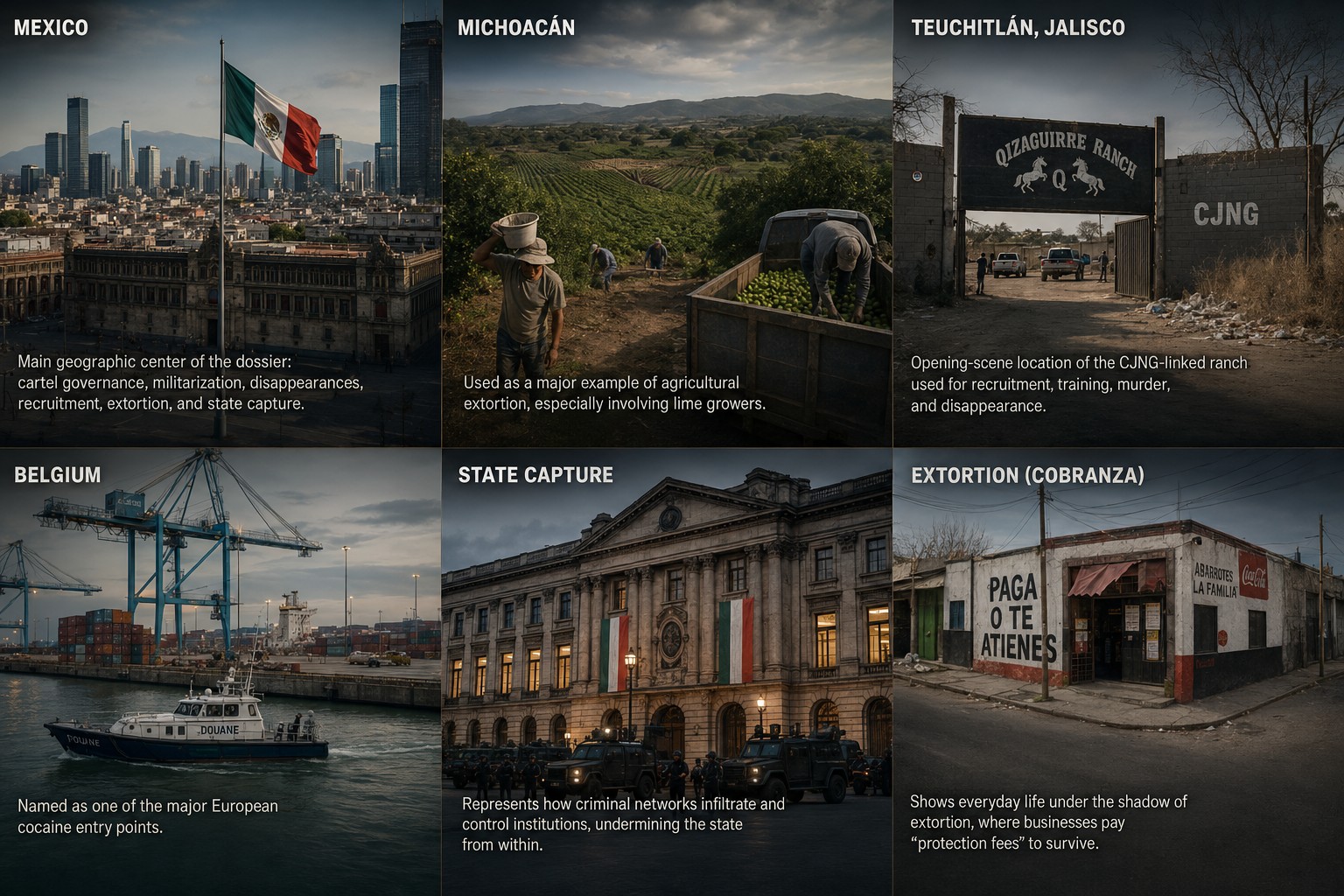
The most useful way into this story is not a mansion, a yacht, or a wanted poster. It is a ranch outside Teuchitlan, Jalisco, where Mexican authorities and searchers documented a case that joined recruitment, training, murder, disappearance, and terror in one location. The point is not that one ranch explains every cartel. The point is that it shows the work modern criminal groups do when they are more than wholesale drug suppliers.[79][96][98]
The supplied dossier begins there for a reason. A trafficking organization can move product through a corridor and still leave many residents untouched. A group that recruits labor, punishes resistance, hides bodies, intimidates families, and taxes the local economy is operating on a different plane. It is not replacing the state in a legal sense; it is exploiting every place where the state is too slow, too corrupt, too frightened, or too absent to protect people.[53][64][63]
Mexico had more than 130,000 people recorded in the official missing-persons registry when the 2026 dispute over the count broke into public view. The government said administrative traces suggested tens of thousands of registered missing people might be alive; families and search collectives answered that a database exercise could not substitute for finding people, identifying remains, or explaining failures. The exchange matters because disappearances are crimes and arguments over whether the state can tell the truth.[53][81][80][97]
Search families often act as investigators because the official system does not move fast enough for grief. They read terrain, follow rumors, compare clothing fragments, press prosecutors, and return to places most institutions avoid. That unpaid civic labor is one of the clearest signs of institutional failure in the file. A state that leaves families to search for the missing fails after violence and teaches violent groups how much room they have.[64][60][62][103]
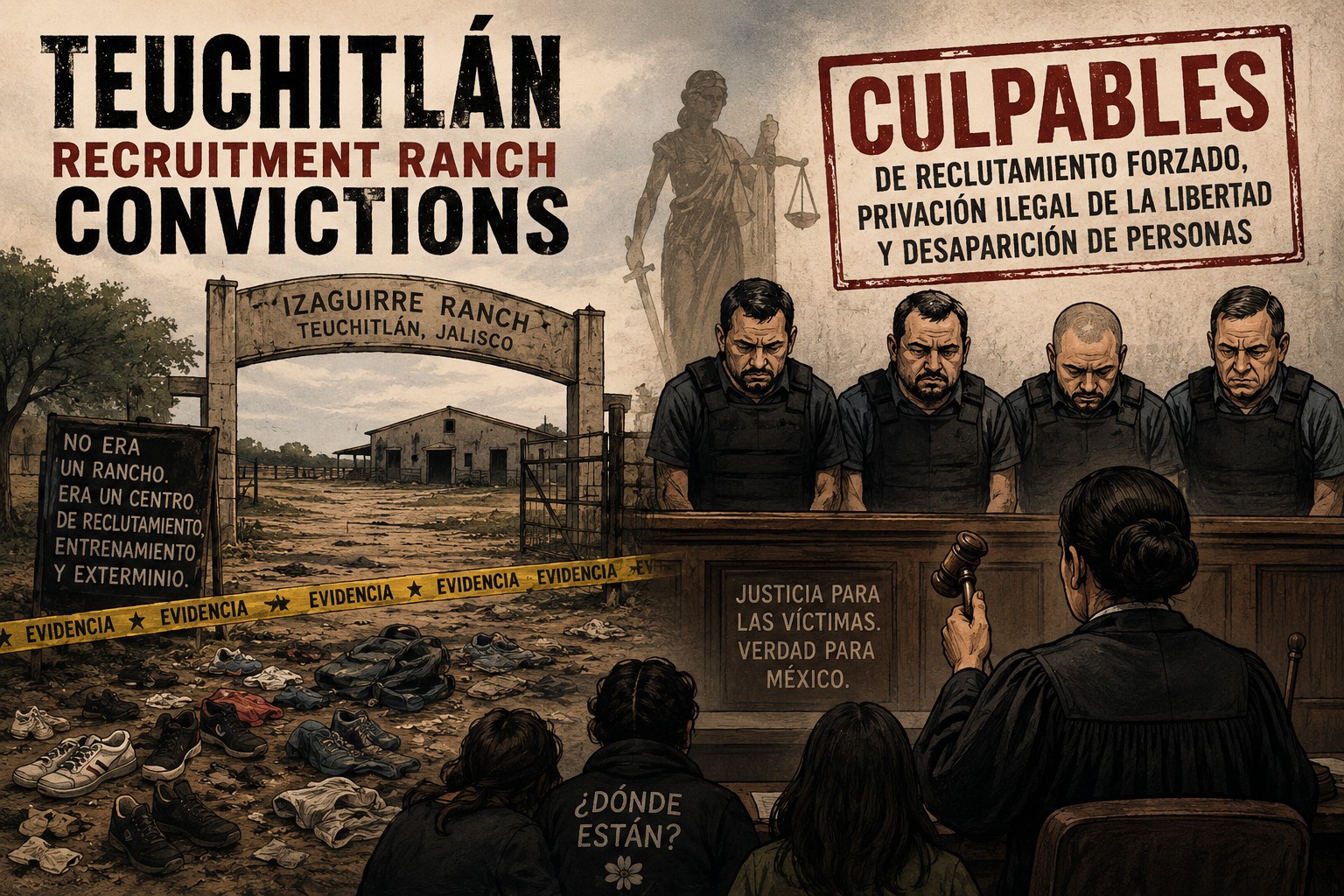
The ranch also strips glamour from the cartel image. Recruitment in that setting is not a music-video fantasy. It is a labor funnel backed by threats. A teenager promised money, a migrant promised a job, or a vulnerable young man promised belonging may discover too late that the invitation has turned into a trap. The record from Teuchitlan is therefore a case study in coercive labor as much as a case study in organized crime.[79][82][68]
There is a careful distinction to keep in place. Editorial images in this package help readers hold the evidence in view, but they are not police photographs or proof by themselves. The proof sits in court records, official registries, public-health data, academic models, sanctions notices, and reporting from the ground. The images belong in the story because scale is hard to read without visual structure; the sources carry the evidentiary weight.[1][9][30]
A modern cartel should be read as a criminal ecosystem. It may contain bosses, armed cells, transport brokers, recruiters, corrupt officials, local tax collectors, accountants, lawyers, business fronts, money couriers, and digital propagandists. Those parts do not always sit in a neat chain of command. They can cooperate, split, subcontract, fight, and reconnect. That messiness is one reason leader arrests can matter deeply without ending the market.[4][45][73]
The word cartel itself can mislead. In economics, a cartel is a collusive arrangement to control price or output. In crime reporting, the term now describes large trafficking organizations and their fragments. Many of the groups in this story do collude and set rules, but they also govern space, sell protection, recruit labor, and launder money. The older word remains useful because readers recognize it; the analysis has to be more precise than the word.[1][24][74]
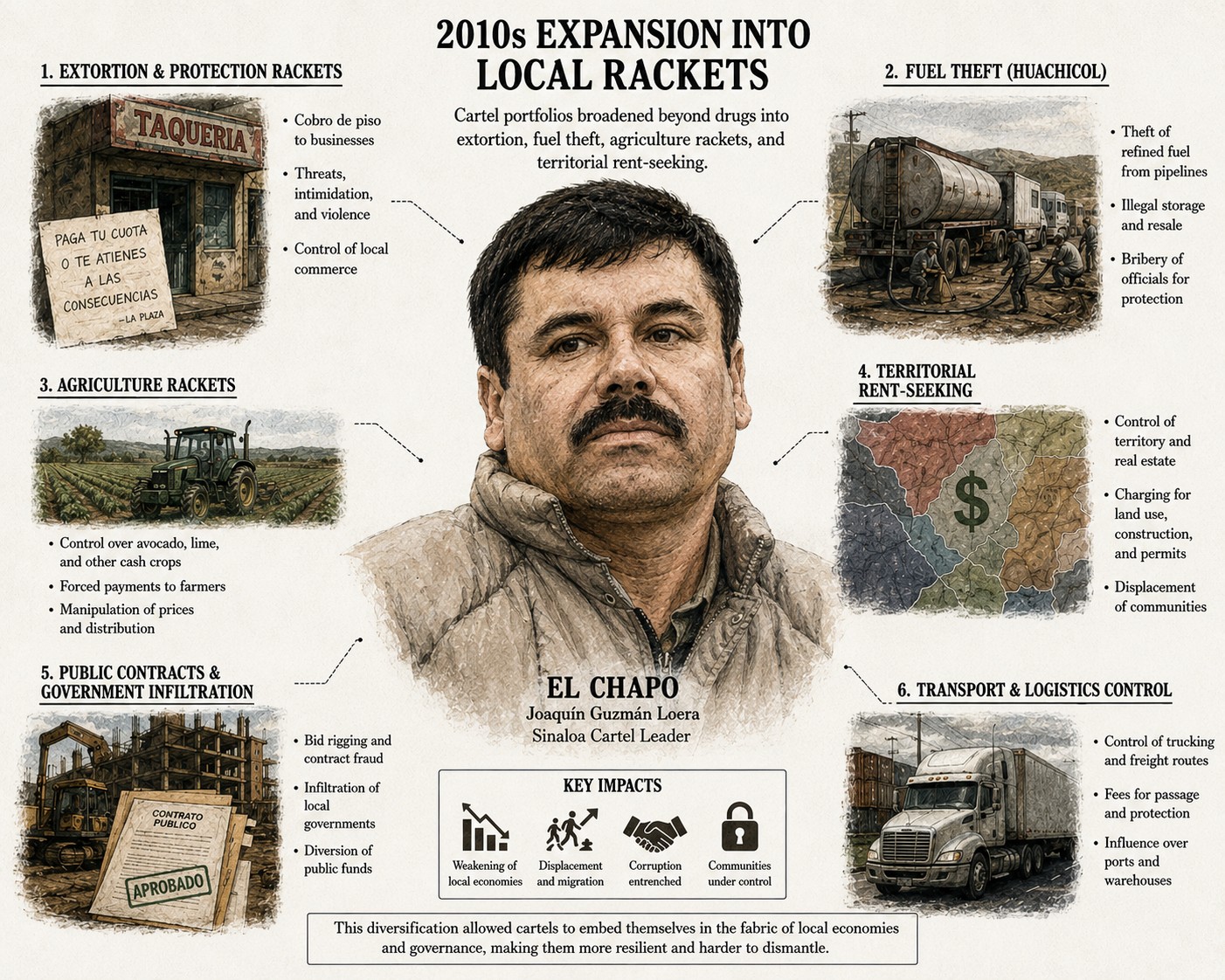
The first conclusion is plain: drug trafficking remains central, but it is not the whole explanation. Cocaine, fentanyl, methamphetamine, and heroin finance large pieces of cartel power. Extortion, fuel theft, migrant exploitation, agricultural rackets, illegal mining, retail shakedowns, and public-contract fraud turn territory into recurring revenue. A strategy that watches only the shipment misses the businesses paying every week to survive.[4][15][83][84]
That broader portfolio is why the story has to move between scales. A family searching in Jalisco, a lime grower in Michoacan, a counterfeit pill in Chicago, a port container in Antwerp, a shell company in California, and a guilty plea in Brooklyn are not separate moral universes. They are pieces of one market system, connected by demand, logistics, fear, corruption, and finance.[39][10][11][51]
How smuggling turned into governance
The history is not a straight line, but the broad movement is clear. Late-twentieth-century cocaine trafficking increased the value of transport corridors and border brokers. Mexican groups that once handled routes for Colombian suppliers gained leverage as enforcement pressure, geography, and consumer demand made them indispensable. Over time, transport power turned into wholesale power, and wholesale power turned into local rule in contested regions.[2][95][74]

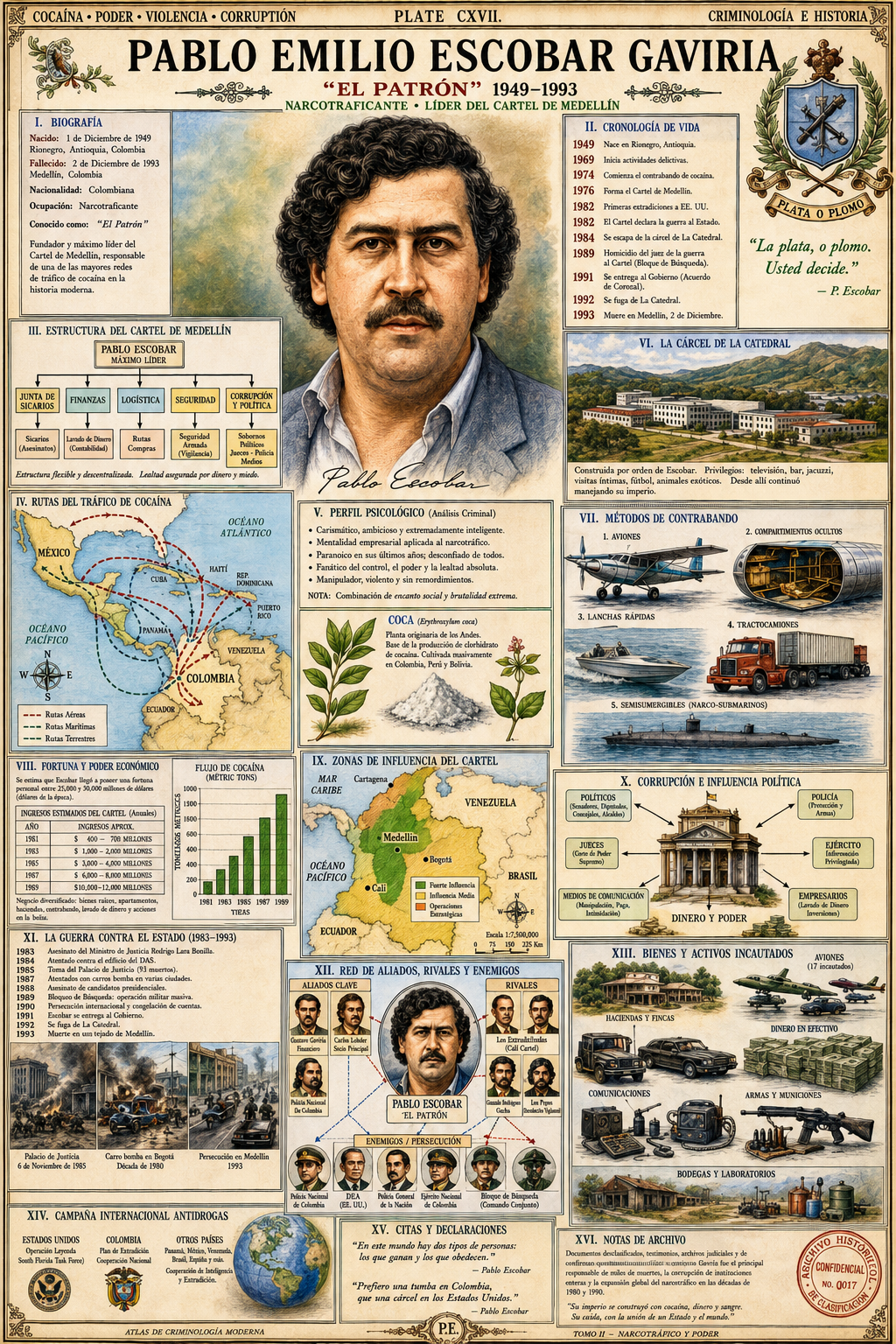
The old kingpin image still matters because it shaped public imagination. Pablo Escobar and later Joaquin El Chapo Guzman Loera taught audiences to look for the boss, the prison break, the mansion, the dramatic capture, and the final sentence. Those details are real parts of history. They mislead when they teach readers to treat the system as a biography.[109][12][71]
Mexico post-2006 security policy intensified the pattern. Militarized campaigns removed leaders and disrupted factions, but they also helped fragment organizations and create new battles over territory, succession, and local authority. That does not mean enforcement created cartels. It means enforcement that removes people without reducing recruitment, corruption, demand, or profits can change the violence rather than end it.[75][68][69][70]
The recruitment model is especially important because it treats cartel endurance as a labor problem. Prieto-Curiel, Campedelli, and Hope estimated that Mexico had between 160,000 and 185,000 cartel personnel in 2022 and argued that reducing recruitment would lower violence more effectively than simply increasing arrests. The exact figure is debated like any model, but the direction of the argument fits the field evidence: every arrest means less if another young person is available tomorrow.[68][69][82]
Leadership still matters. Ovidio Guzman Lopez, Ismael El Mayo Zambada Garcia, Rafael Caro Quintero, and Nemesio Oseguera Cervantes are not interchangeable names on a board. Their arrests, pleas, transfers, or reported deaths alter bargaining, intelligence, morale, factional trust, and legal exposure. The mistake is not paying attention to leaders; the mistake is believing leaders are the whole machine.[10][11][90][91]
The 2025 transfer waves from Mexico to the United States underline that point. Moving Rafael Caro Quintero and dozens of other defendants was not symbolic. It shifted legal risk and gave prosecutors access to defendants who had long histories. Another wave in August 2025 showed continued bilateral pressure. Neither wave, by itself, erased the incentives that make trafficking, extortion, and laundering profitable.[90][89][21]
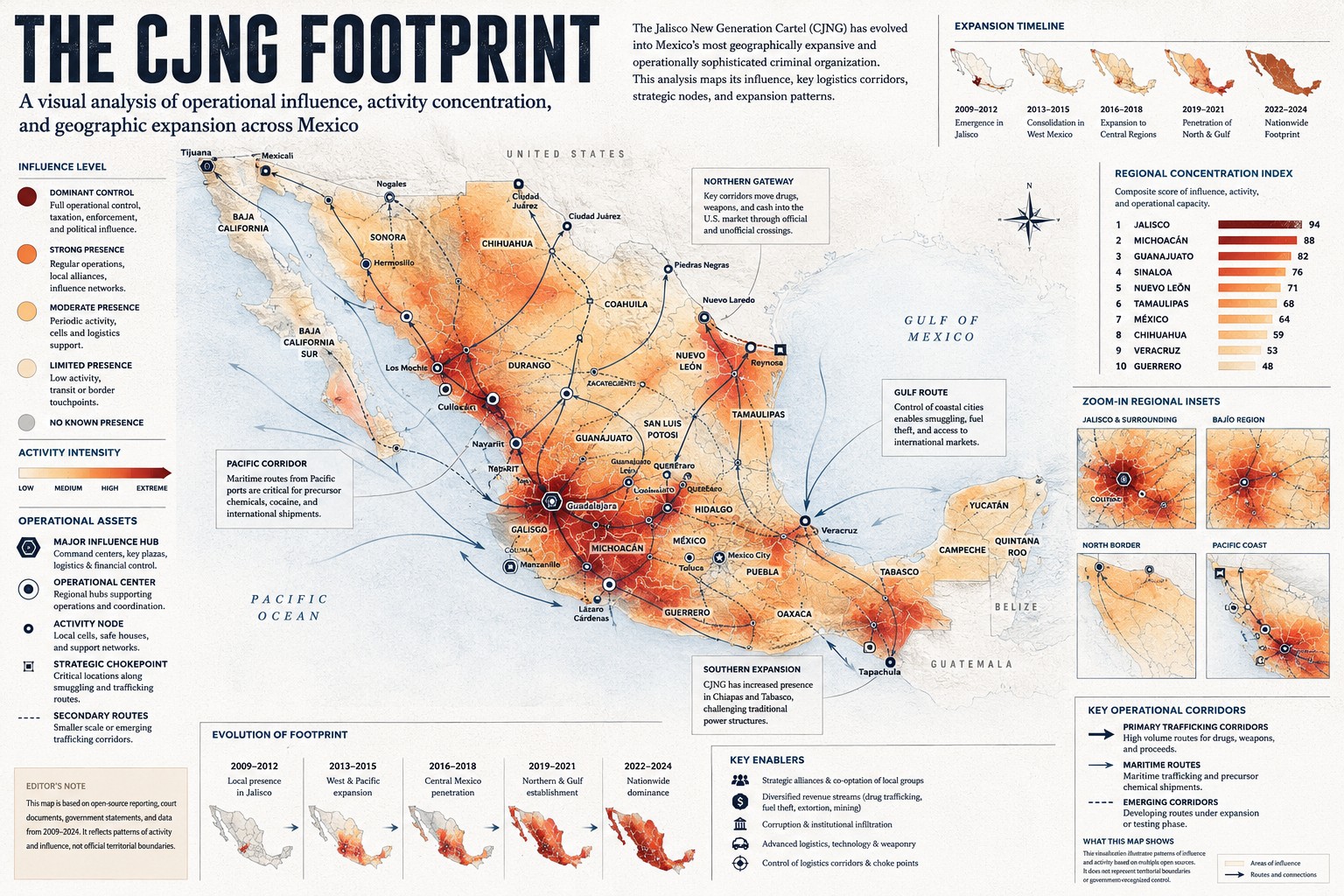
The Jalisco New Generation Cartel, known in many records by its Spanish initials, grew through a mix of territorial violence, logistics, alliances, and diversification. United States agencies have described it as one of the highest-consequence Mexican criminal groups for drug trafficking. After reporting in 2026 said Nemesio Oseguera Cervantes had been killed, the relevant question was not whether the organization vanished. It was who controlled money, routes, alliances, and armed cells afterward.[6][91][92][108]
The Sinaloa network presents a different lesson. The older generation, the faction associated with Los Chapitos, and allied operators have faced arrests, sanctions, pleas, and internal conflict. Yet the network remained central in United States fentanyl cases because it had suppliers, brokers, corrupt protection, and distribution channels beyond any one defendant. That is what a resilient criminal network looks like in public records.[5][10][13][88]
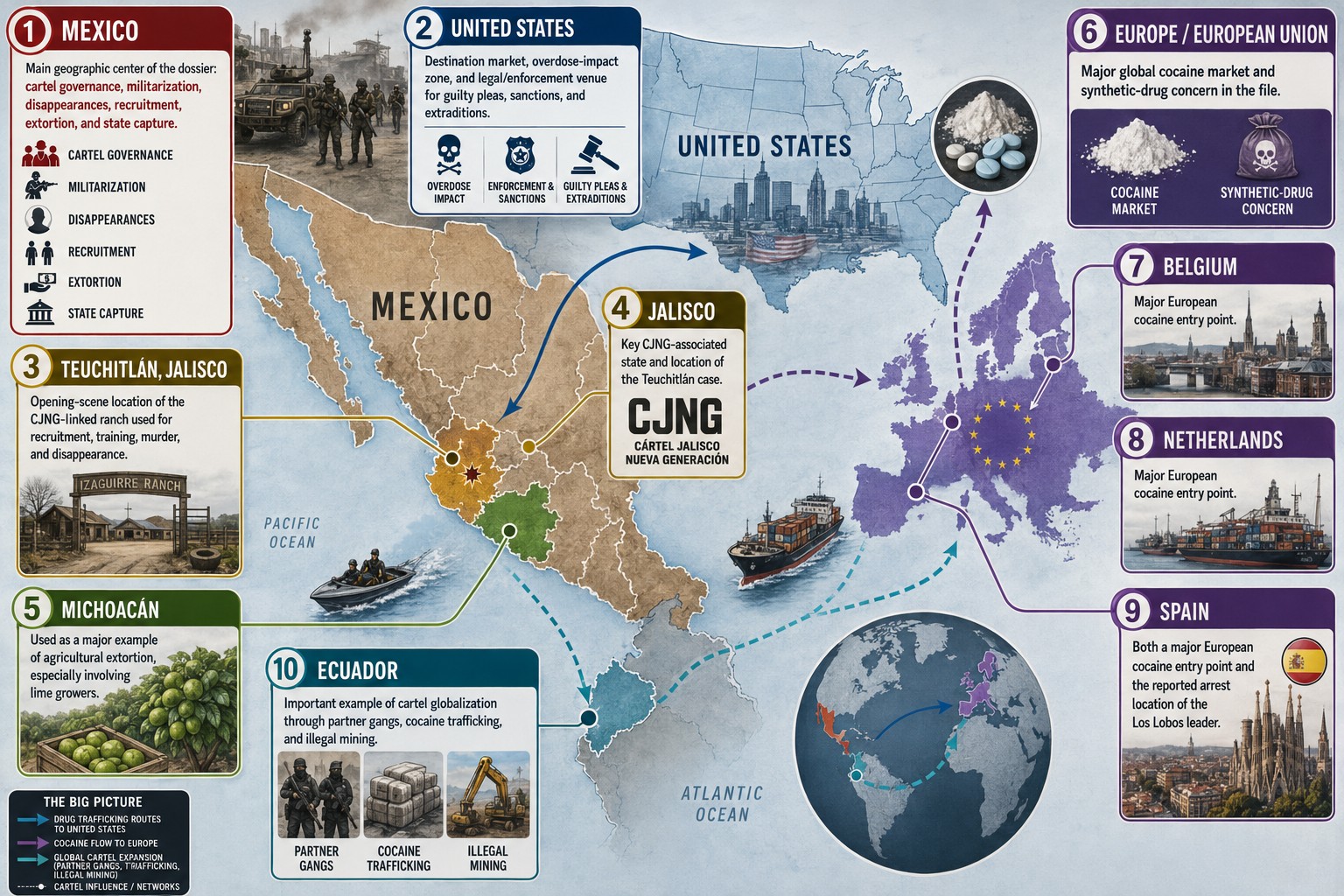
This is why maps of cartel influence should be read carefully. A shaded state on a map does not mean a criminal group owns every town, road, warehouse, and official. It means analysts see activity, alliances, pressure, or operational capacity. Criminal influence often looks like overlapping claims rather than formal borders. A map is a guide to pressure, not a cadastral survey of criminal sovereignty.[72][76][4]
One stable pattern does emerge across the history. Whenever criminal groups can charge for movement, protection, silence, work, land, retail trade, or political permission, territorial control gains value even without a major shipment. That is the bridge from smuggling to governance. The product pays for the network; the network learns how to tax the place it occupies.[83][84][15][56]
Recruitment is the oxygen
Recruitment is where the system renews itself. A cartel that loses a driver, lookout, cook, gunman, courier, accountant, or recruiter can only continue if the position can be filled. That is why the labor market matters as much as the drug market. Arrests reduce capacity today; recruitment decides whether the capacity returns tomorrow.[68][69][82]
Reuters reporting on child recruitment described a pattern that moved through family ties, neighborhood contacts, video games, social platforms, promises of money, and promises of belonging. That evidence is useful because it avoids cartoon villains. Recruitment often finds people already cut off from school, work, protection, or status. The cartel offer is predatory because it arrives where lawful institutions have left a vacancy.[82][106][60]
Digital contact does not mean recruitment is only online. The phone can start a relationship, reinforce a myth, or help a handler screen vulnerability. The pressure usually still lands in physical space: a neighborhood, a bus station, a warehouse, a safe house, a ranch, a vehicle, or a family home. Digital media lowers the cost of approach; territorial power still supplies the threat.[82][106][65]
Cartel communication should be covered with restraint. Reporting can describe that groups use videos, songs, banners, private messages, and social channels without reproducing instructions, handles, slogans, or recruitment language. The purpose is to explain the environment, not to serve as a distribution channel for intimidation or fantasy. The best evidence is court material, field reporting, academic work, and careful local journalism.[106][82][65][66]
Recruitment also produces coercion after entry. A person may begin with a promise of work and later face threats against himself or his family. A minor may be told he is disposable. A migrant may be trapped by debt or geography. A local youth may be pulled through kinship and then punished for hesitation. That mix of choice, pressure, and terror is one reason clean moral categories fail as analysis.[79][82][64]
The Teuchitlan case belongs in the recruitment section because it links labor to disappearance. Reports around the ranch described a place of violence where people were allegedly pulled into a system. The meaning of the site is therefore administrative: intake, discipline, disposal, secrecy, and fear. It is the ugly office work of criminal control.[79][96][100][101]
Youth recruitment is not solved by a poster campaign. It requires schools that keep students attached, labor markets that offer real wages, family services that respond early, safe reporting channels, digital literacy, and local police that do not turn a complaint into a death sentence. Prevention sounds soft only if the listener has never counted how much violence a new recruit can produce.[68][37][61]
The model also changes how arrests should be evaluated. A spectacular capture may be worth doing, but its long-term effect depends on whether the organization can replace the person. If replacement is easy, the policy outcome is temporary disruption. If replacement is expensive, risky, and socially harder, the same arrest has a larger effect. Recruitment is the multiplier hidden behind the headline.[68][24][4]
That logic applies to corruption too. A criminal group must recruit officials as well as teenagers. It needs police willing to look away, prosecutors willing to stall, customs officers willing to miss a container, municipal officials willing to approve a contract, and financial actors willing not to ask. Institutional recruitment is quieter than armed recruitment, but it can be more valuable.[9][52][48][58]
The strongest policy implication is that a serious anti-cartel strategy has to compete for people before cartels do. Competing for people means credible work, credible safety, credible justice, and credible belonging. A state that appears only as a raid team arrives late. A state that appears as a school, clinic, prosecutor, search office, job program, and trustworthy local police arrives in time to matter.[75][60][68][36]
Extortion is everyday rule
Extortion is the part of cartel power that many residents meet before they ever see a drug shipment. A business owner pays because refusing can mean damage, kidnapping, death, or closure. A producer pays because crops cannot hide. A driver pays because the route is exposed. A town pays because fear runs on a schedule. This is governance by invoice and threat.[84][83][102][56]
The Michoacan lime case is a concrete example. Associated Press reporting described criminal groups extorting growers and the killing of a growers leader after he denounced the racket. The case matters because it shows how agricultural production can turn into a tax base for armed groups that do not plant, harvest, ship legally, or accept market risk.[83][59][57]
The same logic reaches storefronts. A corner shop, restaurant, repair stall, transport company, bar, market vendor, or construction crew can be told to pay for protection from the people making the threat. The payment is often small enough to repeat and large enough to drain the business. That recurring structure is what makes extortion politically important. It makes fear routine.[84][102][56]
Extortion is also undercounted. Victims may not report because police are distrusted, prosecutors are slow, retaliation is plausible, and the payment may feel like the cheapest path to staying alive. Victimization surveys help because they ask about experiences beyond filed complaints, but fear still shapes what people disclose. Official crime data are necessary; they are not the full map.[57][56][60]
Agriculture is especially vulnerable because land, harvests, routes, refrigeration, packing houses, and buyers are visible. A cartel can tax acreage, crates, shipments, water, fuel, trucking, or wholesale access. The grower produces food inside a physical chain that can be interrupted at many points. Criminal groups exploit that visibility with chilling efficiency.[83][15][84]
Fuel theft and crude-oil smuggling show another form of local rent seeking. Treasury sanctions in 2025 tied the Jalisco New Generation Cartel to fuel theft and crude-oil smuggling. The details matter because fuel is not a glamour commodity. It is infrastructure. Criminal access to fuel markets can finance operations while corrupting transport, storage, and legitimate business channels.[15][17][51]
Public contracts create a related opening. A criminal group does not need to win a contract in its own name. It can threaten bidders, place a friendly contractor, demand a percentage, force purchases from controlled suppliers, or punish officials who resist. This is why local government capture is a financial story as much as a political one.[58][70][9]
Extortion changes community behavior before it changes statistics. People close early, avoid roads, stop reporting, move inventory quietly, pay in cash, send children away, or leave town. Each adjustment gives the criminal group more authority. The payment is only the visible transaction. The deeper loss is the shrinking of normal life.[84][62][60]
The state sometimes appears as the solution and sometimes as part of the danger. A business owner who suspects police leak complaints has little reason to report. A journalist who sees officials as aggressors as well as protectors has little reason to trust formal safeguards. A search family that feels dismissed by authorities may keep digging without them. Trust is not a slogan here; it is a survival tool.[85][65][53][64]
The policy answer begins with making extortion more costly to commit and less dangerous to report. That means protected complaint channels, financial tracing, witness protection, fast prosecution, disciplined police, local intelligence, and credible emergency response. It also means economic support for sectors under pressure. A shopkeeper cannot testify against a criminal tax if the lawful state cannot keep the doors open afterward.[56][57][59][75]
When the state is inside the story
The phrase state capture can sound abstract until a court record gives it names, dates, and payments. Genaro Garcia Luna, Mexico former public security secretary, was sentenced in the United States after prosecutors said he took bribes from the Sinaloa Cartel while holding senior security power. That case is not a metaphor. It is a public record showing that anti-cartel institutions can be compromised from within.[9][74][61]
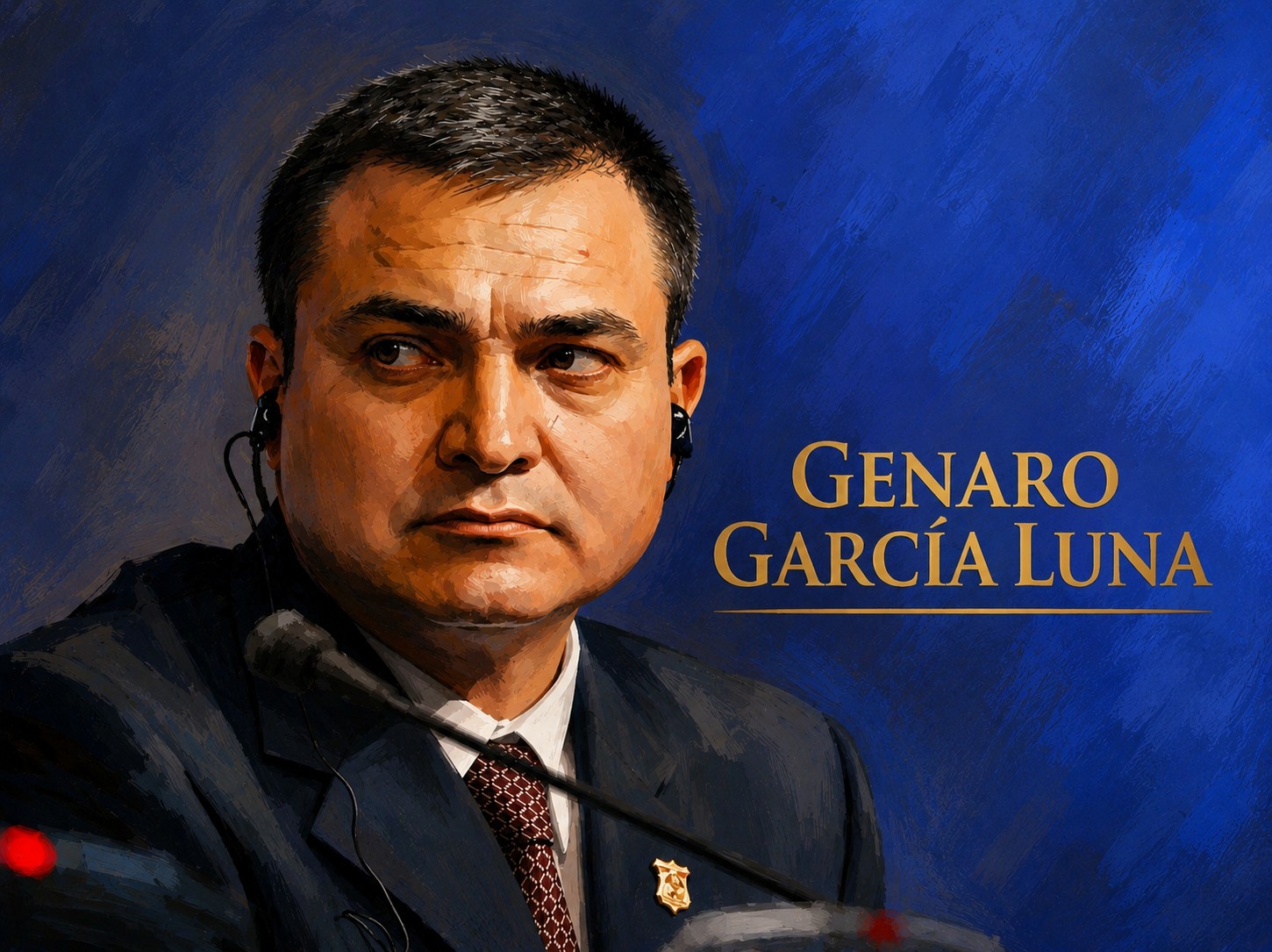
The case matters beyond one official. Cartels do not have to defeat the state if they can rent pieces of it. A compromised officer can provide intelligence. A prosecutor can slow a file. A municipal official can steer a contract. A prison official can protect a leader. A customs officer can miss a container. A politician can look away. Each favor converts public authority into private criminal capacity.[9][45][52]
Political violence is one way criminal groups negotiate with the state. Academic research on assassinations in Mexico found that organized crime can use violence to influence candidate selection, retaliate against crackdowns, and shape local government. Data Civica has separately tracked political violence in Mexico through its Votar Entre Balas project. The evidence does not mean every local killing has the same motive. It means organized crime is a political actor in many places.[70][58][76]
Journalists sit at the collision point between criminal power and public power. Reuters, citing Article 19, reported that murders and disappearances of Mexican journalists nearly doubled in 2025 and that many attacks came from public officials. That finding is crucial. The threat to reporting can be a cartel gunman, a lawsuit, a local official, a police leak, a protection failure, or a smear campaign.[85][65][66][67]
State capture also distorts data. If families distrust registries, if victims do not report extortion, if journalists self-censor, if officials hide bodies, or if police classify crimes in ways that reduce pressure, the public record thins than the violence. This does not make official data useless. It makes triangulation necessary: official statistics, field reporting, court records, family testimony, and civil-society monitoring have to be read together.[53][57][60][81]
Militarization complicates the picture. Soldiers and marines can disrupt heavily armed groups, protect operations, and seize assets. They can also deepen accountability problems if civilian institutions are bypassed, local police remain weak, and the justice system cannot hold cases. The debate is not soldiers or no soldiers. The debate is whether force is paired with institutions that can survive after the convoy leaves.[75][61][21]
Foreign-terrorist-organization designations add another legal layer. In 2025, United States policy moved toward treating several cartels and criminal groups through terrorism-related authorities. That can expand tools for prosecution, finance, immigration, and sanctions. It can also encourage political language to outrun strategy. A designation does not, by itself, protect a journalist, fund a search commission, clean a police department, or stop a teenager from being recruited.[22][20][23][25]
The strongest anti-capture tools are boring in the best sense. Beneficial-ownership registries, procurement audits, independent prosecutors, disciplined internal affairs units, protected reporting channels, judicial security, campaign-finance scrutiny, and local press protection do not make great speeches. They make corruption harder to hide. Cartels do not fear adjectives. They fear institutions that keep receipts.[52][27][58][65]
Readers should resist the temptation to treat corruption as cultural destiny. Corruption is an incentive structure. It grows where salaries are low, accountability is weak, oversight is dangerous, political protection is purchasable, and criminal money arrives faster than legal budgets. That means it can be reduced by design, even if not eliminated. The alternative is fatalism, which is just impunity wearing a tired hat.[76][74][75]
The public record therefore supports a clear claim: cartel power often moves through institutions as well as around them. That claim should be precise. It does not mean the entire state is captured. It means enough offices, officials, contracts, routes, police units, courts, or records can be bent to give criminal groups room. The fight is over those rooms.[9][70][85]
The clean-looking money
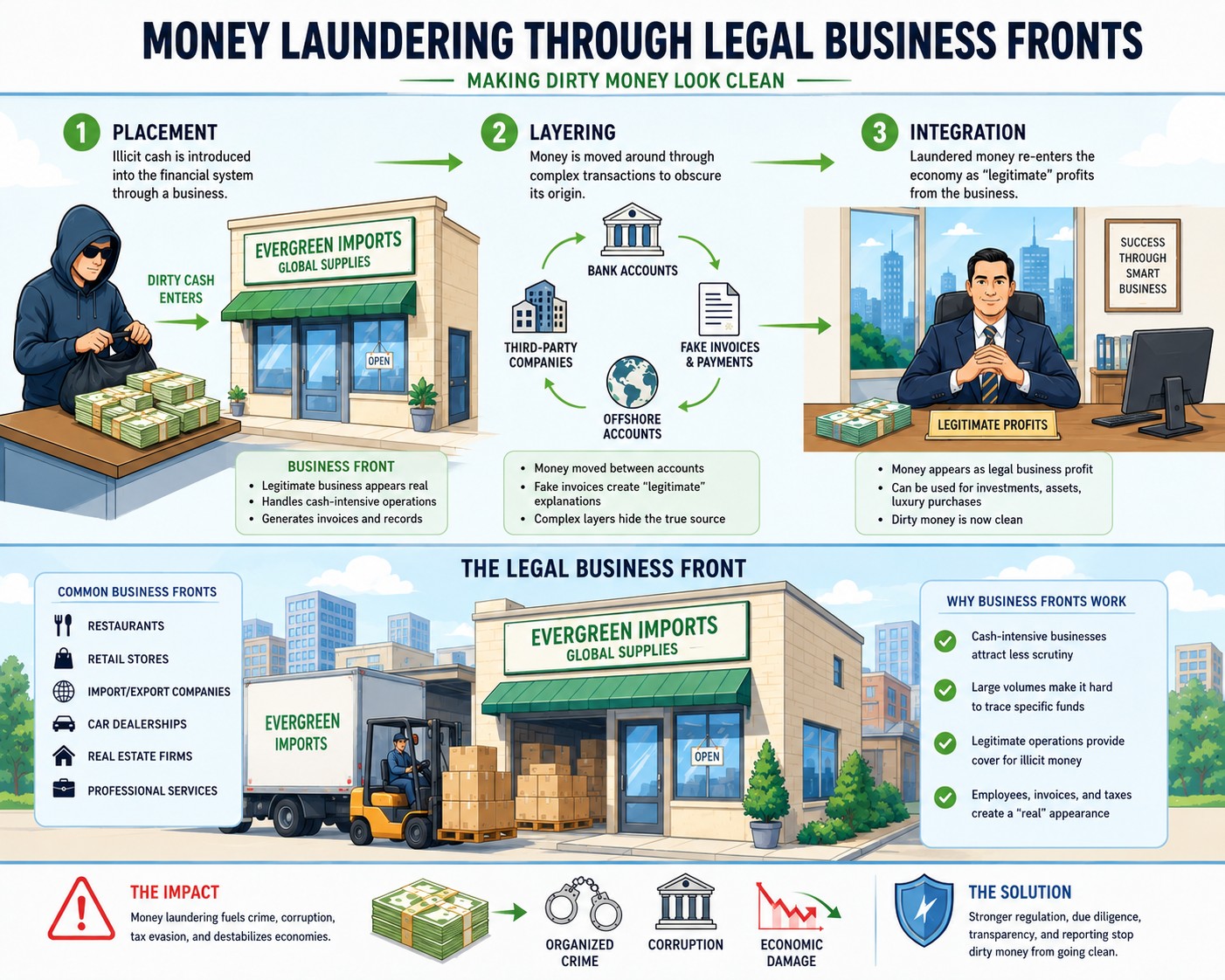
Money laundering is where violence tries to put on a suit. Cash from drugs, extortion, fuel theft, kidnapping, or illegal mining has to be stored, moved, disguised, and eventually spent. The process can involve businesses, real estate, trade invoices, shell companies, professional services, banks, money-service businesses, cash couriers, cryptocurrency, or relatives. The main point is simple: power lasts when dirty revenue can enter legal life.[51][18][16]
The familiar laundering sequence is placement, layering, and integration. Placement introduces illicit value into the financial system. Layering moves it through transactions that obscure origin. Integration returns it as apparently legitimate profit, property, or investment. Real cases rarely follow a classroom diagram neatly, but the diagram helps readers understand why a storefront, import company, luxury asset, or real-estate deal may matter in a cartel case.[51][52][19]
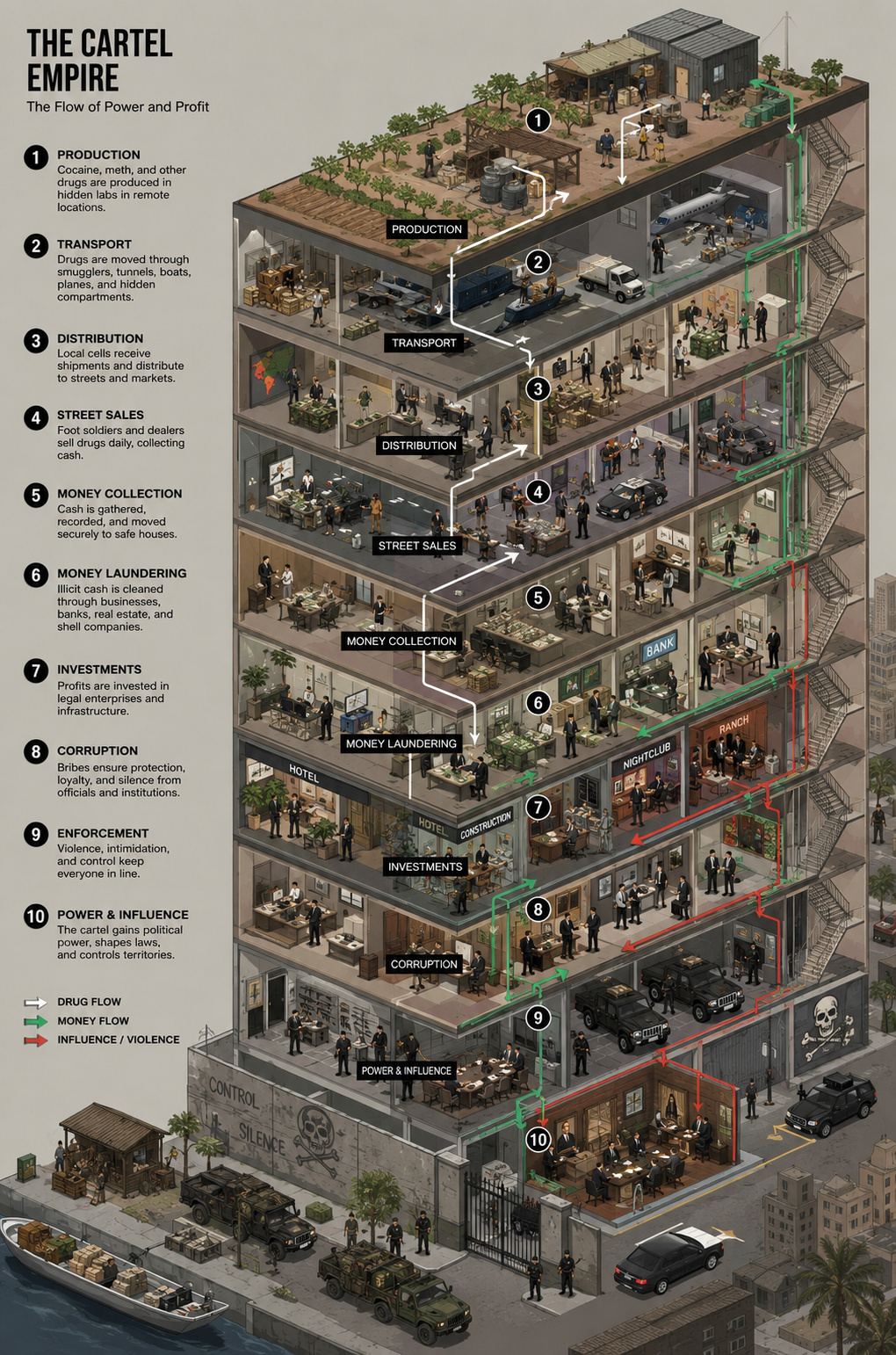
Trade-based laundering deserves special attention because it hides inside normal commerce. A shipment can be overvalued, undervalued, misdescribed, routed through intermediaries, or paired with false invoices. The same legal container system that moves legitimate goods can hide drug shipments, precursor chemicals, or money flows. Ports are law-enforcement choke points and financial interfaces.[48][46][51][49]
Business fronts do not have to be glamorous. Restaurants, retail stores, car dealerships, import-export firms, real-estate companies, construction businesses, agricultural intermediaries, trucking operations, and professional services can all provide cover if records, cash flow, and ownership are hard to verify. That does not make those sectors suspicious by default. It makes due diligence real work.[52][19][16]
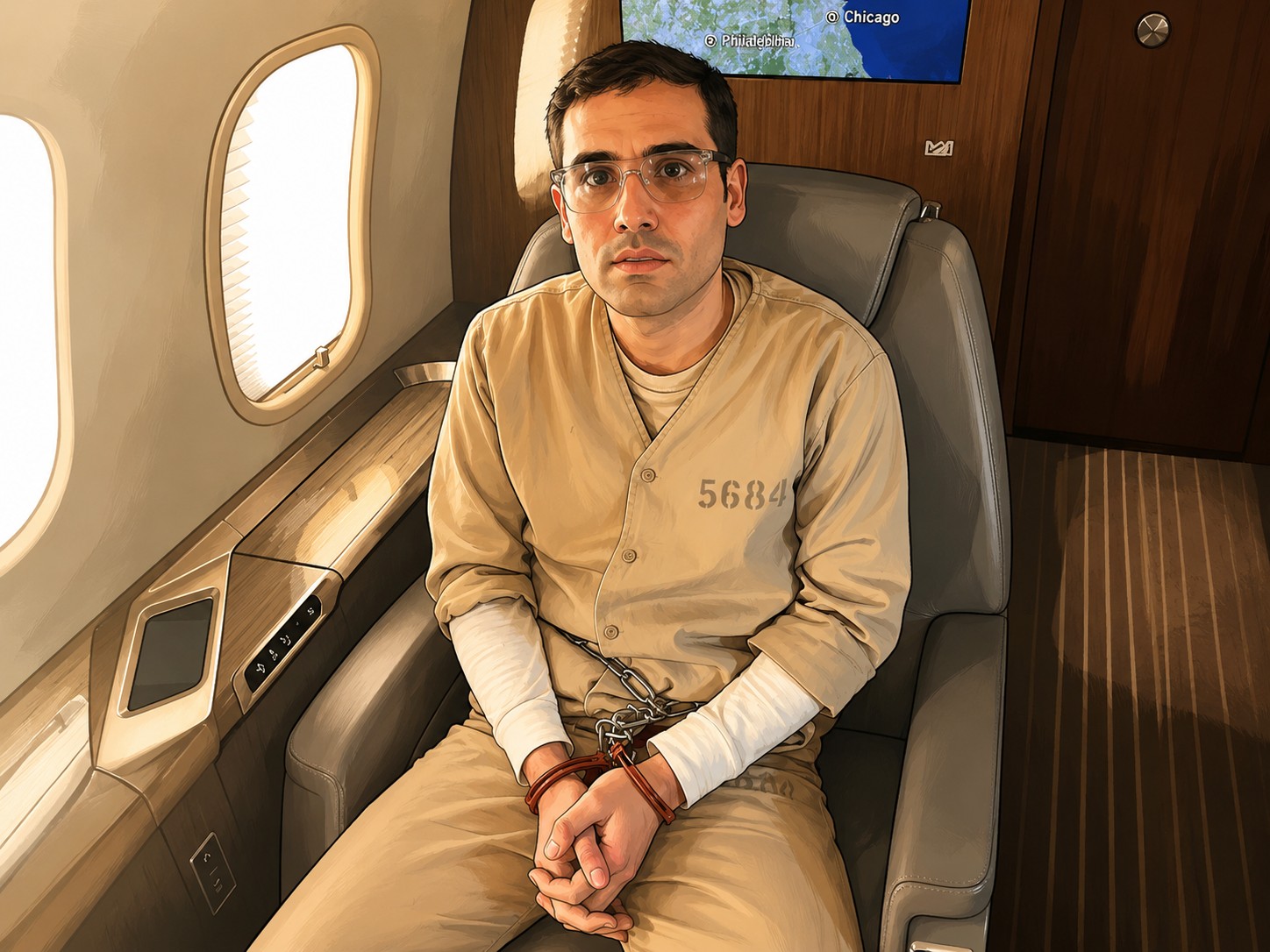
The Christian Fernando Gutierrez Ochoa case belongs here because it shows how family, business, identity, and United States legal exposure can intersect in a Jalisco New Generation Cartel-linked case. The public reporting around the case includes allegations and admissions that point to a wider lesson: criminal money often needs ordinary-looking structures. The strongest facts are the court records; the image is an editorial illustration, not evidence.[93][9][51]

Financial enforcement works best when it raises the cost of concealment. Sanctions can freeze access, indictments can expose methods, beneficial-ownership rules can narrow anonymity, auditors can catch procurement fraud, and banks can flag suspicious patterns. None of that replaces community safety or public health. It attacks the ability of violence to turn into usable wealth.[17][18][27][15]
There is also a fairness issue. Overbroad suspicion can harm legitimate businesses in communities already under pressure. A better approach targets behavior: unexplained cash volume, hidden ownership, mismatched invoices, coercive local conditions, politically exposed relationships, repeated shell entities, and transactions inconsistent with the stated business. Good anti-money-laundering work is evidence-led, not rumor-led.[51][19][27]
Laundering connects consumer countries to producer and transit countries in a way border rhetoric often hides. A drug purchase may happen in one city, an overdose in another, a bribe in a third, a shell company in a fourth, and a property purchase in a fifth. The money does not respect the moral map that lets consumers imagine violence as foreign.[1][39][18][87]
Professional enablers are a sensitive part of the file. Lawyers, accountants, real-estate brokers, company-formation agents, customs brokers, and bankers are not villains by category. Some are victims of deception or pressure. Some are negligent. Some are knowingly useful. The policy challenge is to distinguish those categories without leaving easy doors open for criminal finance.[52][19][45]
The public should read asset stories as governance stories. A mansion, restaurant, fuel company, ranch, truck fleet, or import business can be trophy, tool, cover, or all three. The cartel does not simply want money. It wants money that can buy loyalty, corrupt authority, pay lawyers, replace losses, and make violence look like success.[16][15][51]
Synthetics, cocaine, and the global loop
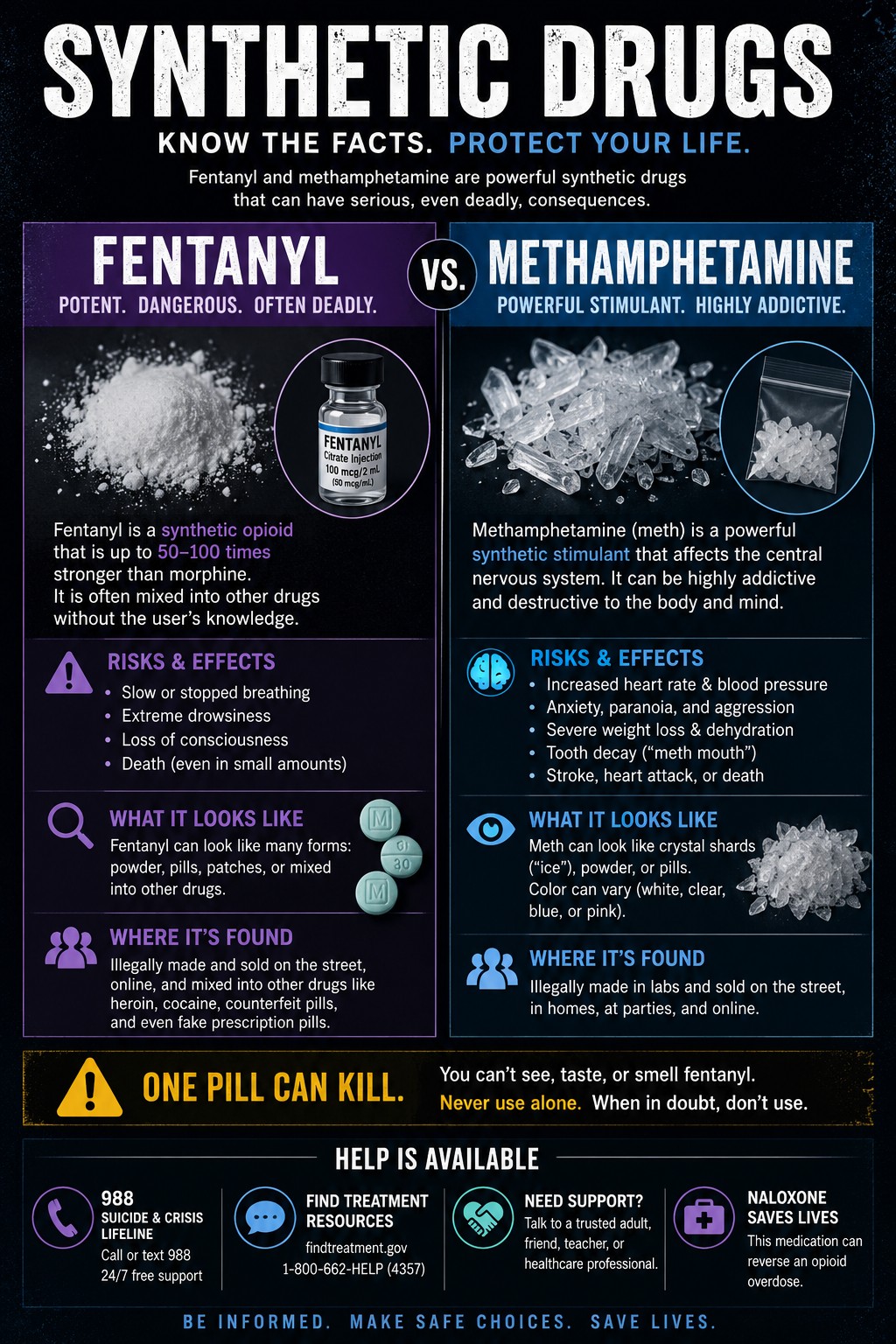
Synthetic drugs changed the economics of organized crime because chemistry can reduce dependence on crops, seasons, and bulky shipments. Fentanyl is potent in small quantities. Methamphetamine can be produced through chemical supply chains that differ from crop-based drugs. That does not make borders irrelevant; it changes what traffickers need from borders, ports, labs, finance, and distribution networks.[4][33][34][49]
The United States overdose picture must be held with two facts at once. Overdose deaths fell sharply in 2024, according to federal data and Reuters reporting, and that decline matters. The remaining toll was still enormous, with synthetic opioids continuing to account for a large share of deaths. Public health can move outcomes; the scale of harm remains unacceptable.[30][87][32][35]
Naloxone, treatment access, surveillance, and honest risk communication are security tools when the market is killing consumers. They do not replace prosecution. They reduce death, reduce panic, and give users a path out of demand. A strategy that treats public health as separate from cartel policy misunderstands the destination side of the business.[36][37][31][8]
Cocaine remains a massive parallel market. The European Union Drugs Agency reported record cocaine seizures in Europe, with Belgium, Spain, and the Netherlands central to the seizure picture. That does not prove every gram is tied to a Mexican group. It proves cocaine logistics, port corruption, and European demand remain major organized-crime drivers even as fentanyl dominates United States public debate.[39][38][47][2]
Ecuador shows how partnerships complicate the old map. Reuters reported that a leader of Los Lobos, an Ecuadorian gang linked to drug trafficking and illegal mining, was arrested in Spain and had alleged ties to the Jalisco New Generation Cartel. The important lesson is not that Mexican organizations directly command every foreign partner. It is that transnational markets reward alliances among local specialists.[86][44][76]
Europe port security is therefore part of the same story as Mexican extortion and United States overdose deaths. Containers, precursor chemicals, cocaine, cash, corrupt port workers, shipping paperwork, and encrypted coordination can join places that rarely appear together in political speeches. The market is global because logistics are global. The violence is local because people live somewhere specific.[48][39][49][1]
Precursor controls matter because synthetic-drug markets rely on chemical inputs. International Narcotics Control Board reporting tracks precursor issues across regions, while United States and European agencies warn about changes in synthetic-opioid and synthetic-stimulant supply. The challenge is that legal chemical commerce is vast. Enforcement has to find suspicious patterns without crippling legitimate industry.[49][50][4][41]
The destination market also shapes violence in source and transit regions. Demand does not order a specific murder, but it finances the system that can pay for murder, bribery, coercion, and recruitment. That distinction is important. Consumers are not personally responsible for every act in a supply chain. They are also not outside it.[1][30][43][87]
The supplied geography and footprint maps are useful because they keep multiple scales visible at once. Mexico remains the geographic center of this package. The United States appears as destination market, enforcement venue, sanctions authority, and public-health crisis site. Europe appears as a cocaine market and port-security problem. Ecuador appears as an example of criminal globalization through partner gangs.[4][39][86][21]
Global does not mean shapeless. Each node has a role. Producers, brokers, transporters, enforcers, corrupt officials, money launderers, retail distributors, consumers, doctors, treatment providers, journalists, and families all see different parts of the same structure. Good reporting names the part without pretending it is the whole.[1][45][51]
People, cases, and the danger of biography
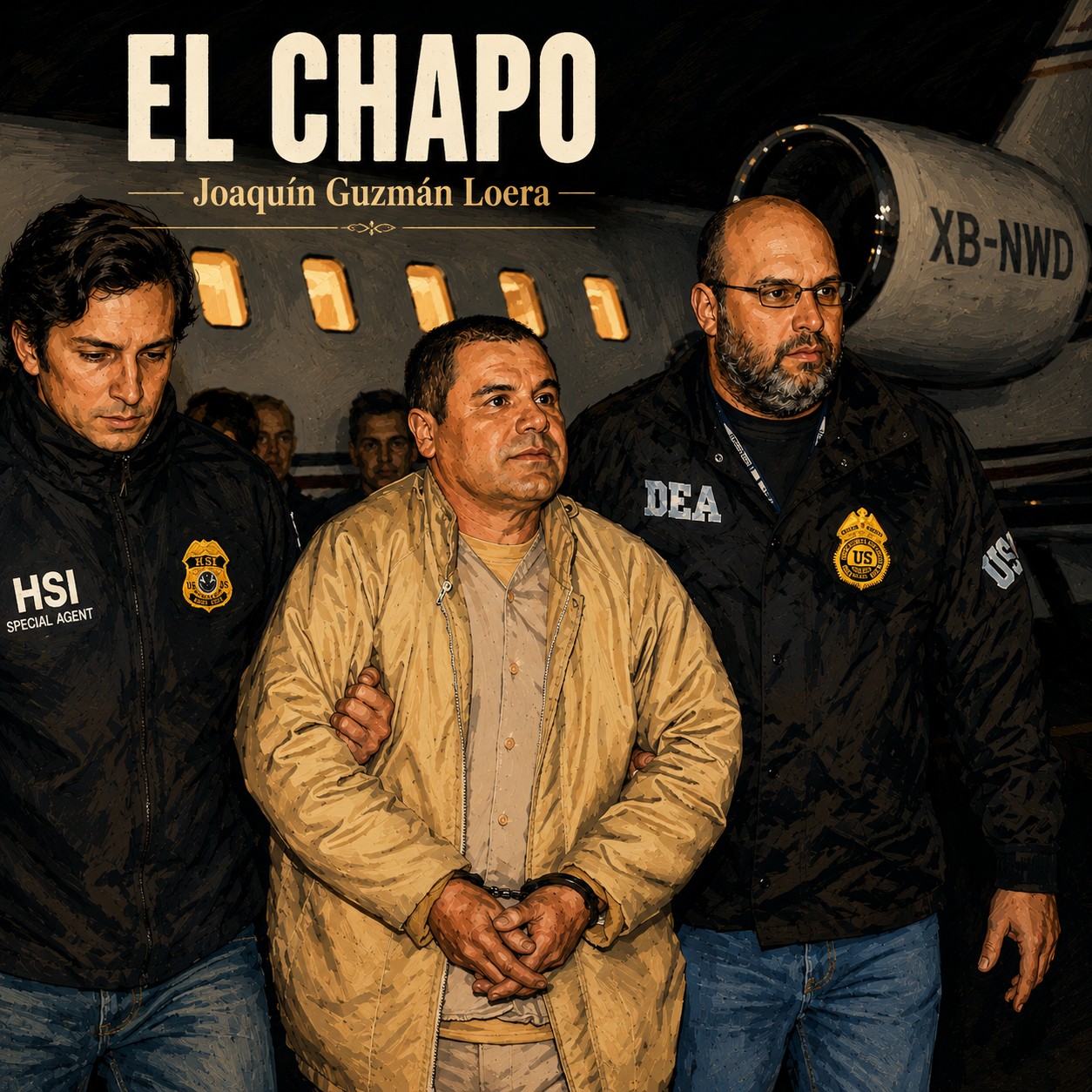
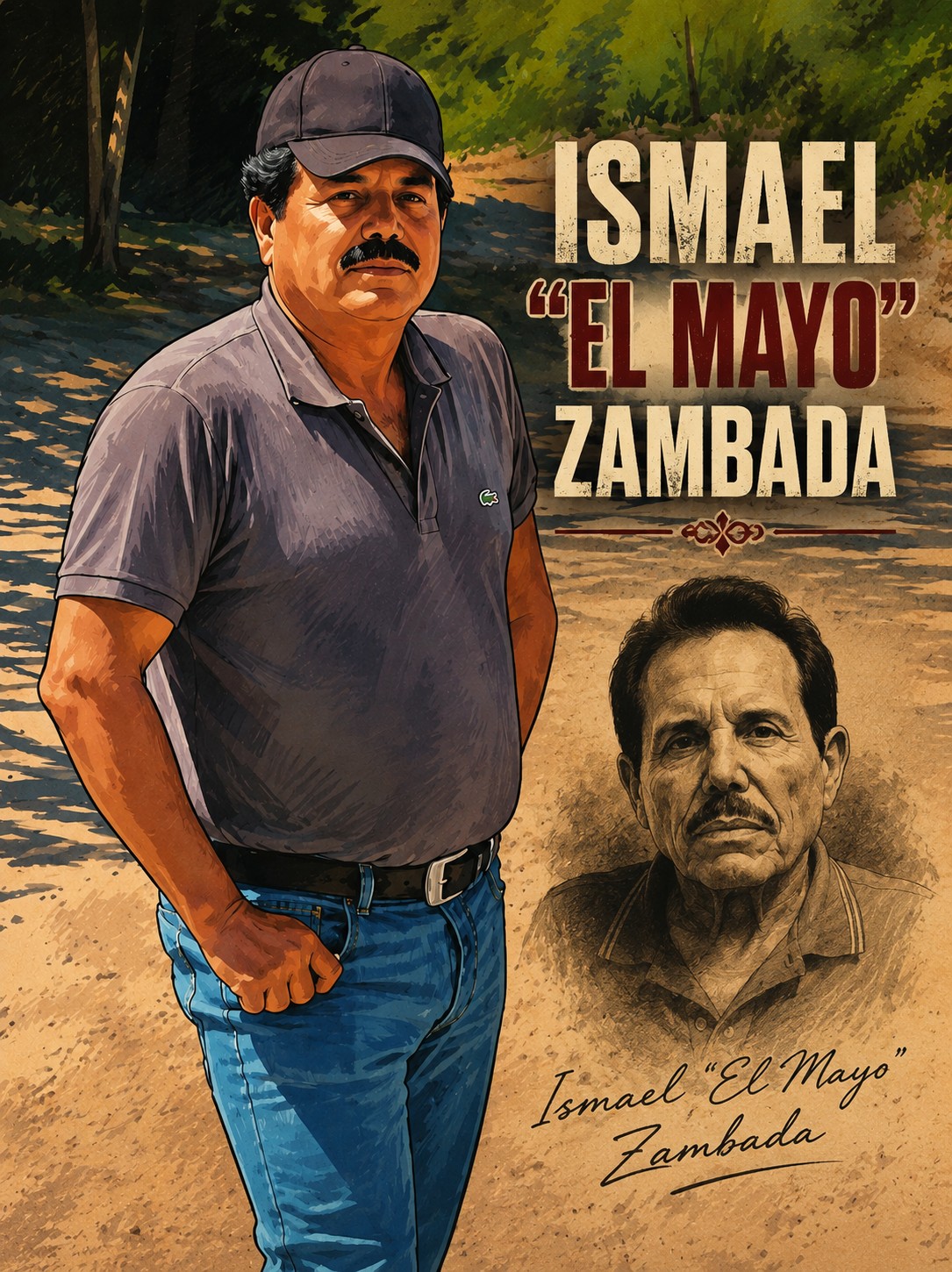
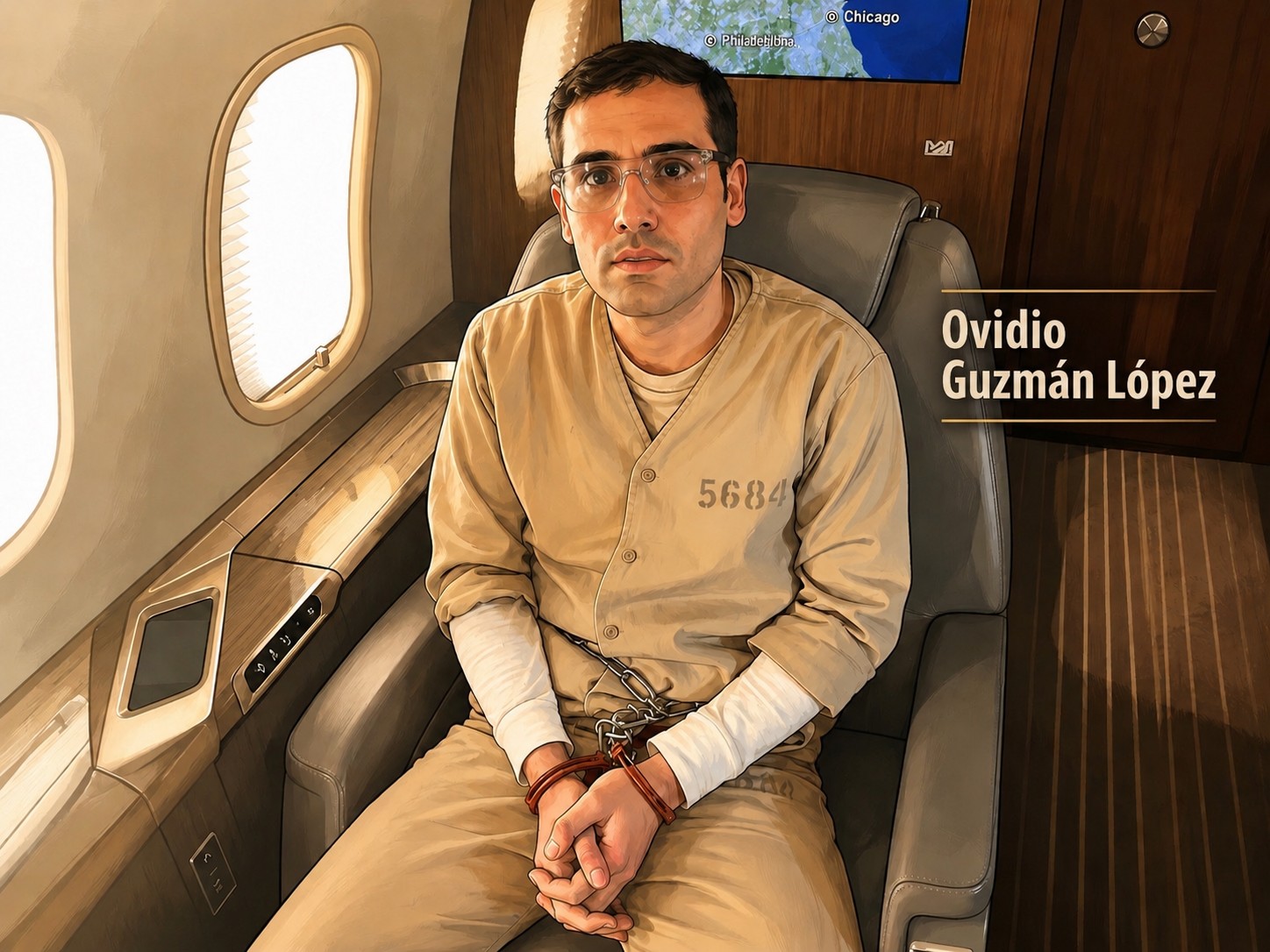
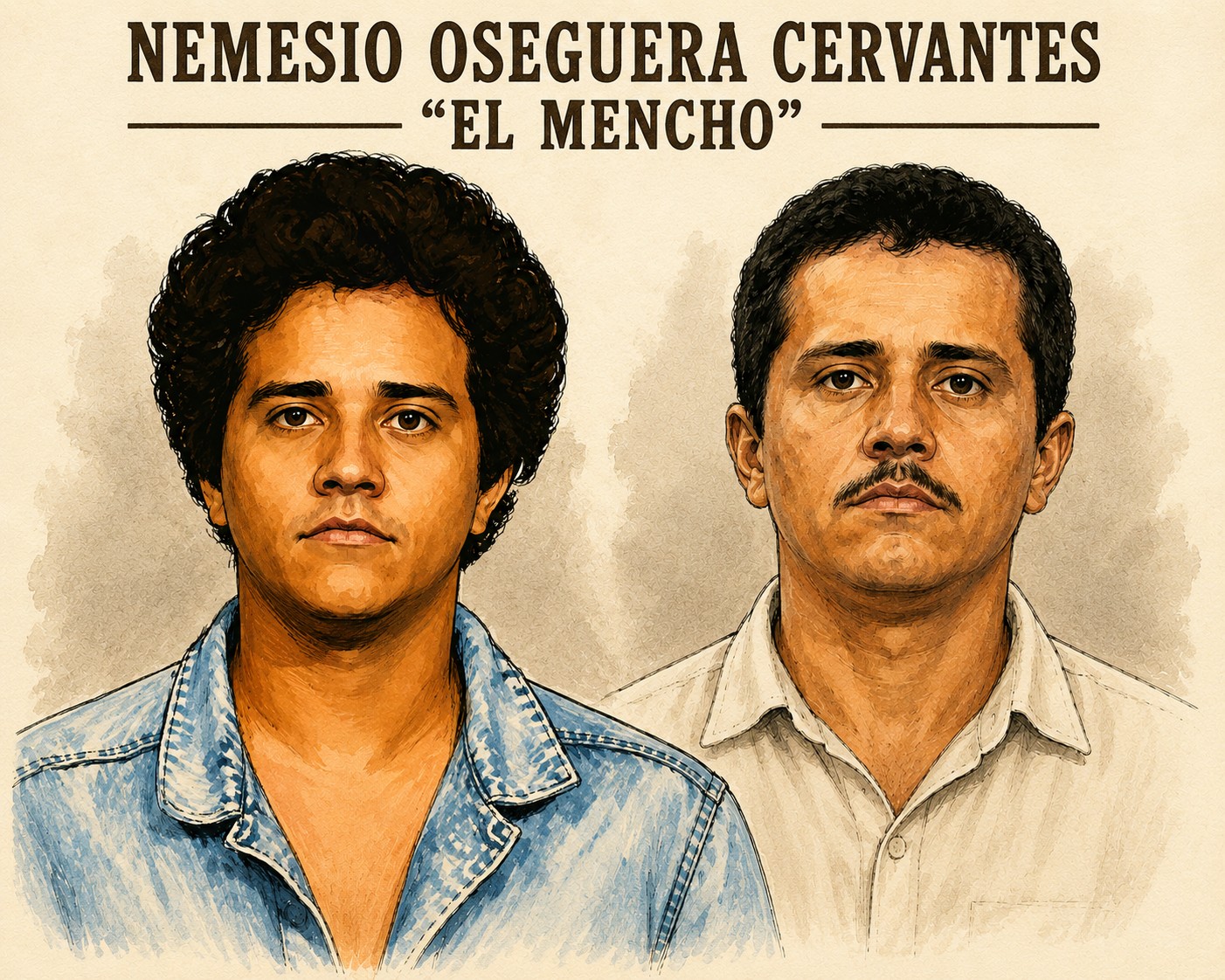
The named figures in this package are useful only if they point beyond themselves. Pablo Escobar represents the older public myth of the kingpin. Joaquin El Chapo Guzman Loera represents capture spectacle and the endurance of a network after a famous sentence. Ismael El Mayo Zambada Garcia represents an older Sinaloa generation now visible in a United States plea. Ovidio Guzman Lopez represents the factional and synthetic-drug turn.[109][12][11][10]
Rafael Caro Quintero connects older cases to present pressure. His transfer to the United States in 2025 was a legal and diplomatic event with a long history behind it. The point is not nostalgia for an earlier cartel era. It is that old crimes, old networks, and old legal files can return to the center when governments change tactics.[90][14][21]
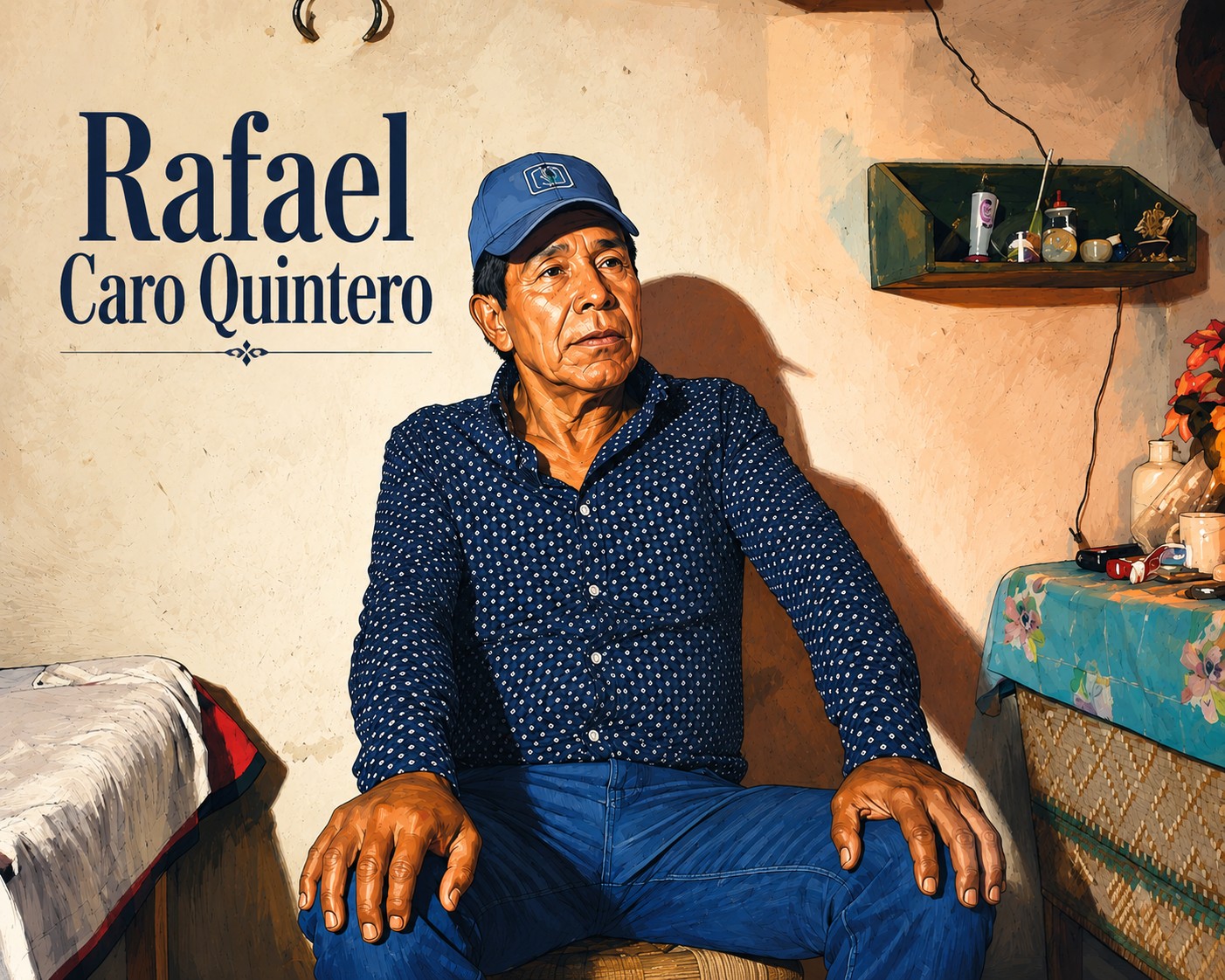
Nemesio Oseguera Cervantes, called El Mencho in public reporting, is different because 2026 reporting said he had been killed. That kind of event can produce confusion, rumor, succession maneuvering, and exaggeration. The cautious formulation is necessary: reporting indicated a leadership shock; it did not prove automatic organizational collapse. Networks can absorb the loss of a leader if money, alliances, and command structures remain.[91][92][6][108]
Genaro Garcia Luna belongs in the visual record for another reason. He was not a cartel boss. He was a former security chief convicted in the United States for taking cartel bribes. His case makes the state visible inside the cartel story. The public needs that reminder because a purely outlaw-centered narrative lets corrupt institutions off too easily.[9][61][75]
Christian Fernando Gutierrez Ochoa belongs in the laundering section because his case points to business fronts, family ties, legal exposure, and the ordinary-looking structures criminal groups use. The image is an editorial illustration supplied for the package; the facts come from reporting and records. That distinction protects the story from confusing art with evidence.[93][51][16]
The biography trap is simple. A reader learns the name, nickname, outfit, arrest photo, aircraft, and sentence, then feels informed. The system remains under-described. Better reporting asks what the person controlled, who replaced him, who laundered the money, who recruited the labor, which officials were useful, which communities paid, and what market remained afterward.[45][68][24]
Court records are still essential. Pleas and indictments can identify conduct, dates, routes, shipments, bribes, killings, and financial methods that would otherwise remain hidden. They also have limits. Defendants may plead for strategic reasons. Cooperating witnesses may have incentives. Prosecutors tell a case through charges. Defense lawyers challenge credibility. The record is powerful, not magical.[11][10][13][9]
The best use of named people is structural. Ovidio Guzman Lopez helps explain Los Chapitos and fentanyl charges. Ismael El Mayo Zambada Garcia helps explain the long Sinaloa arc. Genaro Garcia Luna helps explain state capture. Nemesio Oseguera Cervantes helps explain Jalisco New Generation Cartel succession risk. Rafael Caro Quintero helps explain old cases returning through current diplomacy.[10][11][9][90]
The story therefore uses portraits as signposts, not trophies. A face can help a reader remember a case. It should not make the case smaller. The question after each portrait is the same: what network did this person reveal, and what part of that network survived the image?[71][72][95]
What prosecutions can prove
Prosecutions are strongest on specific conduct. A guilty plea can establish that a defendant admitted crimes. An indictment can allege a pattern and name co-defendants. A sentencing memorandum can describe evidence, witnesses, and harm. A court record can put dates and transactions into public view. Those strengths are why court records are central to this feature.[11][10][12][9]
Prosecutions are weaker as maps of entire criminal systems. A case is shaped by charges, jurisdiction, available evidence, cooperating witnesses, plea strategy, admissibility rules, and prosecutorial priorities. The public should not expect one case to explain every route, ally, official, or revenue stream. Courtrooms reveal slices. The analysis has to assemble the slices without pretending they are the whole loaf.[13][11][24]
Cooperating witnesses require caution. They may know valuable facts because they participated in crimes. They may also have incentives to minimize themselves, implicate rivals, or satisfy prosecutors. Defense lawyers often attack that incentive structure for good reason. The answer is not to ignore insiders. The answer is to read them beside documents, seizures, messages, financial records, and independent reporting.[9][11][10]
Extraditions and transfers shift where truth can be tested. When a defendant reaches a United States courtroom, prosecutors may gain leverage, victims may gain a forum, and agencies may gain intelligence. But transfers can also create diplomatic tension and do not automatically improve local security in the place the defendant left. Legal accountability and territorial safety are related, not identical.[90][89][21]
The Ovidio Guzman Lopez plea is important because it connects a named defendant to United States drug-trafficking charges and Los Chapitos context. The Ismael El Mayo Zambada Garcia plea is important because it connects an older Sinaloa figure to admitted crimes. The Garcia Luna sentence is important because it connects public authority to cartel bribery. Each case illuminates a different part of the system.[10][11][9]
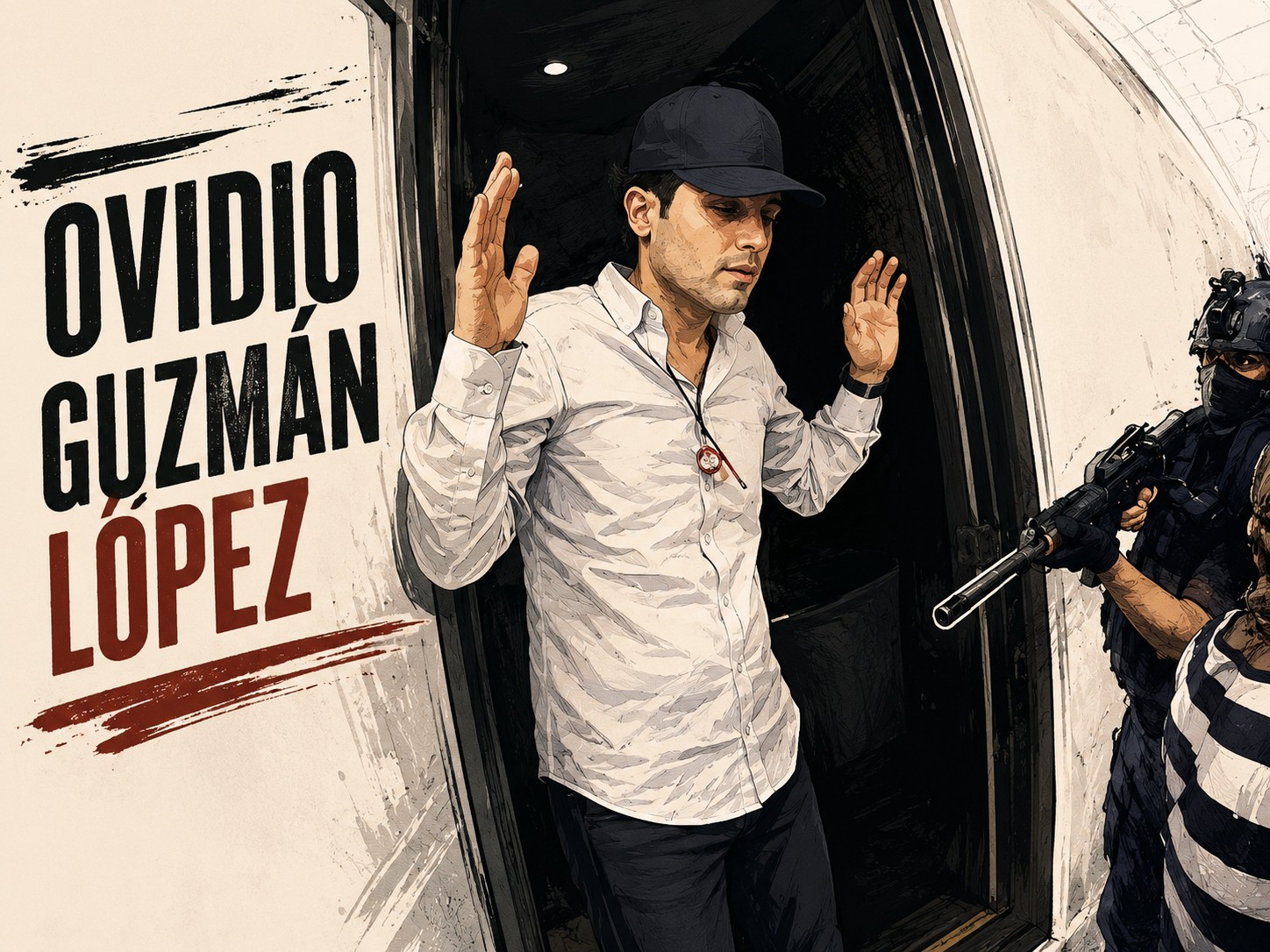
The legal-status language has to stay disciplined. Alleged conduct is alleged unless admitted or proven. Reported deaths are reported deaths unless official confirmation is clear. Sanctions are government actions, not criminal convictions. Editorial portraits are art, not evidence. Careful wording is not weakness. It is how the story keeps its footing.[91][92][17][93]
What communities know first
Communities often know a criminal system before agencies can prove it. They know which road changed, which shop is paying, which family left, which official suddenly stopped answering, which journalist stopped publishing, and which young people began disappearing from school. This knowledge is local, partial, and dangerous to speak. It is also the first alarm.[84][82][65]
Local reporting is essential because it catches texture that national summaries miss. Spanish-language outlets following Teuchitlan documented outrage, official explanations, family responses, and public confusion as the case developed. Some details may change as investigations continue, but the local record shows how a case lands in the society living with it.[96][98][99][100]
Civil-society groups help bridge fear and data. ARTICLE 19 records attacks on press freedom. Data Civica tracks political violence. Observatorio Nacional Ciudadano analyzes crime trends. Human-rights groups document disappearance, militarization, and impunity. These sources are not neutral in the sense of being uninterested; they are valuable because their interest is often where official attention failed.[65][58][59][60]
Victims may disagree with each other, and that is normal. A business owner may want police action immediately. A family of the missing may distrust the same police. A journalist may need protection from both criminals and officials. A young recruit family may fear punishment and rescue at the same time. Serious policy has to hold those conflicts without flattening them into a slogan.[64][85][82][62]
Community knowledge also counters cartel propaganda. Criminal groups project inevitability, wealth, masculinity, protection, and belonging. Residents know the other side: disappearances, debt, fear, addiction, closed businesses, coerced silence, and teenage funerals. Reporting should not let the performance outrun the cost. The people living under the performance know the bill.[106][82][84]
The most reliable coverage listens locally and verifies externally. It takes families seriously, checks court files, reads official data, watches sanctions notices, follows money, consults academic work, and avoids repeating threats for drama. That approach is slower than spectacle. It is also less likely to serve as free advertising for the people causing the harm.[79][9][51][68]
What to watch next
Watch recruitment indicators alongside arrest totals. If youth recruitment remains easy, the system can replace losses. Better questions include school dropout risk, child involvement in criminal groups, digital grooming patterns, local labor options, coerced recruitment allegations, and whether communities trust reporting channels enough to use them.[68][82][106]
Watch extortion data beside victimization surveys. Filed complaints alone will understate harm where people fear retaliation. Surveys can catch more of the hidden crime, but they also depend on willingness to disclose. The gap between official complaints and lived experience may be one of the clearest measures of cartel authority.[56][57][84]
Watch ports and precursor alerts. Cocaine seizures in Europe, precursor shifts, synthetic-stimulant trends, and port-corruption cases will show how networks adapt to enforcement. A changing route does not always mean a shrinking market. It may mean the market found a cheaper or safer way around pressure.[39][48][49][41]
Watch financial cases that look dull at first. A shell company designation, real-estate seizure, customs-broker indictment, fuel-theft sanction, or beneficial-ownership rule can reveal more about cartel endurance than another photo of seized drugs. Follow the people who make criminal money spendable.[15][16][52][19]
Watch journalist-safety and search-family protection. If reporters and families cannot speak, the public record gets poorer and criminal authority gets cleaner. Attacks on journalists, judicial harassment, threats to search collectives, and failures of protection are not side issues. They are attacks on the evidence system itself.[85][65][66][64]
Watch public-health outcomes without treating them as separate from security. Overdose deaths, naloxone distribution, treatment access, counterfeit-pill warnings, and drug-use trends show how the destination market is changing. A cartel strategy that ignores users will miss the demand that makes supply profitable. A health strategy that ignores organized crime will miss why the supply is so dangerous.[30][36][8][43]
The framing mistakes to avoid
The first mistake is treating cartel violence as exotic violence. The file is frightening, but the mechanisms are familiar: labor recruitment, market demand, financial concealment, political protection, communications strategy, and institutional failure. The horror lies partly in how ordinary the infrastructure can look. A shipping manifest, a municipal office, a cash business, and a school dropout can matter as much as a gunman.[1][51][68][48]
The second mistake is treating consumer countries as innocent audiences. United States overdose deaths, European cocaine demand, precursor commerce, and financial systems are not outside the story. They are parts of the market that make violence profitable elsewhere. A humane drug policy can care about users while still naming the demand that funds coercion.[30][39][49][18]
The third mistake is using cartel communications as spectacle. A threat video, banner, song, or social-media post can be newsworthy because it shows intimidation, recruitment style, or factional messaging. It can also provide free distribution for the group. The safer editorial choice is to describe the function through reporting and research, avoid handles and slogans, and keep attention on victims, records, and institutions.[106][82][65][67]
The fourth mistake is assuming local silence means local consent. People often stay silent because they are making rational calculations under threat. A shopkeeper who pays, a family that does not report, or a journalist who avoids a name may be choosing survival. Coverage should not confuse coercion with approval, or fear with apathy.[84][85][64][62]
The fifth mistake is pretending official data and victim testimony compete with each other. They answer different questions. A registry gives a recorded count. A family explains what the registry failed to resolve. A survey estimates hidden victimization. A court case proves specific conduct. A sanctions notice shows a government theory of finance. The story gets stronger when those forms are read together.[53][57][11][16]
The sixth mistake is reducing policy to toughness. Toughness can mean arresting violent leaders. It can also mean protecting witnesses for years, auditing municipal contracts, funding search teams, expanding treatment, enforcing beneficial-ownership rules, and disciplining corrupt police. The second list is less dramatic. It is also where durable power is often contested.[25][52][36][75]
Pressure points that can change incentives
Recruitment prevention changes incentives because it raises the cost of replacing personnel. If a criminal group has to spend more time, money, violence, and risk to find labor, every enforcement action matters more. That is why schools, jobs, youth protection, digital-safety work, and credible local police are not charity appended to security. They are security before the raid.[68][82][106][60]
Extortion enforcement changes incentives when payment is harder to collect than fear is to maintain. That requires more than a hotline. It requires protected reporting, rapid investigation, money tracing, emergency support for businesses, and credible retaliation prevention. The goal is to make the collector unsure that a threat will produce quiet money.[84][57][56][59]
Financial transparency changes incentives by making corruption and laundering more expensive. Beneficial-ownership rules, sanctions coordination, suspicious-activity reporting, trade-based laundering investigations, and professional-enabler accountability can force criminal money into riskier channels. The cartel still wants revenue; the policy question is how much risk it must pay to use that revenue.[52][19][15][16]
Port integrity changes incentives by narrowing the space where legal volume hides illegal cargo. Better worker protection, corruption cases, container targeting, customs cooperation, and shipping documentation can make a route less dependable. The point is not perfect inspection. The point is making corrupt access uncertain enough that networks have to expose themselves while adapting.[48][44][28][49]
Public-health capacity changes incentives because death is part of the market outcome. Naloxone, treatment, overdose surveillance, honest counterfeit-pill warnings, and medical support reduce harm and can reduce demand. They also give governments a way to measure success outside seizure weight. A life saved is not a soft metric. It is the metric refusing to die politely for a press conference.[32][36][87][35]
Protection for journalists and search families changes incentives by keeping evidence alive. When reporters can publish and families can search, criminal groups and corrupt officials face a thicker public record. When those witnesses are silenced, the record thins and impunity is easier to manage. Safety for truth-tellers is therefore not a side benefit. It is investigative infrastructure.[65][66][64][85]
How readers can audit the next cartel headline
For a leader arrest, ask who controlled finance, recruitment, routes, and local protection after the arrest. A captured boss may be central, symbolic, or already weakened. The useful follow-up is whether the network loses capacity or simply changes the names on the next indictment.[12][10][11][24]
For a seizure, ask what the seizure measures. It may show enforcement success, large supply, better detection, a bad shipment decision, or all of those at once. Tons seized at a port can reveal market scale without proving the total market size. A number is a clue; it is not the whole case file.[39][28][47][2]
For a disappearance story, ask who searched, who delayed, who kept records, who challenged the records, and whether families trust the process. The missing-person count is a starting point. The harder questions concern identification, prosecution, family participation, and whether the state treats uncertainty as a problem to solve or a way to reduce pressure.[53][81][80][64]
For an extortion story, ask what sector is being taxed and why that sector is exposed. Crops, transport, construction, retail, and fuel all create different vulnerabilities. The payment demand is the visible act. The control point is the deeper finding.[83][84][15][102]
For a terrorism-designation story, ask what new authority is created and what problem it cannot solve. Designations can affect finance, prosecution, immigration, and diplomacy. They do not automatically improve local police, search capacity, public health, or youth recruitment prevention. The label is a tool, not a strategy in ceremonial clothing.[20][23][22][25]
For a cartel-communication story, ask whether the coverage explains function without amplifying fear. The best version tells readers what the communication was trying to do, who verified it, how officials and communities responded, and what consequences followed. The worst version turns intimidation into content and calls the traffic a scoop.[106][82][65][67]
What the article refuses to flatten
The article refuses to flatten Mexico into a crime scene. Mexico is the central geography of the dossier because the violence, disappearances, recruitment, extortion, and state-capture evidence are concentrated there. It is also a country of families, journalists, prosecutors, farmers, students, officials, researchers, and searchers fighting over truth in dangerous conditions. Treating Mexico only as cartel terrain repeats the erasure that criminal groups depend on.[53][65][64][60]
The article refuses to flatten the United States into an enforcement hero or a consumer villain. United States agencies bring prosecutions, sanctions, intelligence, public-health data, and border operations. United States demand, gun flows, overdose deaths, and financial systems also belong in the record. Both facts can be true without cancelling each other. The market is too connected for clean moral geography.[13][16][30][26]
The article refuses to flatten Europe into a downstream footnote. European cocaine demand, port corruption, record seizures, and synthetic-drug warnings make Europe a major part of the same market. Belgium, the Netherlands, and Spain appear in the file because ports and consumers create value that violent networks can chase. The route may begin elsewhere, but the price is paid where the market is strong.[39][48][41][44]
The article refuses to flatten users into either criminals or passive victims. Some drug use is recreational, some is compulsive, some is deceived through counterfeit pills, and some is tied to untreated pain, trauma, or addiction. Public health matters because death is not a policy instrument. Demand matters because markets respond to buyers. Humane policy has to carry both truths at once.[33][34][37][87]
The article refuses to flatten cartel recruits into a single moral type. A recruit can be ambitious, coerced, poor, groomed, threatened, young, violent, terrified, responsible, or disposable, sometimes more than one at once. That complexity does not excuse crimes. It explains why recruitment prevention is a security strategy and why punishment alone keeps meeting new faces in the same vulnerable places.[68][82][69][106]
The article refuses to flatten the state into villain or savior. Police, soldiers, prosecutors, search commissions, courts, customs agencies, public-health offices, and local governments can protect people, fail them, or be compromised. The question in each case is specific: which institution acted, which stalled, which was corrupted, which was underfunded, and which people inside it took risks anyway.[9][75][53][21]
The article refuses to flatten images into proof. The supplied art makes scale visible; the rail photographs create atmosphere and side-note rhythm; the maps help readers navigate geography. None of those images substitutes for a citation. The evidence sits in linked records, reporting, data, and research. The visual design should make the reader more curious about the source trail, not less.[1][38][11][79]
The article refuses to flatten policy into a final answer. A better strategy is a disciplined stack: recruitment prevention, extortion enforcement, anti-corruption work, financial transparency, port integrity, public-health capacity, journalist protection, family-centered search systems, and international cooperation. None of those tools is glamorous enough for a movie ending. Together they are the closest thing the evidence offers to a serious beginning.[68][84][52][48][36]
The final practical point is attention span. Cartel power benefits when public attention moves in bursts: a ranch, a plea, a killing, a seizure, a sanctions notice, a shocking statistic, and then silence. The local payment, the missing-person search, the court delay, the port vulnerability, and the treatment gap continue after the cycle moves on. A serious newsroom should keep returning to the slow facts because slow facts are where criminal power often hides.[79][81][84][39]
That is why this package is built as a dossier rather than a single dramatic scene. The ranch opens the story, but the evidence moves through labor, money, institutions, health, ports, politics, and families. The point is not to make the subject feel larger than action. The point is to make action less naive. If the next policy response cannot name recruitment, extortion, laundering, corruption, demand, and search capacity in the same breath, it is probably fighting the last headline.[1][68][51][36]
Source trail: 109 public receipts
The links below are intentionally visible so readers can audit the package without digging through the final bibliography first.
Source notes
This bibliography includes 109 unique links from official records, courts, public-health agencies, international drug monitors, academic work, human-rights groups, local Mexican reporting, wire services, and policy analysis. The list is dense by design: the article is meant to be auditable.
- United Nations Office on Drugs and Crime, World Drug Report 2025 United Nations Office on Drugs and Crime - High-level framing of drug markets as health, governance, and security problems.
- United Nations Office on Drugs and Crime, Global Report on Cocaine 2023 United Nations Office on Drugs and Crime - Cocaine supply-chain and market context for the global comparison.
- United Nations Office on Drugs and Crime, Global Study on Homicide United Nations Office on Drugs and Crime - Background on homicide, organized crime, and institutional conditions.
- Drug Enforcement Administration, 2025 National Drug Threat Assessment Drug Enforcement Administration - United States threat assessment for Sinaloa, the Jalisco New Generation Cartel, fentanyl, and methamphetamine.
- Drug Enforcement Administration, Sinaloa Cartel profile Drug Enforcement Administration - United States agency profile of the Sinaloa Cartel.
- Drug Enforcement Administration, Jalisco New Generation Cartel profile Drug Enforcement Administration - United States agency profile of the Jalisco New Generation Cartel.
- Drug Enforcement Administration, Fentanyl Awareness Drug Enforcement Administration - Public-health and enforcement context for illicit fentanyl.
- Drug Enforcement Administration, One Pill Can Kill Drug Enforcement Administration - Counterfeit-pill warning used for the destination-market section.
- Department of Justice, Genaro Garcia Luna sentencing Department of Justice - Court record for state capture and cartel bribery.
- Internal Revenue Service Criminal Investigation, Ovidio Guzman Lopez guilty plea Internal Revenue Service Criminal Investigation - United States guilty-plea record for Los Chapitos and fentanyl trafficking.
- Department of Justice, Ismael El Mayo Zambada Garcia guilty plea Department of Justice - Guilty-plea record for the Sinaloa co-founder.
- Department of Justice, Joaquin El Chapo Guzman sentencing Department of Justice - Court record for the older kingpin era and life sentence.
- Department of Justice, Sinaloa Cartel and Los Chapitos fentanyl charges Department of Justice - Charging context for fentanyl production and distribution allegations.
- Department of Justice, Rafael Caro Quintero charges and extradition context Department of Justice - Historical court context for Rafael Caro Quintero.
- Treasury Department, Jalisco New Generation Cartel fuel theft and crude-oil smuggling sanctions Treasury Department - Sanctions example for fuel theft, crude-oil smuggling, and cartel finance.
- Treasury Department, Sinaloa Cartel money launderers and operators sanctions Treasury Department - Sanctions example for laundering networks and operators.
- Office of Foreign Assets Control, Counter Narcotics Sanctions Office of Foreign Assets Control - Program context for narcotics-related sanctions.
- Financial Crimes Enforcement Network, illicit fentanyl financing alert Financial Crimes Enforcement Network - Financial-sector indicators for fentanyl-linked illicit finance.
- Financial Crimes Enforcement Network, advisories and alerts Financial Crimes Enforcement Network - Financial-crime context for laundering and professional-enabler risk.
- State Department, Foreign Terrorist Organizations State Department - Foreign-terrorist-organization list and designation context.
- State Department, 2025 International Narcotics Control Strategy Report State Department - International narcotics-control policy context.
- White House, Executive Order 14157 White House - Policy context for United States cartel designations.
- Federal Register, cartel foreign-terrorist-organization designations Federal Register - Official publication record for designation actions.
- Congressional Research Service, Mexico: Organized Crime and Drug Trafficking Organizations Congressional Research Service - Congressional research context for Mexican drug-trafficking organizations.
- Congressional Research Service, criminal organizations and terrorist designations Congressional Research Service - Policy analysis of designating cartels and criminal organizations.
- Government Accountability Office, firearms trafficking to Mexico Government Accountability Office - Context for cross-border weapons flows and enforcement gaps.
- Government Accountability Office, anti-money-laundering oversight Government Accountability Office - United States oversight context for financial enforcement.
- Customs and Border Protection, drug seizure statistics Customs and Border Protection - United States border seizure data.
- Customs and Border Protection, southwest land border encounters Customs and Border Protection - Border context separate from drug-market claims.
- Centers for Disease Control and Prevention, provisional drug overdose death counts Centers for Disease Control and Prevention - Public-health data for overdose mortality.
- Centers for Disease Control and Prevention, State Unintentional Drug Overdose Reporting System Centers for Disease Control and Prevention - Overdose surveillance context.
- Centers for Disease Control and Prevention, naloxone information Centers for Disease Control and Prevention - Evidence context for overdose reversal.
- National Institute on Drug Abuse, fentanyl drug facts National Institute on Drug Abuse - Plain-language health context for fentanyl.
- National Institute on Drug Abuse, methamphetamine drug facts National Institute on Drug Abuse - Plain-language health context for methamphetamine.
- National Institute on Drug Abuse, overdose death rates National Institute on Drug Abuse - Longer-term overdose trend context.
- Substance Abuse and Mental Health Services Administration, naloxone Substance Abuse and Mental Health Services Administration - Treatment and overdose-reversal context.
- Substance Abuse and Mental Health Services Administration, FindTreatment.gov Substance Abuse and Mental Health Services Administration - Treatment access context for the rail card and public-health section.
- European Union Drugs Agency, European Drug Report 2025 European Union Drugs Agency - European drug-market overview.
- European Union Drugs Agency, cocaine in the European Drug Report 2025 European Union Drugs Agency - European cocaine seizure and availability context.
- European Union Drugs Agency, opioids in the European Drug Report 2025 European Union Drugs Agency - European opioid and nitazene context.
- European Union Drugs Agency, synthetic stimulants in the European Drug Report 2025 European Union Drugs Agency - European synthetic-stimulant context.
- European Union Drugs Agency, methamphetamine in Europe European Union Drugs Agency - European methamphetamine context.
- European Union Drugs Agency, wastewater analysis and drugs European Union Drugs Agency - Demand and use-indicator context.
- Europol, European Union Serious and Organised Crime Threat Assessment 2025 Europol - European organized-crime threat assessment.
- Europol, decoding the most threatening criminal networks Europol - Network structure and organized-crime analysis.
- Europol, drug trafficking crime area Europol - European drug-trafficking context.
- Europol, cocaine trafficking and criminal networks Europol - European cocaine-crime context.
- Europol, ports and organized crime analysis Europol - Port-abuse and logistics context.
- International Narcotics Control Board, precursors technical reports International Narcotics Control Board - Precursor-chemical control context.
- International Narcotics Control Board, annual reports International Narcotics Control Board - International narcotics-control context.
- Financial Action Task Force, methods and trends Financial Action Task Force - Laundering methods and typology context.
- Financial Action Task Force, beneficial ownership Financial Action Task Force - Beneficial-ownership context for shell companies.
- Mexico National Search Commission, missing-persons public dashboard National Search Commission of Mexico - Official missing-person registry context.
- Mexico National Search Commission homepage National Search Commission of Mexico - Institutional search-commission context.
- National Institute of Statistics and Geography, mortality statistics National Institute of Statistics and Geography - Official mortality and homicide data context.
- National Public Security System Executive Secretariat, crime incidence data National Public Security System Executive Secretariat - Official crime-incidence context.
- National Institute of Statistics and Geography, National Victimization Survey 2025 National Institute of Statistics and Geography - Victimization and underreporting context.
- Data Civica, Votar Entre Balas Data Civica - Political violence and organized-crime electoral pressure context.
- Observatorio Nacional Ciudadano, publications Observatorio Nacional Ciudadano - Civil-society crime analysis context.
- Human Rights Watch, World Report 2026: Mexico Human Rights Watch - Human-rights context for disappearances and militarization.
- Human Rights Watch, World Report 2025: Mexico Human Rights Watch - Human-rights background and continuity.
- Amnesty International, Mexico country report Amnesty International - Human-rights context for violence and impunity.
- Office of the United Nations High Commissioner for Human Rights, Mexico Office of the United Nations High Commissioner for Human Rights - United Nations human-rights context.
- International Committee of the Red Cross, Mexico and Central America International Committee of the Red Cross - Humanitarian context for missing people and families.
- ARTICLE 19 Mexico and Central America ARTICLE 19 - Press-freedom and journalist-safety context.
- Committee to Protect Journalists, Mexico Committee to Protect Journalists - Journalist-safety context.
- Reporters Without Borders, Mexico Reporters Without Borders - Press-freedom risk context.
- Science, Reducing cartel recruitment is the only way to lower violence in Mexico Science - Peer-reviewed recruitment model and violence analysis.
- Prieto-Curiel, Campedelli, and Hope, cartel recruitment model preprint arXiv - Open version of the recruitment and cartel-membership model.
- Political assassinations and organized crime in Mexico arXiv - Academic analysis of organized crime and political violence.
- InSight Crime, Sinaloa Cartel profile InSight Crime - Organized-crime background on Sinaloa.
- InSight Crime, Jalisco Cartel New Generation profile InSight Crime - Organized-crime background on the Jalisco New Generation Cartel.
- InSight Crime, Mexico organized crime news InSight Crime - Current organized-crime reporting context.
- Council on Foreign Relations, Mexico long war on drugs Council on Foreign Relations - Policy background on Mexico, violence, and cartels.
- Washington Office on Latin America, Mexico security policy and militarization Washington Office on Latin America - Civil-society policy analysis of militarized security.
- Global Organized Crime Index, Mexico Global Organized Crime Index - Comparative organized-crime profile.
- Brookings, fentanyl and synthetic opioids policy analysis Brookings Institution - Policy context for synthetic opioids and precursor supply chains.
- Wilson Center, fentanyl and Mexico policy analysis Wilson Center - Policy context for United States-Mexico cooperation.
- Associated Press, Teuchitlan recruitment ranch convictions Associated Press - Reported convictions tied to a recruitment ranch in Jalisco.
- Associated Press, Mexico missing-person registry dispute Associated Press - Reporting on the missing-person registry dispute and family concerns.
- Reuters, Mexico says it identifies 40,000 of country missing as possibly alive Reuters - Reporting on registry claims and family criticism.
- Reuters, how Mexico cartels recruit children Reuters - Field reporting on child recruitment, grooming, and social media.
- Associated Press, lime growers leader killed after denouncing cartel extortion Associated Press - Agricultural-extortion example from Michoacan.
- The Guardian, how can Mexico confront the rise in deadly extortion The Guardian - Reporting on extortion as a daily criminal tax.
- Reuters, murders of Mexican journalists nearly double in 2025 Reuters - Journalist-safety and official-aggressor context.
- Reuters, leader of Ecuador Los Lobos gang arrested in Spain Reuters - Ecuador-Spain partnership and globalization example.
- Reuters, United States overdose deaths dropped in 2024 Reuters - Final 2024 overdose-death reporting.
- Reuters, United States sanctions Los Chapitos faction Reuters - Sanctions pressure on Los Chapitos.
- Reuters, Mexico transfers 26 more cartel members to United States Reuters - August 2025 transfer wave.
- Associated Press, Rafael Caro Quintero and others transferred to United States Associated Press - February 2025 transfer wave.
- Associated Press, what to know about the killing of El Mencho Associated Press - Reported February 2026 killing of Nemesio Oseguera Cervantes.
- Associated Press, Mexican authorities hand over El Mencho body Associated Press - Follow-up reporting on the reported killing.
- Associated Press, Christian Fernando Gutierrez Ochoa case Associated Press - Case context for Jalisco New Generation Cartel laundering and family networks.
- Associated Press, United States arrests El Mayo Zambada and Joaquin Guzman Lopez Associated Press - Arrest context for Sinaloa leadership.
- BBC, Mexico cartels and drug war explainer BBC - General explainer background on Mexico cartels.
- El Pais, Teuchitlan and Rancho Izaguirre reporting El Pais - Spanish-language context on Rancho Izaguirre and public outrage.
- El Pais, Mexico disappeared and search families El Pais - Spanish-language reporting on the registry dispute.
- Animal Politico, Rancho Izaguirre and disappearances Animal Politico - Mexican reporting context on the Teuchitlan case.
- Proceso, Rancho Izaguirre coverage Proceso - Mexican reporting context on recruitment and the ranch.
- Milenio, Rancho Izaguirre coverage Milenio - Mexican reporting context on the case timeline.
- Infobae, Rancho Izaguirre and official investigation Infobae - Regional reporting context for the opening scene.
- El Financiero, Mexico extortion and business impact El Financiero - Mexican reporting context on extortion and businesses.
- La Jornada, desaparecidos and search families La Jornada - Mexican reporting context on families and registry trust.
- UnoTV, Rancho Izaguirre explainer UnoTV - Local explainer context for Teuchitlan.
- Cadena SER, Rancho Izaguirre coverage Cadena SER - International Spanish-language coverage of the case.
- El Colegio de Mexico, Los algoritmos del miedo El Colegio de Mexico - Academic context for fear, digital media, and organized-crime communication.
- Inter-American Commission on Human Rights, Mexico Inter-American Commission on Human Rights - Regional human-rights context.
- Rewards for Justice, Nemesio Oseguera Cervantes Rewards for Justice - United States wanted-and-reward context for the Jalisco New Generation Cartel leader.
- Britannica, Pablo Escobar Britannica - Historical background for the older kingpin image.
Related reading
World • Investigation
Europe's Cocaine Boom Is Hiding in Plain Sight
Spain's 30-tonne Arconian seizure was the loudest signal yet. The deeper story is demand, trafficking logistics, British consumers, port corruption, public health, violence and enforcement trying to keep up.

World • Analysis
America's Military Year Is a Map of Force
From the Maduro raid to the Iran war, Hormuz, cartel boat strikes, classified AI and the defense factory floor, 2026 shows how U.S. power now moves through operations, logistics and production.
Health • Report
Measles Is Not a Childhood Memory Anymore.
The 2026 measles surge is a reminder that public health depends less on dramatic emergency language than on whether routine vaccination systems still hold.