By the time the photograph became a thumbnail, the story had already moved inland.

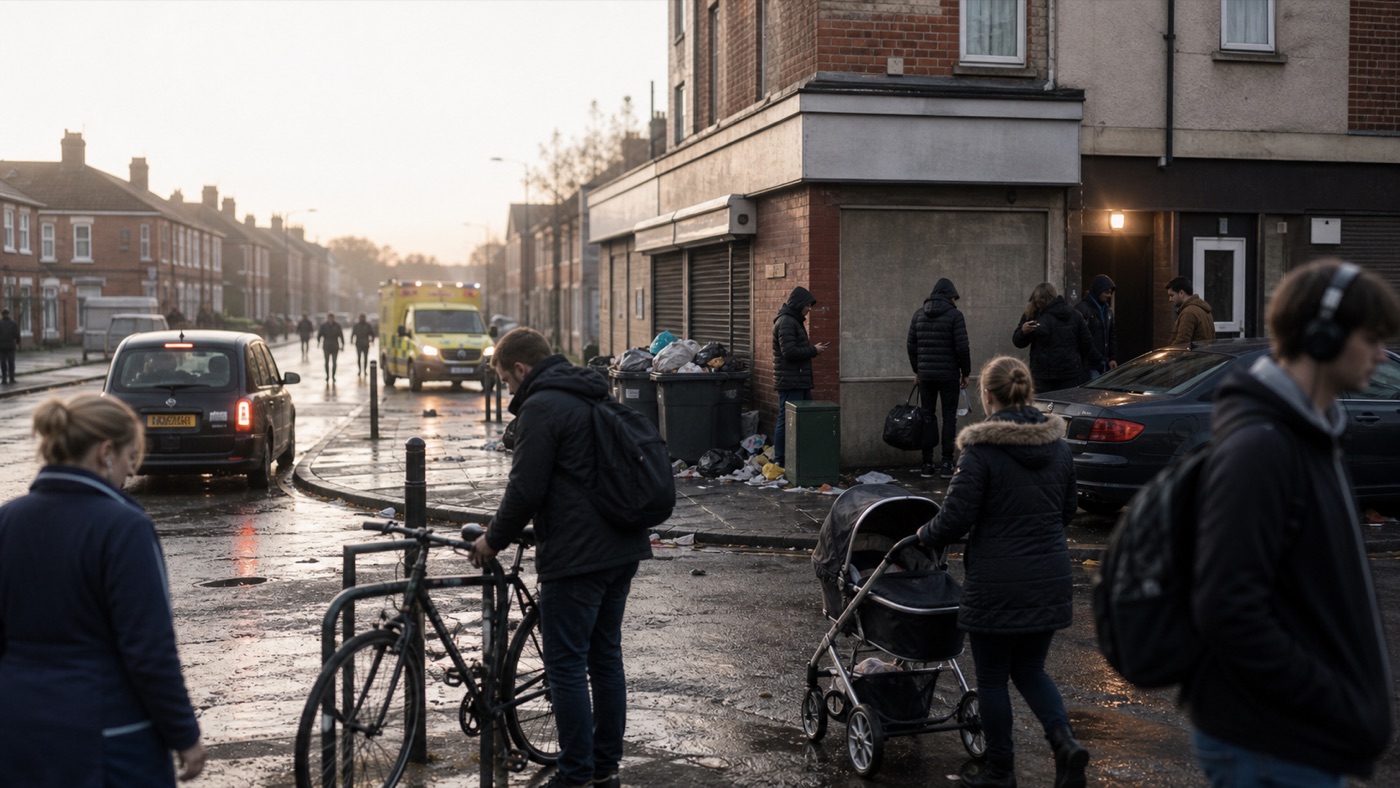
The picture we chose for this article is not a ship. It is a British street at the start of the day: wet pavement, a yellow ambulance in the distance, a pram crossing the foreground, ordinary people moving through ordinary pressure, and a small group of men tucked by a doorway and a car as if the city itself has learned to look past them. That is the sharper image of Europe's cocaine problem. The drug does not stay in the hold of a freighter. It leaves the sea and becomes a rent payment, a hospital bed, a phone message, a warehouse bribe, a debt, a party, a panic, a shooting, a court file, a wastewater reading, a customs alert, and finally a line in a government table.

Spain's May 2026 seizure of the Comoros-flagged Arconian gave Europe the number that made the room go quiet: about 30 tonnes of cocaine, a cargo Spanish court records valued at more than 812 million euros, with 23 crew members detained without bail, according to Reuters and Spanish reporting. The ship was intercepted near the Canary Islands after the Guardia Civil received intelligence about its route and cargo. The haul was described as Europe's largest recorded cocaine bust, surpassing Germany's 2024 Hamburg seizure and more than doubling Spain's previous record, the 13-tonne load found in a shipment of Ecuadorian bananas at Algeciras in 2024. source source source

But the easy headline is the wrong shape. Thirty tonnes sounds like a wall. It is really a leak in a dam. Europe is not being hit by occasional spectacular shipments; it is living inside a market that has become industrial, resilient and consumer-driven. The Arconian matters because it connects the Atlantic route to the high street, the container yard to the emergency department, the cartel accountant to the pub toilet, and the ports of Antwerp, Rotterdam, Hamburg, Algeciras and Le Havre to residential blocks where the harm is less photogenic and more permanent.

This article follows the chain without glamorising it: consumers, traffickers, logistics, impact and enforcement. It uses official data where official data exists, news reporting where the record is moving faster than public statistics, and public social links only as a window into reaction, not as evidence. The thread running through all of it is simple: Europe is not merely intercepting more cocaine. Europe is absorbing more cocaine.

The bust was the symptom

Large seizures invite a comforting misunderstanding. A state makes an arrest, stacks the cargo, publishes the number, and the public sees control. That is partly true. A 30-tonne interdiction is a serious enforcement event. It removes a vast load from circulation, disrupts a network, and gives investigators phones, documents, crew statements, vessel histories and financial trails. It also shows that someone thought Europe could absorb a shipment that large, or at least split it and move it onward, without the market collapsing.

That is why the number should be read less as a trophy than as a diagnostic. The European Drug Agency's 2025 cocaine chapter describes cocaine as the most commonly used illicit stimulant in Europe and says indicators point to wide availability. EUDA reported roughly 4.6 million adults aged 15 to 64 in the European Union using cocaine in the last year, and it has repeatedly warned that high availability is showing up in seizures, treatment entries, wastewater and emergency presentations. source source source

UNODC's global reports explain the upstream pressure. Cocaine manufacture has risen sharply over the past decade as coca cultivation and processing expanded in the Andean region. Once production surges, traffickers do not wait for Europe to remain a luxury niche. They build new wholesale channels, test new landing zones, exploit new legal cargo, and sell into a consumer market that is richer, urban, digitally connected and willing to treat the drug as a weekend product rather than a hard-crime commodity. source source

The irony is that the richer the data gets, the less the story can be reduced to the data. Wastewater samples catch what surveys miss. Emergency rooms catch the nights people would rather forget. Customs seizures catch the shipments that enforcement actually saw. Police case files catch pieces of networks that are designed to be replaceable. None of those systems sees the whole market. Together, they show a continent where the old categories are breaking down: recreational user, organised criminal, port worker, courier, patient, victim, witness, target. In the cocaine economy, those categories touch each other all the time.

The Arconian, then, is not the beginning of the story. It is the kind of event that forces the story to become visible.

The map is not a line

It is tempting to draw the cocaine story as an arrow: South America to Europe. That misses the intelligence of the system. The market is not a line; it is a portfolio. It uses ocean routes, legal cargo, fishing and pleasure craft, port insiders, brokers, encrypted communications, money-service businesses, street networks and local intimidation. When one route gets hot, another becomes attractive. When a port hardens, traffickers test a smaller port. When a crew is arrested, the financiers look for another crew. The product is illegal, but the operating logic is corporate: diversify, outsource, corrupt, compartmentalise, replace.

EUDA and Europol have described how European cocaine trafficking relies on access to logistics, corruption and violence. The European Ports Alliance was launched because governments concluded that police could not treat ports as ordinary border points. Modern seaports are enormous, privately operated, time-sensitive and economically vital. They cannot simply be frozen while every container is opened. That imbalance gives organised-crime groups room to search for weak points: workers under pressure, contractors with access, containers that move too quickly, scanners that cannot see everything, and paperwork that looks legitimate until it does not. source source source source

Broad pressure map

Where the story concentrates

This is an editorial schematic, not an operational map. It shows broad pressure zones discussed in official and public reporting.

Seizure pressure Demand signal Route displacement

That is also why the Canary Islands matter. They are not a final consumer market for 30 tonnes. They sit near Atlantic approaches that can connect South American supply, West African staging, Iberian coasts and smaller craft. The article does not map specific transfer points because that would be irresponsible and because public reporting rarely gives a complete picture anyway. The useful map is broader: production pressure in the Andes; Atlantic movement; Spanish, Belgian, Dutch, German, French and British enforcement; and consumer demand that makes all of it worth attempting.

In this market, a map with a single arrow lies. A map with pressure zones gets closer.

The trafficker is not one person

The word trafficker makes the business sound smaller than it is. There is no single villain carrying Europe on his back. There are financiers who never touch cargo, brokers who connect supply to transport, maritime crews who may or may not understand the full load, port insiders, corrupt facilitators, local wholesalers, street sellers, debt collectors, money launderers and people who are simply pressured into one role at the wrong moment. Some are violent professionals. Some are disposable. Some are victims until they become useful. Some are both.

That structure is what makes the market durable. A seizure can remove product and arrests can matter, but the network is built to shed parts. Europol has repeatedly warned that serious organised crime in Europe is agile, service-based and violent, with corruption as a central enabler. That is not abstract. A port worker with a pass is more useful than a man with a gun. A database login can be more valuable than a speedboat. A frightened contractor can become a bridge between legal cargo and criminal cargo without the public ever seeing the moment it happened. source source source

The violence arrives when the quiet system breaks. Antwerp, Rotterdam, Marseille and other cities have all had to confront the fact that cocaine money does not stay offshore. It buys intimidation. It buys information. It buys weapons. It creates debts that young men are asked to collect with fear. It turns mistakes into punishments and theft into retaliation. In Belgium, officials and journalists have described how pressure on Antwerp has pushed gangs to adapt routes and tactics while violence spills into wider urban life. source source source

This is where the consumer story and the trafficker story meet. A user buys a gram without seeing the worker threatened at a port, the driver recruited on debt, the apartment used as a stash site, the encrypted chat seized by police, the family warned not to talk, or the hospital team dealing with the consequences later that night. The market depends on that distance. It wants consumption to feel private, almost frictionless. Journalism has to collapse the distance.

There is no clean consumer in a dirty supply chain. That does not mean every user is a cartoon villain. It means the choice is not as private as the marketing makes it feel.

Britain is not downstream of the story

The British angle is not that drugs arrive somewhere else and eventually wash up in the UK. Britain is part of the demand engine. The country's consumer market is large, wealthy enough to pay, geographically close to continental supply nodes and socially split between casual use and serious harm. Cocaine can appear in a corporate bathroom, a festival tent, a flat above a shop, a suburban kitchen, a football weekend, a university night out, or a worker's pocket at the end of a brutal week. The culture changes the costume; the drug does not change its supply chain.

Official UK data makes the harm harder to dismiss. The Office for National Statistics reported that cocaine was mentioned on 1,279 death certificates in England and Wales for deaths registered in 2024. The Home Office's wastewater programme has used sewage sampling to estimate consumption in cities, a method that catches population-level use without waiting for people to admit it in surveys. The National Crime Agency's strategic assessments connect Class A drug markets to organised crime and wider harm. source source source

The public conversation often splits cocaine into two separate stereotypes: the glamorous user and the violent dealer. Real life is messier. The same market that supplies expensive weekend use can also feed compulsive use, debt, exploitation and emergency care. Cocaine is frequently used with alcohol, which can intensify risk. It can strain hearts, worsen mental-health crises and become one ingredient in a wider pattern of polysubstance harm. The health system sees the body after the social story has finished pretending nothing happened. source source source

The thumbnail's British street is why this piece does not put the trafficker at the centre as a fantasy figure. The trafficker is visible, but the public owns the frame. A parent with a pram, a nurse walking home, a commuter, a student, a delivery rider: these are the people who live around the market whether they buy into it or not. They live with intimidation, police activity, street violence, emergency demand, local fear, and the slow civic corrosion that follows when illegal money becomes normal enough to be ignored.

Britain is not a footnote. It is one of the rooms where the European cocaine story becomes ordinary.

Why seizures do not settle the case

The seizure number is always dramatic, and it should be. But a seizure total can be read two ways. It may show enforcement success. It may show more supply. Often it shows both. When customs seize record loads, that can mean officers are better equipped, intelligence is sharper, corruption has been exposed, and international cooperation is working. It can also mean the underlying flow is so large that the visible catches keep growing even when the system improves.

That tension runs through Europe's cocaine debate. Antwerp's historic 121-tonne figure in 2023 made the port a symbol of pressure. Subsequent declines at one port do not necessarily mean the market has shrunk; they can mean traffickers adapted, split cargo, shifted routes, or moved risk elsewhere. The European Ports Alliance exists precisely because no single port can win by hardening itself and pushing the problem down the coast. source source source

For consumers, this can sound distant. It is not. Every successful wholesale shipment changes local availability. Availability changes purity, price and frequency of use. Frequency changes health burden and debt. Debt changes violence. Violence changes policing. Policing changes neighbourhood life. A container terminal and a residential street can look unrelated until the chain is drawn in reverse.

That is why the article treats enforcement as necessary and insufficient. Customs, coast guards, prosecutors and police can save lives by removing dangerous supply and dismantling violent groups. But enforcement alone cannot explain why the market keeps finding customers. Nor can public health alone solve a market protected by violence and corruption. Europe needs both languages at once: the language of interdiction and the language of demand.

The violence begins before Europe

A European feature can become provincial if it starts only at the port gate. Cocaine bound for Europe begins in landscapes and political economies far from Antwerp or Liverpool. Coca cultivation, processing, pressure on rural communities, corruption, armed groups, transit corridors and port violence are part of the same consumer product. Ecuador's recent security crisis, for example, cannot be reduced to European demand, but European demand is part of the incentive structure that makes ports, prisons, gangs and politics collide.

UNODC and specialist crime monitors describe a market that expanded after production capacity grew. Once cocaine supply is abundant, traffickers compete for route advantage and market access. That competition does not look like an app price war. It looks like intimidation, territorial violence, murdered witnesses, bribed officials, overloaded courts and communities asked to live beside an industry whose profits are exported upward while its fear stays local. source source source

The European consumer rarely sees that. Cocaine is marketed socially as a shortcut: confidence, energy, status, permission to keep going. The supply chain is marketed by omission. No one hands a user a balance sheet showing the family threatened in a port city, the low-level courier's risk, the laundering operation behind a legitimate front, the dead in a transit country, or the paramedic later trying to restart a heart. The product works partly because its violence is made invisible at the point of sale.

Good reporting should refuse that convenience. It should not preach. It should reconnect the thing bought in secret to the systems that made it available.

The consumer is the business model

The consumer aspect is the hardest to write because it is the easiest to flatten. If the article simply scolds users, it misses why cocaine remains attractive. If it treats use as style, it launders the violence. If it treats every user as the same, it misses class, addiction, mental health, coercion, culture and habit. The truth is rougher: demand is made by many kinds of consumers, and the market does not need them to agree with one another. It only needs them to keep buying.

Some users buy status. Some buy endurance. Some buy escape. Some buy it once and regret it. Some buy it weekly and insist it is under control. Some are dependent and know it. Some sell to fund use. Some are pulled into debt. Some pretend the supply chain is not their problem because the packet is small and the night is private. The market is skilled at turning all of those motives into cash.

The consumer market also has a class camouflage problem. Cocaine can look different depending on who is holding it. In one room it is treated as criminal evidence; in another it is treated as a joke about a long night. That double standard matters because traffickers do not care whether the buyer thinks of himself as a criminal, a patient, a professional, a student or someone who only uses on special occasions. Every purchase joins the same ledger. The powder does not become cleaner because it passes through a nicer bathroom. It does not lose the intimidation behind it because the buyer has a salary, a private school accent, a mortgage or a plausible excuse. The supply chain is democratic in the ugliest way: it lets different classes pretend they are buying different things while drawing money into the same violent market.

That is why public health cannot be an afterthought in a trafficking story. Treatment access, education, early intervention, emergency response, nightclub safety, mental-health support and honest risk communication all matter. So does social honesty. A country cannot treat cocaine as both a joke and a public emergency and expect the contradiction to solve itself. source source source

Enforcement can raise costs for traffickers. Demand reduction can change the market's reward. Public health can keep people alive. Financial enforcement can attack profit. Local community work can keep recruitment and fear from becoming normal. None of those is enough alone. Together they are at least a strategy rather than a performance.

What enforcement can and cannot do

The best enforcement stories usually end with a photo. The better question is what happens after the photo. Investigators can work phones, banking records, vessel histories, freight records and interviews. Prosecutors can build conspiracy cases. Customs can refine risk models. Ports can rotate staff, harden access, improve vetting, expand scanning and share intelligence. European agencies can coordinate cases that used to stop at the border. Those are real gains.

But the market also learns. It learns which ports draw heat, which containers are scrutinised, which crews are exposed, which phones are compromised, which corrupt channels are burned, and which enforcement announcements can be treated as the cost of business. That is not an argument for fatalism. It is an argument for humility. A 30-tonne seizure is a blow, not a cure.

The same humility applies to maps. The pressure map in this article deliberately avoids exact operational detail because the public does not need a smuggler's route planner. What the public needs is strategic clarity: the Atlantic corridor matters; Iberian approaches matter; the North Sea port system matters; UK demand matters; Mediterranean and smaller-port displacement matter; and all of it is joined by money. source source source

Europe's enforcement agencies are not failing because cocaine still exists. The problem is larger than that. They are fighting an adaptive market backed by global supply and local demand. The fair question is whether governments are matching enforcement with treatment, prevention, anti-corruption, port resilience and financial investigation at the same scale as the market they are describing.

The street is the ending

Return to the British street. The reason the image works is not that it shows a villain. It is that it refuses to let the viewer keep the story offshore. A huge seizure can feel spectacular enough to remain abstract. A wet pavement, an ambulance, a pram, a commuter, a doorway and a hidden exchange make the story smaller in the right way. Smaller means harder to evade.

Europe's cocaine economy is not a distant criminal machine that occasionally collides with respectable life. It is already braided through respectable life. It uses legitimate transport, legitimate ports, legitimate phones, legitimate roads, legitimate banks, legitimate shops, legitimate apartments and legitimate nights out. The illegality is not separate from the city. It parasitises the city.

That is the consumer aspect, the trafficker aspect, the impact aspect and the enforcement aspect in one frame. Consumers create the reward. Traffickers organise the risk. Communities absorb the impact. Enforcement interrupts the system. Public health tries to keep the damage from becoming a death certificate. Politics decides whether the response is serious or merely loud.

The Arconian gave Europe a number: 30 tonnes. The better question is what number comes after it. Not the next seizure weight, though there will be one. The number that matters is the number of deaths, emergency calls, intimidated workers, corrupted insiders, recruited teenagers, broken families, laundered profits, and ordinary streets asked to carry a market they did not choose.

That is where the cocaine story is going down. Not only at sea. Not only in ports. In the morning, on the pavement, in plain sight.

Source notes

This stack uses official agencies, public statistics, court and reporter accounts, official social feeds and clearly labeled public-reaction links. Social platforms are included as conversation/context links, not as factual evidence.

  1. Reuters via Internazionale: 30-tonne Arconian seizure - Reuters account of the seizure, crew detentions and court valuation.
  2. Reuters: Spain seizes 30 tons cocaine in record European haul - Original Reuters link for the Arconian story.
  3. El Pais: 30 tonnes valued at 812 million euros - Spanish court and valuation detail.
  4. El Pais: record cargo allegedly bound for Spain - Spanish destination and case context.
  5. Cadena SER: 1,279 bundles, 30,215 kg, 812 million euros - Spanish reporting on weight and bundle count.
  6. Devdiscourse: Reuters Arconian pickup - Syndicated Reuters context.
  7. TradingView: Reuters Arconian pickup - Reuters wire mirror.
  8. Euronews: Europe record cocaine bust - European news context.
  9. Reddit r/europe Arconian discussion - Public reaction only.
  10. Reddit r/worldnews Arconian discussion - Public reaction only.
  11. Reddit r/OrganizedCrime Arconian discussion - Public reaction only.
  12. EUDA European Drug Report 2025: cocaine - Cocaine use, seizures and harms in Europe.
  13. EUDA European Drug Report 2025 - Full EU drug situation.
  14. EUDA wastewater analysis and drugs - Wastewater signals in European cities.
  15. EUDA wastewater data - Wastewater data page.
  16. EUDA European Drug Report 2024 - Prior-year baseline.
  17. EUDA stimulant health and social responses - Public-health response context.
  18. EUDA drug-induced deaths - Fatal harm context.
  19. EUDA hospital emergency data - Emergency presentation context.
  20. EUDA/WCO seaports report - Seaport vulnerability and seizure context.
  21. EUDA/Europol EU Drug Market: Cocaine - Market structure and violence context.
  22. Europol EU-SOCTA 2025 - Serious organised crime threat assessment.
  23. Europol EU Drug Markets Analysis: Cocaine - Drug-market threat analysis.
  24. Europol SOCTA 2021 - Earlier baseline.
  25. Europol EncroChat operation - Encrypted-crime network context.
  26. Europol Sky ECC operation - Encrypted communications context.
  27. Eurojust EncroChat support - Judicial cooperation context.
  28. Eurojust drug trafficking - Cross-border prosecution context.
  29. European Commission: European Ports Alliance - EU port-security initiative.
  30. CLECAT: European Ports Alliance launch - Public-private ports context.
  31. Euronews: EU ports alliance - News context.
  32. Council EU ports-alliance document - Council follow-up.
  33. Reddit r/europe ports alliance discussion - Public reaction only.
  34. Reddit r/OrganizedCrime ports alliance discussion - Public reaction only.
  35. UNODC World Drug Report 2025 - Global production, use and seizure context.
  36. UNODC World Drug Report 2024 - Prior-year baseline.
  37. UNODC Global Report on Cocaine 2023 - Global cocaine-market analysis.
  38. UNODC Drug Monitoring Platform - Global monitoring context.
  39. UNODC Colombia monitoring - Colombia source-country context.
  40. UNODC Peru and Ecuador office - Andean source/transit context.
  41. UNODC Bolivia - Bolivia source-country context.
  42. UNODC-WCO Container Control Programme - Container-control context.
  43. World Customs Organization publications - Customs enforcement context.
  44. The Guardian: Belgium drug smugglers and Antwerp port - Antwerp pressure and route-shift reporting.
  45. The Guardian cocaine topic - European cocaine reporting index.
  46. Port of Antwerp-Bruges security - Port-security context.
  47. Port of Antwerp-Bruges newsroom - Port public records.
  48. Belgian customs and excise - Belgian customs context.
  49. VRT NWS English - Belgian public-broadcaster context.
  50. The Brussels Times - Belgian news context.
  51. Port of Rotterdam safe port - Rotterdam port-security context.
  52. Dutch customs - Dutch customs context.
  53. Netherlands prosecution service drugs - Dutch prosecution context.
  54. Dutch police drugs page - Dutch police context.
  55. German customs - German customs context.
  56. Port of Hamburg press - Hamburg port context.
  57. German BKA organised crime reports - Organised-crime baseline.
  58. Spanish National Police press room - Spanish enforcement context.
  59. Spanish Interior Ministry press - Spanish government context.
  60. France 24 cocaine topic - France and Europe reporting.
  61. French Interior Ministry news - French enforcement context.
  62. French OFAST page - French anti-drug office context.
  63. Le Monde drug topic - French reporting context.
  64. NCA National Strategic Assessment 2026 harm domain - UK organised-crime and harm context.
  65. NCA drug trafficking threat - UK drug-trafficking context.
  66. NCA news - UK enforcement news.
  67. ONS drug poisoning deaths 2024 registrations - Cocaine-related deaths in England and Wales.
  68. ONS drug poisoning deaths 2023 registrations - Prior-year comparison.
  69. Home Office wastewater analysis - UK wastewater cocaine-consumption context.
  70. Home Office drug misuse findings - Survey prevalence context.
  71. UK drug seizures collection - UK seizure context.
  72. OHID substance misuse treatment statistics - Treatment context.
  73. NHS Digital drug misuse statistics - Health-system context.
  74. ACMD reports - UK policy context.
  75. National Records of Scotland drug-related deaths - Scottish drug-death context.
  76. HRB Drugs and Alcohol Ireland - Ireland drug data context.
  77. HSE Ireland cocaine information - Health-effects context.
  78. InSight Crime Ecuador - Ecuador organised-crime context.
  79. International Crisis Group Ecuador - Ecuador security crisis context.
  80. GI-TOC Ecuador organised crime analysis - Criminal-network context.
  81. Reuters Americas coverage - South American context.
  82. BBC Ecuador topic - Public-facing Ecuador context.
  83. Colombia drug observatory - Colombia source-country context.
  84. Peru DEVIDA - Peru source-country context.
  85. Bolivia government home ministry - Bolivia policy context.
  86. FATF methods and trends - Money-laundering context.
  87. OECD illicit trade - Illicit-market policy context.
  88. Basel AML Index - Financial-crime context.
  89. NIDA cocaine drug facts - Health effects background.
  90. WHO psychoactive drugs - General health context.
  91. The Lancet Psychiatry - Clinical literature context.
  92. BMJ - Clinical literature search base.
  93. The Guardian UK cocaine topic - UK public-interest reporting.
  94. BBC cocaine topic - UK reporting context.
  95. Sky News cocaine topic - UK reporting context.
  96. ITV cocaine topic - UK regional reporting context.
  97. Channel 4 News - UK public-interest reporting.
  98. VICE cocaine topic - Consumer-culture context.
  99. WIRED EncroChat coverage - Encrypted-crime context.
  100. The Conversation cocaine topic - Academic/public analysis.
  101. UNODC X account - Official social feed.
  102. EUDA X account - Official social feed.
  103. Europol X account - Official social feed.
  104. NCA X account - Official social feed.
  105. Guardia Civil X account - Official social feed.
  106. Spanish National Police X account - Official social feed.
  107. Reddit r/ukdrugs - Public conversation only.
  108. Reddit r/london - Public conversation only.
  109. Guardia Civil YouTube - Official video feed.
  110. Europol YouTube - Official video feed.
  111. NCA YouTube - Official video feed.
  112. The Press social rail standard - Editorial rule against fake screenshots.